
What is in a name – To His Coy Mistress (with apologies to Andrew Marvell)
Had we but world enough and time…
Whilst writing the review of the next story, I was pondering the title of its’ first episode. I vaguely knew the source poem and had always assumed that it was partially a pun on the word mistress/missy. It also mirrors nicely both the Doctor and the Master’s relationship with Missy over many years, her coquettishness and each of them trying to persuade her to join them. Which of her prospective suitors will she go with? That wicked old ex for hers – representing the misdemeanours of her past self or her wholesome old, childhood high school crush – her past before she strayed or a potential new future?
The heart of this story is after all a twisted love triangle between three rather narcissistic, brilliant people – two of whom are aspects of the same person! Albeit, it is also a love triangle with added Cybermen, body horror, evil villains, multiple time zones, black holes, spaceships and explosions! In other words, prime Steven Moffat! Thematically, the poem, using as it does imagery of the passage of time to persuade a lover to bed, also works in the context of this story as a reference to the speed with which time passes on the ship. Appearing to move faster in Bill’s part of the ship in contrast to the end where the TARDIS lands, which is closer to the black hole. As the ship pulls slowly away from it and time dilates around it.
This isn’t of course, the shows’ first brush with Andrew Marvell. He is one of the more appropriate names in the list of Cambridge alumni that the Fourth Doctor recites to Romana, whilst punting on the Cam in ‘Shada’. Appropriate because they resemble two lovers languorously passing an Autumn day together, with all the time in the world. Romana as his (as opposed to K9’s) Coy Mistress.
Anyway, I wondered if I had missed some deeper meaning from the poem. And despite any qualification to do so, I decided to take another look. Commenting from the viewpoint of having no expertise whatsoever is of course de rigueur in the wider world these days! I’m sure someone will set me right, if due to my lack of expertise, I stray too far from the path.
Had we but world enough and time,
This coyness, lady, were no crime.
We would sit down, and think which way
To walk, and pass our long love’s day.
The poem is written from a prospective lover to his ‘mistress’, urging her to return his love and live for the day carpe diem. This passage indicates that his lady’s coyness could be excused, if the author had all of the time in the world, but he doesn’t. In fact, the poem was published posthumously in 1681, Marvell died aged 57 in 1678. For all of the characters in this story time is indeed running out, just at different rates depending on how close to the black hole you are. A sort of scientific version of the ‘Tom’s Midnight Garden’ template that Steven Moffat adopted in a number of other stories – for example ‘The Girl in the Fireplace’.
The next passage explores the nature of the passage of time and how the author would spend many more years than his mortal span to eventually win her. The line Vaster than empires and more slow seems particularly apt here.
Vaster than empires and more slow;
An hundred years should go to praise
Thine eyes, and on thy forehead gaze;
Two hundred to adore each breast,
But thirty thousand to the rest;
An age at least to every part,
And the last age should show your heart.
For, lady, you deserve this state,
Nor would I love at lower rate.
But at my back I always hear
Time’s wingèd chariot hurrying near;
And yonder all before us lie
Deserts of vast eternity.
Thy beauty shall no more be found;
Nor, in thy marble vault, shall sound
My echoing song; then worms shall try
That long-preserved virginity,
And your quaint honour turn to dust,
And into ashes all my lust;
The grave’s a fine and private place,
But none, I think, do there embrace.
The grave and ‘turn to dust’, forming part of the lovers escalating argument, what use is your virginity when you are dead, time is short, come on you know you want to! And ultimately it is to the grave that all three of the main protagonists in the triangle will go, Time’s wingèd chariot hurrying near. Despite everything that Bill goes through in this story, she at least gets to live on outside of time with her own love – transformed not into amorous birds of prey – but rather into sentient, lesbian puddles able to travel faster than light! Even Nardole looks set to grab a piece of life with Hazran while he still can, before the Cybermen return. However, for the rest The grave’s a fine and private place, But none, I think, do there embrace. And it is a lonely death for the Doctor – or at least appears to be on the floor of the control room or later alone in the wilderness amidst the snows of Antarctica. Missy dies alone in the forest, murdered by her ex and the Master, murdered by his future self and amour, presumably makes it back to die alone in his own TARDIS.
Now let us sport us while we may,
And now, like amorous birds of prey,
Rather at once our time devour
Than languish in his slow-chapped power.
Let us roll all our strength and all
Our sweetness up into one ball,
And tear our pleasures with rough strife
Through the iron gates of life:
Thus, though we cannot make our sun
Stand still, yet we will make him run.
I don’t know maybe this is all a bit of a stretch and a pretentious one at that! It has also caused me to jump ahead to the ending of the story prematurely and well, we do like to look for patterns in things that don’t exist. Maybe Steven Moffat just saw the title on a Big Finish River Song/Sixth Doctor story that passed his desk in 2016 and was intrigued? Or maybe studied Marvell at University of Glasgow? Or just thought it sounded like a cool Bond film type title? But no, I think it is rather fitting and lyrical and instinctively feels like it fits thematically with the story and well it made me think for a few minutes, while I spectacularly fail to seize the day (it’s over rated!)
World Enough and Time
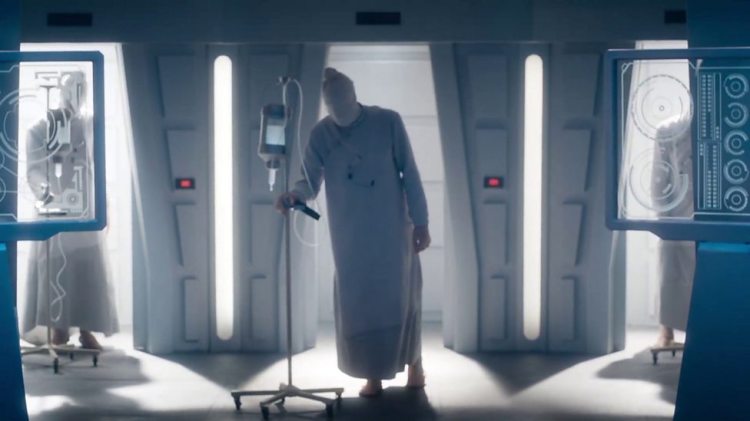
Pain. Pain. Pain. Pain. Pain. Pain. Pain. Pain. Pain.
They are the cure, they are the future. To survive they are what we must all become
Let’s cut to the chase – this is brilliant and I absolutely adore it. It is also for me, the best series finale by a country mile. Right that’s out of the way – it isn’t a very interesting opinion though is it? So, here’s another opinion if that was a bit dull for you – as a ‘Genesis of the Cybermen’ story, ‘World Enough and Time’ isn’t as good as ‘Spare Parts’. It isn’t. Others may disagree, that’s fine, I prefer ‘Spare Parts’ in that respect – it is a more coherent and interesting world and doesn’t have Missy dabbing! This story does do something different though and contains so many wondrous things, including a plea for a kinder, more decent world, so let’s not worry about all of that too much. From now on this review will be entirely positive. However, I’ll leave the thought here though, that maybe it should have acknowledged its’ debt to ‘Spare Parts’ in some way, like Russell did back in 2006? Or maybe if I’m being very generous, it’s just a case of parallel evolution of function and body plan – a Dolphin to ‘Spare Parts’ Ichthyosaur?
Right housekeeping done, on with the rest of the review.
Folding food and inventing colours
Let’s take a quick look at the context of this story. By 2017, Steven Moffat had been contributing scripts for the show for 12 years (I make it somewhere around 40 episodes officially more or less – but many more as substantial or partial re-writes of others scripts). He had been showrunner for 7-8 years and had originally expected to leave with series 9, but ultimately stayed on to helm series 10, while the BBC waited for Chris Chibnall to become available. It is to his great credit that even at the end of his time (this was originally to have been his final story), for his last series finale and under very difficult personal circumstances, that he is able to pull something like this story out of the bag. He described it as ‘crawling towards the finish line‘, but it never feels like that – it is a triumph. A story that manages to be epic, exciting, entertaining, darkly funny and action packed, but also personal, emotionally satisfying, rich and complex. To the extent that even though some of the tricks and techniques might have become overly familiar over the years, it is still an interesting new blend of them.
And on that last point, by this time, we sort of know what we are likely to get from Steven Moffat. For some fans, familiarity had bred contempt and yes, again here there are familiar themes re-visited. At times (not in this story especially) it all begins to feel a bit like Billy Connolly’s description of Mexican food – it’s all the same, just folded differently. To think that way though, is to do an injustice to a writer who brought much originality and new thinking to the show and to my mind at least is the most important writer the show has had since Robert Holmes. And yes, we do revisit some old favourites here, but when it works, my it works well – what a writer. It reminds me of a review I once read of My Bloody Valentine’s ‘m b v ’ album, their rather good, but much delayed follow up to the miraculous ‘Loveless’, which addressed the complaints that it wasn’t as wildly and startlingly original as that album, more a progression in that sound, by quoting someone who said ‘It’s like they found a new colour. I don’t expect them to find another one.’ And that is Steven Moffat – he gave us so much that was distinctive and original and of himself, but you can’t invent something that is that brand new and startling every week for such a long, sustained period – how could anyone?
To my mind, the central conceit of this episode, is also a sort of distilled essence of Moffat. We get time running at different rates at different ends of a spaceship. In fact, the idea came from his son, who was studying physics and had completed an internship at CERN. The effects of gravity on time in the vicinity of a Black Hole, drives events in the first episode of this story. We also get parallel stories told from different perspectives, in different time codes, which goes all the way back to ‘Coupling’ – yes, in a sitcom about the sex lives of young professionals. We also get a story that is told slightly out of order, time paradoxes, companions dying and reborn, leaving with an immortal. The old start the second episode from a very different place than the ending of the first trick also reappears, taking ‘The Doctor Falls’ in a slightly different but satisfyingly linked direction. Even that location is another rural setting housed inside a spaceships We have children being defended from nightmare figures coming to take them away, hiding under the bed, the Doctor making a stand at a western style homestead, complete with barn. I could name the stories – but you already know them. If any of them are called ‘Hell Bent’ – well this is much better than that, so don’t worry about it, just pretend that one never happened. There are more repeated references and themes even than those – but you get the drift?
In the wider context of series 10, the themes that pervade the 2017 series, culminate in this story. From the start we had the Doctor and Nardole at St Luke’s University in Bristol, guarding something in a vault, which turns out to be Missy, rescued by the Doctor and Nardole from execution. The potential redemption of Missy is one the main story arcs, alongside Bill’s journey from serving chips in the university canteen, to tuition from the Doctor, to regular student, fellow traveller and friend. We also have Heather, the girl in the puddle/with a star in her eye, that Bill falls for in ‘The Pilot’, although until this story we don’t know that she will be returning, so that aspect isn’t so much of an arc seeded across the series.
Really though, for the roots of this story you have to go back further than series 10. ‘Tenth Planet’ aside, ‘World Enough and Time’, whilst working perfectly well on its’ own, also feels like a much more successful bookend to a story that started two series ago with ‘Dark Waters/Death in Heaven’. It has much in common with that story – themes of cyber conversion and body horror, mortality, Missy and her relationship with the Doctor, flying Cybermen (really not sure about that) and jet-black humour. It is a much more successful story than that previous finale though. It is also a story that feels like it comes from a very personal place. While writing the second half of series 10, Steven’s mother was seriously ill, dying in hospital, which apparently influenced the setting of the first episode and I will touch again on that aspect of the story later. Overall though, the story almost seems to have been designed to close this key piece of dialogue from Clara in ‘Death in Heaven’, as she contemplates killing Missy:
‘Old friend, is she? If you have ever let this creature live, everything that happened today, is on you. All of it, on you. And you’re not going to let her live again.’
My oldest friend in the Universe – The Master’s Tale
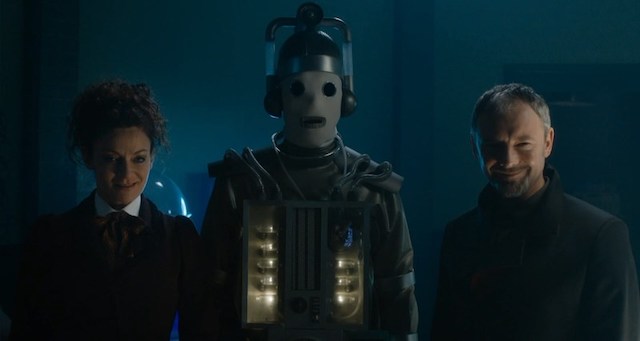
Time is running slower at this end of the review. I started raising my eyebrow last week and it is nearly there now….
In the last part, I started discussing the role of the Master in this story. Of the clemency shown by the Doctor to his ‘oldest friend’ and the consequences of that and that’s where I’ll pick things up again here.
Earlier in the season Missy survives execution through the intervention of the Doctor – he takes personal responsibility for her. Oh and then swans off on various jaunts because he just can’t help himself, that’s what he does. Oh and for good measure puts his two friends in direct danger, while he shows off, just to test her good intentions. Oh and eats crisps and acts like a dick. And guess what, yet again more people die and events are put in motion that will lead to the ‘death’ of Bill and the Doctor and lots of other people.
That particular plot strand has always existed between the two characters – the Doctor arguing for clemency for the Master when many wanted him executed following the events of ‘The Daemons’ for example or in ‘Last of the Time Lords’ when he wants to take the Master into his own custody – his own responsibility, rather than leaving him to face justice and those that he has wronged. This compassion is all very laudable and rationalised in this story as:
DOCTOR: She’s my friend. She’s my oldest friend in the universe.
BILL: Well, you’ve got lots of friends. Better ones. What’s so special about her?
DOCTOR: She’s different.
BILL: Different how?
DOCTOR: I don’t know.
BILL: Yes, you do.
DOCTOR: She’s the only person that I’ve ever met who’s even remotely like me.
BILL: So more than anything you want her to be good?
And yet is it actually morally justifiable, given what happens time and time again? Is the Master actually redeemable – is this the lesson of this story? The Master’s actions result in a huge chunk of the universe being destroyed in ‘Logopolis’ – countless civilisations destroyed – all of which could have been avoided if the Doctor had let Bill Filer just shoot the bastard! Missy refers to the Doctor’s friends as snacks – in ‘Death in Heaven’ she kills Osgood just to annoy the Doctor and then Kate as well – only saved by someone else as the Doctor isn’t able to. This isn’t exactly a one off. It is an interesting moral dilemma – does he/she deserve the death penalty that many wanted in ‘The Sea Devils’ or shown in the TV Movie or at the start of series 10? The answer seems to be lock her up, but then that rarely works, actually neither does killing the character either for that matter – so maybe it is just a moot point?
There are a few moments across the years, where the relationship between the Doctor and Master are explored. The Doctor wanting to see the universe, the Master wanting to conquer it or watch it burn (‘Colony in Space’ for example). The Doctor wants the Master to change, to fulfill what he sees as his/her potential. In return the Master almost seems to want the Doctor’s attention or in some cases approval. I am thinking of ‘Mind of Evil’ where the Master’s worst fear is the Doctor laughing at him and looking down at him. This translates into the Master’s requirement to humiliate the Doctor, not just kill him – we see this time and again, ‘Deadly Assassin’ or ‘Last of the Time Lords’ for example. They are locked together and yet neither seems to want to let go, as if the need each other somehow, to relish the next contest, no matter the ‘collateral damage’. In that respect Clara is right to call the Doctor out on this and Bill and Nardole are right to be concerned at what the Doctor proposes in ‘World enough and Time’ – ‘she scares me’.
Missy appears to want to change or at least entertain the idea (how seriously we aren’t sure until the end of the story). And Michelle Gomez plays that ambiguity very well. Which is the highlight really of her contribution here. On the downside, we also get Missy being a bit irritating and all of that pointless ‘Doctor Hoo’ stuff and the dabbing. I should say that I really like both the character and Michelle Gomez. When she’s great, she’s dazzling, but when it goes off the rails oh my it can be annoying, in the same way that River Song can be. A little sometimes goes a long way. We get both extremes in this story, thankfully much more of the good stuff.
Ah, you see through my clever disguise.
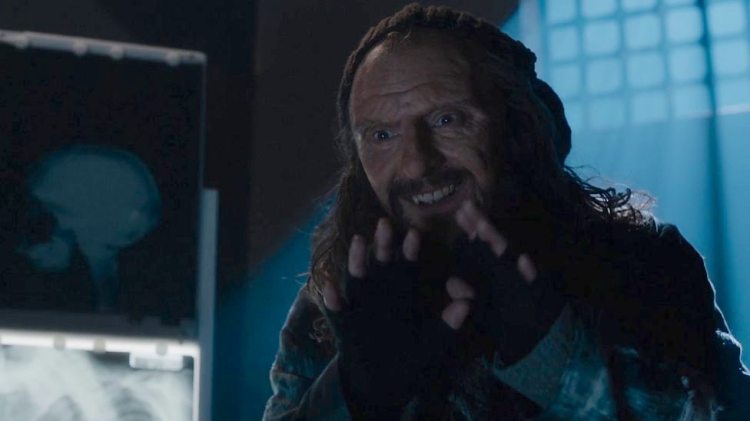
And then we have John Simm. How glorious would that have been as an unannounced reveal? Such a shame – because it also slightly impacted on the character of Mr Razor for me. I recognized him pretty much straight away – that can be fun its own way – knowing more than the characters in the story, but that would have been a great end to the first episode. You see John Simm is very recognizable to me, he is a part of a generation of actors – the likes of Paul McGann, Robert Carlyle, Chris Eccleston, David Morrisey – careers I’ve followed from the start and who’s work I love. Without the announcement I am not sure I would have seen that twist and it would have been one of the great Who moments.
Here’s a thing – Steven Moffat writes this character much better than Russell. He’s glorious in this – both as Razor and the Master. Simm always said that he played the Master as RTD wrote him and asked him to – but there is an implication that he never felt that it was quite right. He also wanted a goatie beard as well! Here he is so gloriously smug and obnoxious – his default mode is smirking. There is a moment I’ll cover later as part of the fall of the 12th Doctor that is just glorious and brilliantly of this Master:
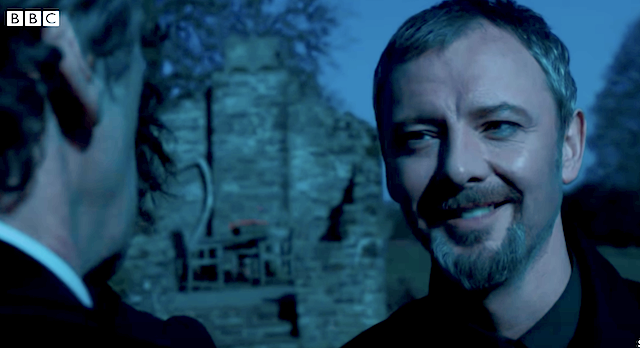
See this face? Take a good, long look at it. This is the face that didn’t listen to a word you just said.
I would have said that his portrayal of the role is the nastiest version, but recently Derek Jacobi’s ‘War Master’ has taken that crown – flipping effortlessly between charmingly plausible to out and out, utter bastard in an instant. Simm though is magnificent in this and bringing him back is an inspired move.
As his alto ego, Razor he gets some brilliantly dark comic moments:
RAZOR: You were sick, very sick. Broken. Heart-broken. New heart. Good, is it?
BILL: I haven’t dared look yet.
RAZOR: Is good. Is very good. Shiny. You can carry it off. Not everybody can. For some people, it all goes a bit, you know.
BILL: What?
RAZOR: Vending machine. Drink it while it is very hot. The pain will disguise the taste.
BILL: Ah, sorry, mate. Guess what I’m about to do.
RAZOR: Do not. Do not do this.
BILL: I’m going to ask you again.
RAZOR: When you hug me, it hurts my heart.
BILL: Ah, sweet.
RAZOR: No. Your chest unit. It digs right in.
BILL: Are you sure about the mask?
RAZOR: Is burgling mask.
BILL: Why?
RAZOR: Just in case.
BILL: In case of what?
RAZOR: Shh!
BILL: But it’s locked.
(holds up a key)
BILL: Where did you get that?
RAZOR: I have burglary skills. They don’t let just anyone wear a mask like this, you know.
BILL: It’s got your name on the label.
RAZOR: I also have key to operating theatre. I clean up on Wednesdays.
It is a rubbish disguise on top of a rubbish disguise – very 1980’s Master, but slightly more entertaining than Khalid!
Is it wrong?

In the opening part of the review I looked at ‘To his coy Mistress’ the Marvell poem that gives the opening episode its title. I talked about the decision that Missy has to make between her ex (Simm) and her old school days crush (Capaldi). Missy meeting her past is echoed in the next story – where the Doctor comes face to face with his own past and has to decide whether he has a future or not. If her relationship with the Doctor is interesting – it is rather the relationship between her and her former self that is fascinating and illuminating. A choice between her old ways and potential new future. The relationship between the two Masters is very well done. I mean it is very Steven Moffat – sexual innuendo filled ‘(is it wrong that? Yes), but it also works very well. We even get a call back to Steven’s first story as Missy and the Master dance together on the rooftop to 1940s music and with a clock face – mirroring Rose and Jack in an echo of ‘The Empty Child’.
I will look at the end of Missy’s story, along with the Doctor later, but here we get a rather beautiful eulogy to her past as she kills him:
I loved being you. Every second of it. Oh, the way you burn like a sun. Like a whole screaming world on fire. I remember that feeling, and I always will. And I will always miss it.
He admires her style, but even as he dies, but he won’t allow her to join the Doctor – the past reaching forward to prevent a potential future. The past after all hangs over us all and informs all of our actions – here it is just made physical. The Master appropriately shoots Missy in the back, both appearing to die – Missy on the forest floor and the Master, laughing insanely as he descends in his lift, back into the lower floors – into a representation of hell, ready to create the future that Missy has just lived.
This is our perfect ending. We shoot ourselves in the back.
If that is the ending for the character (I can’t believe it will be), for the ultimate narcissist (actually that is probably Trump) – it is an appropriate one.
Genesis of the Cybermen – a case of parallel evolution?

People get the Cybermen wrong. There’s no evil plan, no evil genius. Just parallel evolution.
They always get started. They happen everywhere there’s people. Mondas, Telos, Earth, Planet 14, Marinus. Like sewage and smartphones and Donald Trump, some things are just inevitable.
It strikes me that the first and second parts of this story mirror the evolution of the Cybermen in the series. They start out as a creepy medical experimentation, with echoes of burns victims, built out of spare parts to survive in ‘World Enough and Time’ and end up in ‘The Doctor Falls’ as an ‘invulnerable’ marching army of robots, all lined up to be destroyed in a variety of ways. I’m not sure if that is deliberate or not, possibly it just serves to make both episodes distinctive and to offer more spectacle for the finale of the 12th Doctor, but it is quite clever if it is. The presence of the Master/Missy and the wrapping up of this Doctor, Bill and Nardole’s story also deprives a little bit of exploring their creation and expansion in any great detail, so in some ways it isn’t that satisfying as a ‘Genesis of the Cybermen’ story.
The story talks about the Cybermen and ‘parallel evolution’, appropriate for a story that seems to borrow a number of story elements and themes from other sources. Indeed, ‘World enough and Time’ does not exist in a vacuum, it is difficult to believe that it doesn’t come at least to some degree from ‘Spare Parts’, the world is so close to Mondas as envisaged by Marc Platt, down to the way conversion is used, the creepy hospital wards, the dark post-war feel to the city and the scary nurse figure. I don’t believe I have ever heard Steven Moffat talk about this, but it would be a massive coincidence if this degree of convergent evolution had occurred. I would maybe be more willing to credit otherwise, if throughout my reviews over the last few years that I hadn’t found lots of other bits borrowed (almost Robert Holmes style) from sources such as the Virgin New Adventures and Big Finish, which appear in his stories. Steven Moffat knows his stuff, he is a fan and consciously or unconsciously these books and audios are echoed in his work.
What Steven Moffat does here is very clever – he very nicely sidesteps this as an issue and avoids contradicting ‘Spare Parts’ or ‘Rise of the Cybermen’ or even ‘The World Shapers’ or the introductions to Gerry Davis’s Target novels. Instead, he inserts the idea that there isn’t one ‘Genesis’ rather they are an inevitability, recurring again and again. Here we don’t even know who is responsible for their creation, whether it is by accident or by design, gradual or rapid. It lacks the motivation, rationale or even basic detail of ‘Spare Parts’. It just isn’t that interested. On the plus side we don’t have a John Lumic on the downside we don’t have a Doctorman Christine Allan. Why are the Cybermen needed? We don’t really know. In ‘Spare Parts’ full conversion is required to work on the surface of the planet – to save Mondas, but the population has also become more reliant on spare part surgery – first organic, then artificial. Here they need conversion to reach the upper levels – why not just take the lift? It seems to work for Nardole and the kids? Again, this isn’t a detailed origin story – it has other things to do.
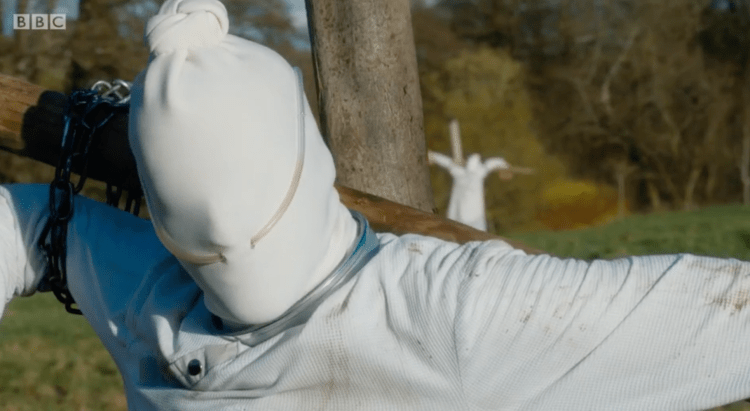
What it does do though, is gives us the most interesting, scary depiction of the Cybermen in the TV show at least, since the 1960’s. This was the task that Steven Moffat originally gave to Neil Gaiman for ‘Nightmare in Silver’ – but was lost for whatever reason as that story totally failed in almost every respect. Moffat gives us the creepiness of the ‘Tenth Planet’/’Spare Parts’ originals – the pain and loss and almost ‘low-fi’ origins of cyber-conversion. The body horror back again and the shadows of Kit Pedlar’s original fears about spare part surgery and cybernetic control systems. You have a series of very memorable images – the hospital wards, Bill as a Cyberman, the top-knot scarecrows in the fields. If you like the marching shiny robot version, well you have those again. Like the flying Cybermen? Have some of those for good measure. Really, it’s only the ‘Excellent’ 80’s version that we are lacking here. Although if you liked that era – well this has it’s equivalent of the Raston Warrior robot massacre from ‘The Five Doctors’ – this time with the Doctor as the main combatant, armed only with a screwdriver. This story even finds time to re-enact image from the back of the Target novelisation of ‘Tenth Planet’ as the Cyberman blasts the Doctor.
Bill’s story
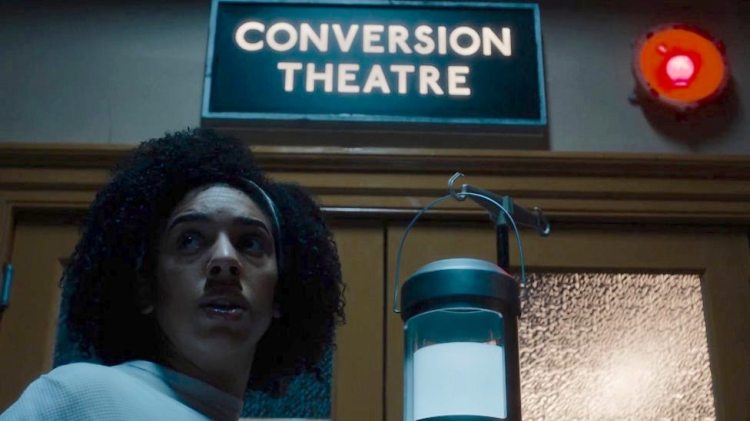
Look, there’s Bill. Dead, dismembered, fed through a grinder and squeezed into a Cyberman. Doomed to spend an eternal afterlife as a biomechanical psychozombie. It was hilarious.
Oh Bill, I really loved you, you were a real breath of fresh air. Only one season, it seems so brief. At the time there was a rather predictable backlash against a black, lesbian companion – and yes, some could argue that it smacks of box ticking – actually almost actively trolling that ‘PC gone mad’ aspect of the audience. What that ignores though is that she’s a terrific character, beautifully played and her sexuality is for the most part used very well across the season – in the likes of ‘The Pilot’, ‘The Eaters of Light’ and in this story. In contrast to some of the clunkier attempts at this, there is a real lightness of touch displayed here – helped by a really winning, likeable performance at the core of this. Put simply Pearl Mackie is absolutely superb – another great casting win for Andy Pryor, I hope she goes on to achieve all that she wants in her career, because she has the talent to go far.
The relationship between Bill and the Doctor is reminiscent of a modern take on the seventh Doctor and Ace or the original intention for Leela, which is junked after ‘Talons’ – the Eliza Doolittle aspect of the Doctor mentoring her. It has a feeling of Willy Russell’s ‘Educating Rita’ – where Rita is obviously very bright, but hasn’t had the opportunity before she meets the university lecturer Frank to develop that. Whilst he acts as her mentor, in return Bill also brings out the best in Peter Capaldi’s Doctor. He ends up almost as her cool Grandad (although judging by ‘Knock Knock’ she is the only one who doesn’t see this!), a mentor, but mostly in the best sense of the word – not patronising or patrician – although he gets things very badly wrong in ‘World Enough and Time’ and can never quite make amends for that, although giving his life without knowing of her redemption and rebirth is cruelty enough.
Pearl Mackie gets some fantastic material in this story. She gets to be worried (rightly) about the Doctor’s plan and then stoically and with great humour deal with having a huge hole blown through her chest, being trapped in the city for 10 years, with only Mr Razor for company and a control unit embedded in her chest, mopping the floors and surrounded by the ‘Top Knots’ screaming in pain. She’s very likeable in those scenes and even more so in those heart-breaking moments in ‘The Doctor Falls’ trying to deal with the fact that she is a Cyberman and the reactions of others around her. Her humour never quite failing her:
NARDOLE: Young lady, you’re coming with me. No arguments. May I remind you I’m still empowered to kick your arse.
BILL: You’d have to go back down there to that hospital and find it, then.
NARDOLE: Look, Bill
BILL: My arse got kicked a long time ago, and there’s no going back. All I’ve got left is returning the favour.
The scenes, beautifully shot by Rachel Tallelay, where we switch between Bill’s perception of herself as human and the reality of her as Cyberman – her hand acquiring a surgical glove are just heartbreaking.
Let’s be honest, the Doctor let’s Bill down very badly, even setting aside that it’s his fault that she ends up being shot. Lying to her:
Bill, I will fix this. I will get you back again, I swear.
And later:
BILL: You said. I remember, you said you could fix this. That you could get me back. Did you say that?
DOCTOR: I did say that, yes.
BILL: Were you lying?
DOCTOR: No.
BILL: Were you right?
DOCTOR: No. Bill.
BILL: We’re not going to get out of this one, are we.
I’ve said in a number of reviews that I really dislike the devaluation of mortality in the show – Clara coming back from the dead and any number of similar revivals for Rory and others. I get that the show is supposed to be optimistic and happy – I don’t personally need any companion to die, but it does slightly devalue the drama of those rare occasions when it does happen if it happens most seasons and is then reversed in some way each time. On this occasion however, I really like the fact that Bill gets a future with Heather exploring the universe. The concept of the pilot is very close to magic and a bit of a cop out – but I like Bill so much, that I am sort of happy to go along with that, hypocritical though it is. It is also very well done – the body of the Cyberman collapsing on the battlefield and Bill left standing there.
The scenes as she leaves the Doctor, dead on the control room floor are quite beautiful:
You know what, old man? I’m never going to believe you’re really dead. Because one day everyone’s just going to need you too much. Until then. It’s a big universe, but I hope I see you again.
Bill’s words here are a variation on Emma’s in ‘The Curse of Fatal Death’ and would have been a fitting epitaph for the character. Her tears, mirroring Sarah’s with Pertwee’s Doctor – Capaldi’s (and my) childhood hero remember. She was only around for one series, but Bill made a big impact I think. She’s up there with some of my favourites from the show’s history – a pity we didn’t have longer with her, something that I’d love Big Finish to address some time.
Nardole’s Tale

And of course, Nardole gets slightly short shrift in all of this. He’s the tin dog after all. Mickey Smith, Rory Williams, Harry Sullivan. But you know what – he just works for some reason, just as of those examples do. After lots of fraught seasons worrying about whatever ‘epic’ season arc Clara has evolved into, instead we have the lovely ‘exposition and comic relief’. Nardole might be the ‘comic relief’ to Bill’s ‘exposition’, but he is great fun and works (actually a lot like Donna) a lot better than we might have believed after his initial appearance. He adds balance to the Capaldi era that had at times been too serious and sometimes lacking in humour (at least humour that isn’t jet black).
And so unlike Bill or the Doctor or Missy/Master we don’t get a lot of development for Nardole (what was all that stuff about ‘If there’s more than three people in a room, I start a black market. Send me with them, I’ll be selling their own spaceship back to them once a week’ where did that all suddenly come from?). We do get a potential romance with Hazran – which is very nicely done (‘I’ll try anything once’!) and he gets to do cool computer stuff and blow things up and be a hero in the mould of the Doctor in ‘Time of the Doctor’ – protecting the homestead and the children. Matt Lucas plays him with a nice lightness of touch and is very entertaining – and although I can’t think of much more to say about him (‘I never will be able to find the words’), I really enjoyed having him in the show and he completed a rather fine series 10 line-up.
The Director’s Tale
I couldn’t wrap up things without talking about Rachel Talelay. I don’t often notice individual directors these days – most of them are of a pretty good standard, so they don’t get to stand out as much as the likes of Camfield or Harper back in the 60’s-80’s when things were a lot more variable. Her work on the show is really extraordinary though.
Quite amazing really – interesting shots (the camera rotating from the top of the TARDIS time rotor at one point), the wonderful lighting and grading and just getting beautiful performances from the cast – especially Peter Capaldi – he seems to just love working with her. Apart from the shots of Capaldi on the floor of the control room and the beautiful transitions between Pearl Mackie as Bill and her as Cyberman, it is the battlefield sequences that really stand out for me – they are just incredible – the action sequences with the Cybermen, the scenes as the Doctor falls and then as Bill/the Cyberman holds him.
In a series of farewells this series, Rachel Talalay is another – she is up there with the likes of Douglas Camfield, David Maloney, Graeme Harper from the classic era. I think probably Joe Aherne, James Hawes, Toby Haynes and Nick Hurran – as the best of the new series. I will review ‘Heaven Sent’ one day – but that story and this one really are the peak of the her work, with ‘Heaven Sent’ as possibly the best directed story of the entire run of the show. Along with Steven Moffat, she is a massive loss to ‘Doctor Who’.
The Writer’s Tale
‘It was like finding the bloodstained diary of the previous occupant of the scary house you’ve just moved into.’
Steven Moffat on reading RTD’s ‘A Writer’s Tale’!
So (nearly) farewell Steven Moffat. Another talent that is missed from the world of Who. It obviously took its toll on him over the years – famously the 50th nearly broke him. During series 10 he had to deal with personal loss and channelled that into his storytelling. This final story is dazzling in its’ construction and quite beautifully written.
The ‘top knots’ arrayed in lines along the hospital ward, attached to drips and audibly or silently when the volume is dimmed mouthing ‘pain, pain, pain…’ is one of the most haunting images in the show’s history. It is almost unbearable for anyone who had to spend time in a cancer ward, either receiving or watching a loved one get chemotherapy treatment. I have unfortunately (as a watcher rather than participant) and while this could have been in very bad taste (see ‘Death in Heaven’ and cremation), for some reason it never quite feels that way. Possibly because it comes from Steven’s own real-life experience? There is jet-black humour there, but for me it works much better in this story.
One of the key lines, that feels very personal to the writer, in this story is:
‘People plus technology minus humanity. The internet, cyberspace, Cybermen. Always read the comments, because one day they’ll be an army.’
I read this in conjunction with a number of interviews at the time and the Doctor’s own plea for kindness in this story as directly coming from the experience Steven had as showrunner. He talked about his children reading terrible things about him on the internet and the toll it took. Now no matter you think of the showrunner, current incumbent included, that sort of behaviour is simply unacceptable.
I am not sure I will ever be quite able to sum up what I think about Steven’s work on the show. In this story, ‘The Empty Child’, ‘Girl in the Fireplace’, ‘Blink’, ‘Silence in the Library’, ‘Day of the Doctor’. ‘Heaven Sent’ and many others he has given up some stellar stories – the very best. He has also delivered some things that I’ve really rather disliked or just plain confuse me. Maybe that’s all just par for the course? You can’t take risks without some of those risks not paying off. One thing I would say is that I would put up with a fair amount of ‘Hell Bent’ in return for those stories I’ve listed above. He came in with a fair bit of credit in the bank for me (‘Coupling’, ‘Press Gang’ and his Who stories) and left with even more in the bank. My favourite Who writer since Robert Holmes – and I don’t say that lightly.
Someone you loved –The Doctor Falls

Without hope. Without witness. Without reward.
Telos! Sealed you into your ice tombs! Voga! Canary Wharf! Planet 14! Every single time, you lose. Even on the Moon.
I miss Peter Capaldi. There I’ve said it. I didn’t always agree with the choices he made when playing the Doctor, I think both he and the production team got things wrong from time to time, the tone sometimes feeling off, things pushed too far in a particular direction in series 8. He was always interesting though, always pushing things and quite simply he is a consummate actor. One that I’ve loved since the 1980’s – ‘Local Hero’, ‘Neverwhere’, ‘The Crow Road’, the stage version of ‘The LadyKillers’, ‘The Thick of It’, ‘In the Loop, ‘The Devil’s Whore’, ‘Torchwood:Children of Earth’, ‘The Hour’, even ‘Paddington’! More than that though, he is a thoroughly decent, principled, thoughtful man and a fellow Who fan. As a fellow Pertwee fan, I salute him and the progression of his hairstyle as it mimics that of his childhood hero!
I hadn’t realised until recently just how much I missed him being the Doctor. I came across his performance in the video for Lewis Capaldi’s song about organ donation ‘Someone you loved’. The song isn’t really my sort of thing, but it really resonated with me at that moment. He still looks like the Doctor from this story in it. His beautifully sad, haunted face, lighting up from time to time with a sad smile, as if he had stepped out from his performance in ‘The Doctor Falls’. I’d never seen it before, but I think it appeared from nowhere on the news or BBC Breakfast or some sort of roundup of the year a few weeks ago. I had a really visceral reaction to it – one that almost reduced me to tears. The song is also used for Toby Hadoke’s 2019 in memoriam video, which starts with a piece of video of Terrance Dicks from 1977 saying ‘the Doctor is an old-fashioned hero’. I had been struggling to write this piece up until that point, but those two coincidences spurred me on to finish it. This often happens to me, I’m struggling to finish something, or even start and something left-field provides the impetus – unless I can find a way in I don’t start, I’m not writing this stuff to a schedule, so why rush it if you aren’t ready?
The Doctor Falls’ almost acts as a mission statement for this Doctor and showrunner. Personally, I don’t really understand whether the journey the character goes on, which mimics the First Doctor’s in some respects, was deliberate and planned or not. I suspect a bit of both, Steven Moffat certainly talked at the time at the tone of the Doctor in series 8 not being quite right – as words he would have written for Matt’s Doctor, in Peter’s hands became quite different – more ‘savage’. So, I think there was a case of adjusting things as they went on. By series 9, the Doctor is still occasionally acerbic and socially awkward, but this is much better balanced and there is a lot less the sort of the rather unpleasant nastiness that he exhibited towards Journey Blue or Danny Pink. And by series 10, a few exceptions aside (‘Thin Ice’ I am referring to you here), we have a very nicely fully-formed Doctor – by turns acerbic but also funny and with a side to him that actually can be loveable at times – in a grumpy sort of way. Throughout all of this Capaldi is excellent I should say, but sometimes the portrayal of the Doctor in that initial series doesn’t feel quite right to me. The professorial, eclectic university lecturer role of series 10 really suits him. I personally would have liked three series of that, but I suspect that might just be me. In retrospect, I find his performance the more extraordinary as time passes.
And then we come to this story, where we have a character pleading for niceness, decency and kindness. It means more somehow coming from him, as he hasn’t always been like that, he has been conspicuously unkind at times. The following speech to Missy/the Master almost acts as a manifesto for what Steven wants to say about this character:
“No! No! When I say no, you turn back around! (catches up with them) Hey! I’m going to be dead in a few hours, so before I go, let’s have this out, you and me, once and for all.
Winning? Is that what you think it’s about? I’m not trying to win. I’m not doing this because I want to beat someone, or because I hate someone, or because, because I want to blame someone. It’s not because it’s fun and God knows it’s not because it’s easy. It’s not even because it works, because it hardly ever does.
I do what I do, because it’s right! Because it’s decent! And above all, it’s kind. It’s just that. Just kind. If I run away today, good people will die. If I stand and fight, some of them might live. Maybe not many, maybe not for long.
Hey, you know, maybe there’s no point in any of this at all, but it’s the best I can do, so I’m going to do it. And I will stand here doing it till it kills me.
You’re going to die too, some day. How will that be? Have you thought about it? What would you† die for? Who I am is where I stand. Where I stand, is where I fall. Stand with me. These people are terrified. Maybe we can help, a little. Why not, just at the end, just be kind?“
And it prompts one of my favourite moments in the show’s history from John Simm, which I referenced earlier:
See this face? Take a good, long look at it. This is the face that didn’t listen to a word you just said.
And then feeds into the exploration of the relationship between the Doctor and the Master
DOCTOR: Missy. Missy. You’ve changed. I know you have. And I know what you’re capable of. Stand with me. It’s all I’ve ever wanted.
MISSY: Me too. But no. Sorry. Just, no. But thanks for trying.
These two are forever entwined – aspects of the same character, both with more than a hint of Glasgow. Their fate is to die together or rather apart but linked. Missy seemingly at least partially a reformed character – a first for the Master and the Doctor for that matter – although killing her former self maybe indicates that the Doctor hasn’t been wholly successful!
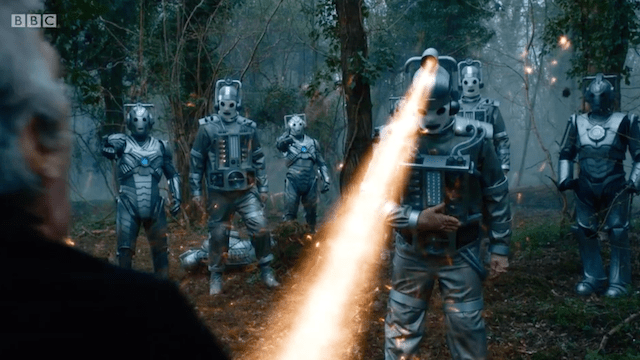
I can’t think of ‘Twice Upon a Time’ as the end for this Doctor. For me, it is more a sidestep, an add on than the end, feeling to me more like the contractual obligation tour date. The Doctor dies caught in a blast of fire from an original Mondas Cyberman – a conscious echo of the Chris Achilleos image on the back cover of the Target book of ‘Tenth Planet’. His dying body is retrieved from the battlefield by Bill and Heather.
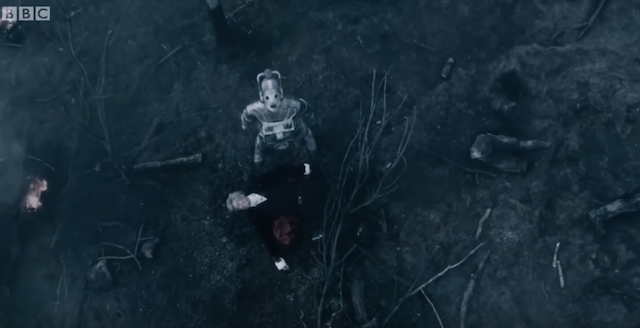
Lost and mourned for on the floor of the TARDIS control room. They leave him to explore the universe, as he lies dead, flying on through the universe, the ship his final resting place. The rest, well the rest is your canon, not mine, your story, it was time for me to let go.
Doctor. Doctor, let it go. Time enough.
Pity. No stars. I hoped there’d be stars

 A Journal of Impossible Things