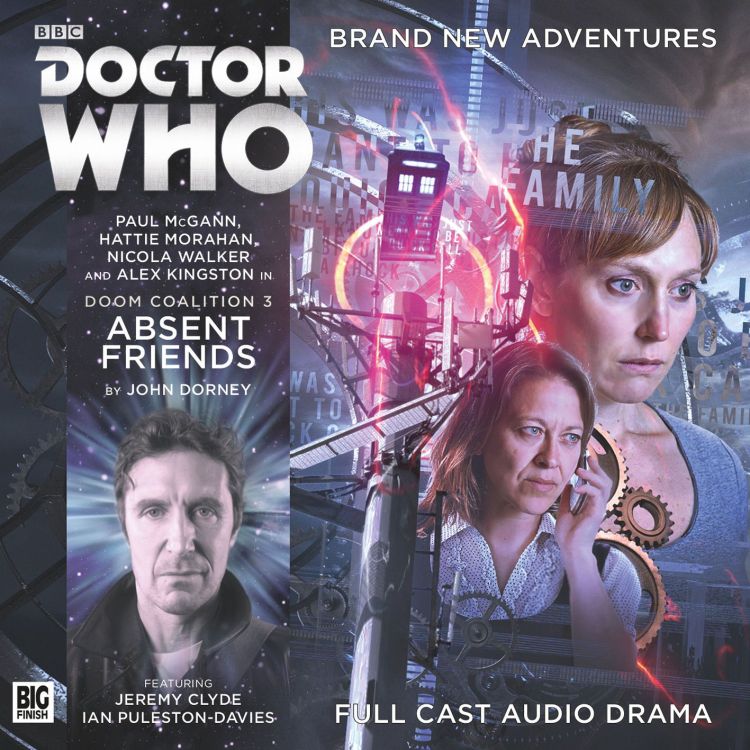
Absent Friends, written by John Dorney is an 8th Doctor story, the first of the 3rd Doom Coalition box set. At the heart of this wonderful story is death and bereavement, how it affects us and how we come to terms with it or fail to over time. It is a narrative structure that only really works via the mechanism of time travel, unless you want to invoke the supernatural. It is Doctor Who for grown-ups or at least for those of us who have suffered loss in our own loves or seen it in others, shorn of monsters or super-villains or violence, battles or explosions. If you haven’t listened to this and are planning too, a piece of advice, get this – it is just beautiful, but maybe skip this review. DWM described it as ‘ one of the most moving hours of drama Big Finish has ever produced‘. Really though it is one of the most moving and thoughtful ‘Doctor Who‘ stories in any medium. If you are searching for a TV series equivalent, it is probably Paul Cornell’s ‘Father’s Day’.
We find the Eighth Doctor travelling with Liv Chenka (the wonderful Nicola Walker) and Helen Sinclair (Hattie Morahan – similarly excellent). In case you haven’t been following either Dark Eyes or the Doom Coalition sets – Liv is a medtech from the future (from Kaldor), who first met the Seventh Doctor in Robophobia (a sequel to Robots of Death) and Helen is a researcher from the British Museum in the 1960’s. Helen is running away from being accused of a theft at the museum (which is very relevant here). You really do not need to know the rest of the Doom Coalition stories to understand this one (you do for the rest of the boxset), but this is such a strong piece of work that it is a shame that it isn’t available as a standalone release.
The TARDIS materialises in the England of 1998 in a village (Calcot) protesting against a company building a mobile phone mask. While the Doctor repairs the TARDIS, Helen heads off against Liv’s advice to London to see what became of her home and family after 30 years. In this case (as opposed to say Father’s Day or Dark Water) the Doctor is oblivious to what he has done, rather than complicit in it and disapproves of Helen’s decision to see her family. In the village, the mobile phone company has given all the villagers a phone, in compensation for the mast – the catch is though that people claiming to be dead friends and family are calling each of the villagers. As the story develops, it becomes clear that in each case the callers are loved one’s who those being called didn’t get the chance to say goodbye to – a son run over in the road or a boyfriend who died in a car crash. They are the loved and lost and the those left behind are left bereaved and with the guilt of of never getting the chance to say goodbye or to tell them how much they loved them.
With Helen away, the Doctor and Liv investigate the phone company. The Doctor assumes that he is in a ‘Doctor Who’ story and sets out to unmask an alien plot. This leads to a very nice feint in the story, where the sinister mobile phone company, with their powerful owners and sinister BOSS and shiny neat staff, with a fake, manufactured quality – just turn out to be a normal mobile phone company with ‘well-groomed’ staff. There is no Nestene influence or mad computer involvement at all. The Doctor is quite put out, that for a change, all of his ideas on what is to blame for all of this are completely wrong! The manager they meet is guilty only of being a capitalist, of insider trading and using moisturiser and product in his hair! The plot mechanism causing the calls is a device – very special clock which influences time, part of the wider ‘Doom Coalition’ narrative. It isn’t a malignant alien plot – just an accident and the mechanism itself barely matters (at least in this story) – what does is the impact it has on the lives of those nearby and the illuminating effect it has on the lives of Liv and Helen and their relationship with the Doctor. The result is a rich, emotional piece – very much suited to the understated, naturalistic acting styles of Nicola Walker, Hattie Morahan and Paul McGann – all of whom excel here.
The narrative splits as Helen travels, against the advice of Liv and the Doctor, to London to check up on her family and meets her brother George, 30 years after originally leaving. She originally ran away with the Doctor after being incorrectly accused of theft from the museum. She poses as her own daughter to explain why her appearance hasn’t changed, whilst he is an old man, towards the end of his life. It is its great credit that the story refuses to just be sentimental, some of these encounters are difficult and full of resentment – in the way that families can be. George is very bitter and rather forthright at the way Helen left the family to carry the can for her. This is all very nicely played and written, as Helen has to face the impact of her disappearance. Her story even has one last, sad, sting in the tail – a bittersweet lesson for her in a story that despite dealing with love, loss and grief – chooses not to be sentimental and cloying.
It isn’t that often that consequences are played out for companions in Doctor Who – mainly in Russell T Davies’ stories. For example, the impact of Rose leaving in Aliens of London on Mickey and Jackie and how it affects her mum in Love and Monsters or the impact of Martha’s friendship with the Doctor on her family in Last of the Time Lords. Helen also has to face the loss of both parents and her older brother in one go, as well as the impact she had on her brother’s life – resulting in his fiancee leaving him and living a life alone. Her dislike of her own father, nicely counterpoints Liv’s relationship with hers. Helen’s story is just as sad though, as she realises that time cannot be re-written, not one line of it once you know the future – and she can never go back and change her own future to put things right (something that applies to all of us). Liv as a doctor, could have saved her own father if she hadn’t been too busy, away working (that bit is familiar). Given the chance again, she realises that she can’t now – the scenes between her and her dad are simply heart-breaking.
Some personal context, This story was released in 2016 at the time of my dad’s funeral. I listened to it (in the background more than anything) on a long train journey back from that, not really knowing anything about it or the story content. If I had, I probably would have avoided it. By the end of the story, I was in tears – not a good look on a train. It touched a very raw nerve. Apart possibly from Father’s Day, the parent show has never been so honest, raw, emotional or truthful.
I believe that John Dorney wrote this a year or so after his own father’s death and indeed it is particularly strong in the scenes between Liv and her father and being given the chance to say things that you never did in life. This doesn’t apply to me, I had months to say everything I needed to say to my father, he died slowly of cancer, even then it wasn’t easy or really in hindsight needed, but I totally understand Liv here. This feels similar to the Doctor enabling Rose to be with her dad to provide comfort as he dies in Father’s Day. The plot device allows Liv to talk once more to her dad. The things that she has to say, aren’t big weighty things, but are rather very simple and personal. Things her dad already knew, he didn’t need to hear her say them, he just loved her without condition. It at least assuages her guilt at not having enough time to say them first time around, if not the guilt of not being around to prevent his death. She falters at warning him about his own illness – to get treatment – she know’s that you can’t change time in that way – she shouts it out loud, but heartbreakingly just after he has gone.
‘Absent Friends‘ is very moving – simple, beautiful and life-affirming. Thank you John Dorney – it was just what I needed, I just didn’t know it.
 A Journal of Impossible Things