
‘Gentlemen, I assure you—the body of evidence that has accumulated over the years is undeniable. The Abominable Snowman does exist.’
‘Oh, Intelligence. You promised to release me, yet still I feel your grasp upon this frail body. Why? What is happening? This was not your plan. But if you continue to expand? I have brought the world to its end.’
Professor Challenger and the Abominable Snowmen
In 1923 Professor George Edward Challenger, whose exploits were chronicled by Sir Arthur Conan-Doyle, took his family on an expedition to Detsen monastery in Tibet to look for the fabled Yeti. The Yeti he finds are robots controlled by an alien entity called the Great Intelligence and he finds himself in a battle to save the world. Confused? Well this is the plot for a proposed 1970’s Disney Film scripted by Mervyn Haisman. In some ways, this is rather appropriate as Edward Travers – the driven, ruthless, curmudgeonly explorer feels very much modelled on Challenger. The idea of him being ridiculed by the scientific establishment likewise feels inspired by ‘The Lost World’. In the script Challenger would have amalgamated the roles of Travers and the Doctor and really taken the story back to its roots – a British explorer journeying to far flung corners of the world to discover mythical creatures. Terrance Dicks covers this in the novelisation:
Edward Travers shivered, and huddled deeper inside his sleeping-bag. He was drifting in and out of an uneasy slumber, fantasy and reality merging and blurring in his mind. In his dream, he was at the Royal Geographical Society, addressing a scornful and hostile audience.
‘Gentlemen, I assure you—the body of evidence that has accumulated over the years is undeniable. The Abominable Snowman does exist.’
He heard again the hated voice of his old rival, Professor Walters. ‘If you’re as sure as that, my dear Travers, I suggest you go and look for the beast!’
Now, this taps right into some of my favourite things. The Royal Geographical Society is an amazing place – I’m lucky to have been there a few times for lectures. I’m also slightly obsessed with explorers travelling to far-flung places in search of scientific enlightenment and new natural wonders – Wallace, Bates, Darwin, Humboldt and the great Polar explorers. So this one really should really be right up my street.
The Abominable Snowmen, The Creature and The Inn of the sixth happiness
Anyway, taking a step back. ‘Abominable Snowmen’ apparently arose out of Troughton’s acquaintance with Henry Lincoln (Soskin) and his desire to see more earth-bound stories. After considering the Loch Ness Monster, they settled on the Yeti instead. The Yeti are a great choice for ‘Doctor Who; and are one of those myth’s that re-surface every few years, usually through a news story where some climber or explorer had found footprints or brought back bones or hair supposedly from the creature. They are also different than anything else that the show had given us up to this point – we’d had the metallic, the scaly and the chitinous, so furry was at least a new texture for a Doctor Who monster. It was also something that was almost guaranteed to appeal to children (see the photograph at the end of this post).
A film of the same name had been released by Hammer 10 years previously, starring Peter Cushing it was based on ‘The Creature’ – Nigel Kneale’s seminal and long lost 1955 BBC production along with the legendary Rudolph Cartier, the producer/director that he also worked with on the Quatermass serials. Wolfe Morris is another link to both – he plays a Sherpa in the film and TV serial and plays Padmasambhava in the ‘Doctor Who’ serial. The monastery setting is also similar, along with an abbot – but really there is not much in the way of commonality between the storylines. In Kneale’s work, the Yeti are advanced primates, with developed mental powers, who just want to be left alone, free from the commercial exploitation of the expedition members – a far cry from the robot Yeti and the possession of the Great Intelligence.
Oh and Cartier managed to persuade the BBC to allow some filming in the alps, rather than Snowdonia (the North Wales locations were also used as China in the film ‘The Inn of the Sixth Happiness’, Snowdon was also used for the Khyber Pass in ‘Carry on up the Khyber’!) and as such Cartier manages to provide some real snow. To be honest though most of the images of the Tibetan steppe which I have seen, show dry, wide sweeping plains, with snow-capped mountains in the background – mountain peaks aside, parts of Wales actually make a reasonable approximation.
On that last point in 1967 the world was a far larger place. Tibet was impossibly far-flung and exotic – as distant as the moon, Spain was still a stretch for most British people. Some had travelled on military service or for trade of course, but most of the audience watching episode one of ‘The Abominable Snowmen’ would have viewed Jersey or the Isle of Man as foreign travel. Fifty years later and I’ve been lucky enough to see the Himalaya and have walked there (India). Despite the on-going situation with Tibet, these days Lhasa is achievable by train from Beijing and money not withstanding I could book a trip there now – it has a Holiday Inn – which doesn’t do much for claims of exoticism. A few years ago I even bumped into the Dalai Lama on the streets of Oxford, so Tibet has also come to us. So, whilst Detsen remains out of reach for most people, these stories of adventures in exotic, far-flung and remote places possibly resonate less today, as does maybe the requirement for a British explorer to frame them for us. I am however old school and I love those stories.
Watching through our fingers
It might be a cliché, but it is also true, that many of us started our relationship with the show watching from behind the sofa or peering through our fingers when things got a little bit too scary. As with most of the missing stories, I can’t help feeling like I am experiencing ‘The Abominable Snowmen’ in a similar fashion, through a veil, not quite able to see it properly. Fifty years on from its transmission, ‘The Abominable Snowmen’ is at least more tangible than the Yeti themselves – a single surviving episode, a few clips, some location footage, some telesnaps and the soundtrack. So it is better off than some of the missing stories – ‘The Massacre’ for example, but it still struck me whilst watching the recon of this, how similar the experience was to watching the two stories available on ViewMaster in the early 80’s – it was a set of slides and something that resembled a cheap plastic VR helmet – I had ‘Full Circle’ and ‘Castrovalva’ and saw the stories in a series of static still photographs. How well would I be able to understand ‘Castrovalva’ from those few photographs? Watching this recon for the first time, I probably could have done without the CGI – churlish though it is to complain about something free that someone has obviously spent a lot of time on. I’m not sure why, but some stories seem to benefit from recons more than others, for this one, I think in future I will stick to the audio instead.
So what did I make of it? Well on this viewing, ‘The Abominable Snowmen’ is a slightly cold, remote thing. The monastery setting is bleak and desolate, no music, just the occasional sound of howling wind or the beeping of a Yeti control sphere. Detsen has the air of a place that was once colourful and full of life, but has through long neglect slid imperceptibly slowly into sadness and disarray. Cold, bare, echoing stone, flickering candles and bleak mountainsides are the backdrop to the story. This feeling permeates through to the people who inhabit this world as well. Travers is bitter, driven, cold, with a bit of a nasty edge to him – he is a far cry from the blustering but loveable old Professor in ‘Web of Fear’. Master Padmasambhava has lived far too long, the Great Intelligence has controlled him so long that it is difficult to know how much of the man the Doctor used to know still exists. Worse than that he has corrupted others around him – the Abbot Songsten for example, who is an obviously good man, reduced by the end of the piece to bludgeoning Khrisong savagely to death. Khrisong is another sad case, embittered and embattled, trying his best to save the rather ungrateful monks. So yes, it feels a sad, lonely place, which no longer has a purpose – not a base, but a forlorn, isolated spot, which is definitely under siege.
I noted the lack of music earlier, but one other impact that has is that we don’t even have music to suggest a sense of urgency, or drama. So the production is very much something which is one-paced. The pace never drops, because it doesn’t have anywhere to drop from. As a one-off, I’ve decided that I quite like this – a bit like the ‘slow food’ movement – just savour the story slowly unfurling. We live with a series today that is for the most part the 45-minute edited highlights of a story – sometimes that works perfectly, sometimes it doesn’t and seems overly rushed. In contrast ‘Abominable Snowmen’ just takes its time, it builds the threat slowly and generates a sense of horror and suspense, but is no rush to reach the denouement. It never feels padded to me, unlike some other 6-parters – using endless escape and capture. Simply at the pace at which it travels (i.e. not very quickly) it has enough material for 6 parts.
So, whilst some of this makes it difficult for me to entirely love it as a finished piece of work, there are images from the story though that are suffused with love and are as colourful as the story is dark. We have those beautiful film excerpts of Jamie and Victoria and the Yeti on the hillside, the surviving 8mm location film and colour photographs of the cast at the location shoot. Not too much of this though translates on screen – so whilst I like it a lot, I don’t entirely love it. I wonder how that would change if it were ever returned?
Jamie, Victoria and their mad Uncle
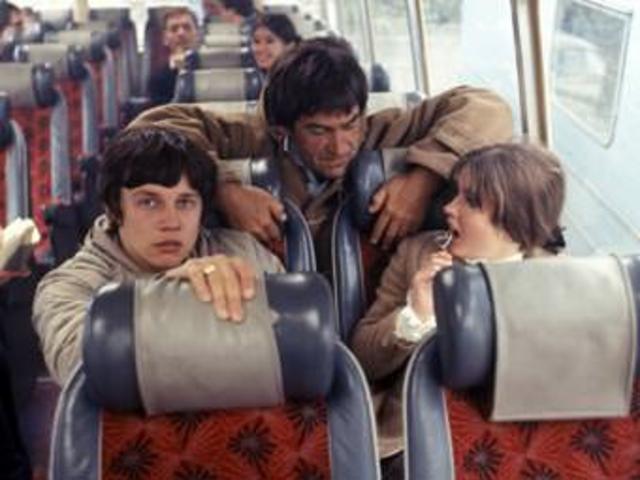
Something I do really love is watching this TARDIS team together. Jamie and Victoria have a lovely relationship – part boyfriend/girlfriend and part orphans thrown together staying with their mad uncle. Their relationship is often quite touching and tactile – it also has a playfulness as they tease each other – but also a genuine concern – Jamie feels protective of her and she does of Jamie in her own way. She is free of the bounds of Victorian Society and whilst she doesn’t exactly turn into a modern feminist (why would she), she is quite curious, headstrong and happy to tease Jamie and put him and the likes of Hopper in their place.
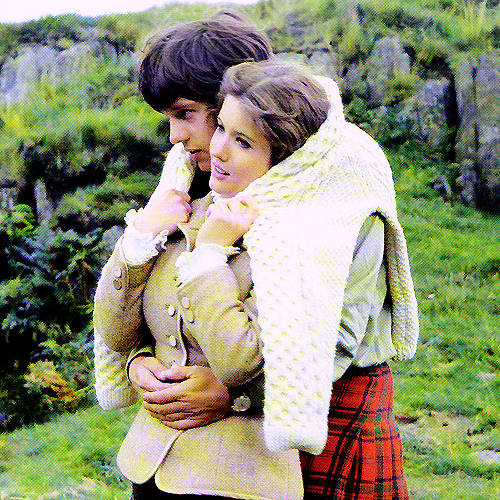
In this story, as in Tomb, Victoria is pretty willing to go off and find trouble. In fact her curiosity is the reason why they leave the TARDIS in the first place:
VICTORIA: Oh, I’m getting bored. Let’s go outside.
JAMIE: No, I don’t think we should.
VICTORIA: All right, I’ll go by myself.
JAMIE: Oh no, you won’t. You won’t leave me here by myself.
VICTORIA: Oh come on. We needn’t be long.
JAMIE: Aye, well, just a quick look then.
VICTORIA: Jamie, look.
JAMIE: What is it?
VICTORIA: Footprints. Look at the size of them. Something’s been walking round the Tardis. What could it be, Jamie, a bear?
JAMIE: Whatever it is, it’s pretty big. We’d better get inside.
VICTORIA: I’d like to find out what it is first. Wouldn’t you?
Later she runs rings around poor innocent Thomni and gets into the one place she knows she isn’t allowed to go – the inner sanctum. In some respects she reminds me of Jo in these stories (even down to wandering off and being hypnotised as in Jo’s first story), you know they are going to get into trouble and need rescuing, but you have to admire their gumption and refusal to be told what to do. She acts similarly in ‘Web of Fear ‘where she goes into the tunnels alone to look for the Doctor and Jamie or in ‘Enemy of the World’ where she adds to the woes of miserable old Griffin the Chef. She’s had more than her fair share of criticism over the years, but for me, she works brilliantly with the Second Doctor and Jamie, as well as Zoe does, just a slightly different relationship. Although both are capable of looking exasperated at Jamie and the Doctor, like the elder, sensible sister or responsible adult in the relationship.

Jamie and the Doctor are like two naughty schoolchildren together – unsurprisingly rather like Pat Troughton and Frazer Hines. They egg each other on and lead each other astray. In this story we get a brilliant moment where the Doctor plants an idea in Jamie’s head, wanders off to leave him to it and makes a quip about Jamie doing what he’s jut asked for:
DOCTOR: Yes, but if they do, do you think you could capture one? I would like to examine one.
JAMIE: Examine it? Aye, we’ll wrap it up for you.
DOCTOR: Thank you, Jamie.
JAMIE: Hey, Doctor, if you really want to capture one of these beasties, I think I have an idea which might just work.
DOCTOR: Oh. Victoria?
JAMIE: Eh?
DOCTOR: Victoria, I think this is one of those instances where discretion is the better part of valour. Jamie has an idea. Come along.
JAMIE: No, Doctor
DOCTOR: Come along.
They clearly love being in each other’s company and are having a brilliant time travelling the universe and getting into all sorts of trouble. This provides a nice counterpoint to the Doctor’s manipulation of Jamie in ‘Evil of the Daleks’ and also the eventual cumulative impact that their lifestyle has on Victoria a few stories later. For me, and it might only be me, is rather wonderful though while it lasts.
The possession of Padmasambhava
‘The Doctor went up to the doors of the Inner Sanctum. He tried them, but they were fast closed. Suddenly, the voice of the Intelligence spoke to them, out of the air. There was a subtle change in its quality. It was harsher, colder, more inhuman, the traces of Padmasambvha’s personality almost completely erased.
‘Why are you here?’ the voice said. ‘Why do you not heed my warnings? You are stubborn, Doctor.’
‘Who are you?’ said the Doctor steadily. ‘Or should I rather ask—what are you?’
A terrible mock-sweetness came into the alien voice.
‘You know me well, Doctor. Am I not your old and treasured friend, Padmasambvha?’
‘No!’ said the Doctor. ‘No, you are not. You have captured his spirit and abused his body. You have taken the mind and being of a good and great man, and corrupted and abused it. I ask again, who are you? Where do you come from?’ ‘I come from what you would call another dimension. I was exiled into yours, without physical substance; condemned to hover eternally between the stars. Then I made contact with the mind of Padmasambvha. He had journeyed further on the mental plane than any other of your kind. I tempted him, promised him knowledge and long life. Gradually I took him over, and made him my own. But I have rewarded him well.’
‘You have enslaved him,’ said the Doctor angrily. ‘Now you withhold from him the one thing he craves—the boon of a natural death. You are evil. You are what men once called a demon!’
The Great Intelligence is one of the more interesting foes over the years – particularly because we find out so very little about it. In this story all we are really told is:
PADMASAMBHAVA: Intelligence . Formless in space. I astral travelled.
DOCTOR: I see. You made mental contact with this intelligence?
PADMASAMBHAVA: It used my mind. It controls my body.
DOCTOR: But why?
PADMASAMBHAVA: Experiment. Wished material form. A voice, it said. I believed. Experiment. But now. Help. You must help me.
So it was a formless entity floating in space, waiting to find form and that is pretty much it. Across the two stories, apart from the Yeti, it is the possession of human agents, ‘puppets’ that characterise the Intelligence. To my mind, the possession of Padmasambhava is one of the most disturbing in the shows history. It is almost as if it has co-habited Padmasamhava for hundreds of years – a demon he met on the astral plain pulling his strings, whilst he is left pleading to be set free. The fact that he is an old friend of the Doctor also lends another layer to this and additional pathos to their encounter:
PADMASAMBHAVA: Come in, Doctor. Good to look upon your face again. So many years.
DOCTOR: Padmasambhava. So it’s true.
PADMASAMBHAVA: I have been kept alive so many years, but now our time left is very, very short. Listen carefully. Perhaps you can
DOCTOR: Kept alive? I don’t understand.
PADMASAMBHAVA: I didn’t know. I didn’t realise.
DOCTOR: What? Try to tell me.
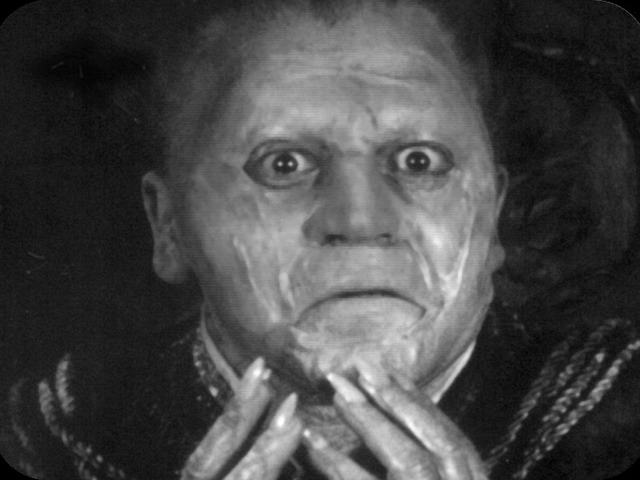
When I first saw episode 2 and the telesnaps, he wasn’t at all what I was expecting – rather than a 300 year old animated cadaver – we in fact get a rather plump looking Wolfe Morris in a latex mask. It does seem to work though somehow. I think my expectations were also tied up again with Target novelisation. Terrance Dicks first describes Padmasambhava through Victoria’s first meeting with him:
‘Victoria’s first thought was that the man before her was incredibly old. Older than Sapan or Rinchen, or any of the other venerable old men at the Monastery. Older than anyone she had ever seen or imagined. So old that the shrunken body seemed like that of a child, swaddled inside the long, flowing robes.
The face was quite incredible. Completely hairless, with huge forehead, sunken cheeks and bony jaw. In contrast to the wizened face and shrunken body, the eyes were huge and dark and alive, shining with the blaze of an almost superhuman intelligence. The Master Padmasambvha had indeed gone beyond the flesh, His body was merely the wornout husk which barely contained his soul and spirit.’
I think possibly the nearest we get to this in later stories is Sutekh’s possession of Marcus Scarman, however in contrast to that, where apart from one moment when Marcus appears to recognise his brother, this has an added dimension in that something of Padmasambhava still seems to be in there and he breaks through between bouts as the Intelligence. This works really well on audio – that really nasty, hissing, guttural voice of the intelligence, contrasting with the sweet, calming, lilting voice of the old master. It is a 3-way performance – Padmasambhava, the possessed Padmasambhava and the Intelligence almost all taking turns and occasionally even talking to eachother – it is impressive stuff. Even so, it is difficult to gauge how much is really left of the Doctor’s old friend:
‘The Doctor walked slowly towards the throne. He looked at the shrunken figure upon it, saddened by the toll the years had taken of his old friend. Padmasambvha had been old when the Doctor first met him—well over a hundred. But he had still been vigorous, clear-skinned and bright-eyed. Now he was a shattered husk of a man, his life prolonged beyond any natural length. But why, the Doctor wondered, and how?’
DOCTOR: Who are you?
VOICE: You know well it is I, the Master, Padmasambhava, who speaks.
DOCTOR: Oh no, it isn’t. I know Padmasambhava. He’s my friend. Where have you come from? Why are you using his body in this fashion?
VOICE: Such a brain as yours is too small to grasp my purpose.
Finally at the end Padmasambhava is set free and we have the pathos and horror of his release and subsequent death, unfortunately we will only know what this looks like if the episode is ever recovered:
PADMASAMBHAVA: At last, peace. Thank you, Doctor.
DOCTOR: Goodbye old friend.
From the telesnaps and audio, Wolfe Morris’s performance does look very effective, but without more surviving episodes it is difficult to entirely say that with any confidence, which is a real shame.
Aside from Padmasambhava, we also have the possession and control of Songsten and Victoria. Again this looks like it might be very effective, her programmed ‘Take me away’ gets very annoying quickly, but the moments where the Intelligence talks through her mouth look like they might have been really quite scary. As I mentioned earlier the scene where Songsten kills Khrisong with his own weapon is really powerful:
SONGSTEN: One moment. You may not take weapons into the presence of the Master.
VOICE : Are you afraid?
After attacking Khrisong, the voice says:
VOICE: You have done well, Songsten.
PADMASAMBHAVA: Why are you making me do this? Why? Release me, I beg of you.
Then we get the most horrible laugh from the Intelligence through the mouth of Padmasamhava. It really is one of the nastiest pieces of possession/body horror in the series history. Later Thomni describes Songsten as a ‘helpless puppet’ as he repeats ‘kill them, kill them, kill them’. More on this aspect when I get to ‘Web of Fear’, which has it’s own quite horrible take on it and I’ll maybe also look at how this was used in the 21st century Great Intelligence stories.
In the end the Intelligence, which seems to have seeped into the fabric of the mountain is defeated and half the mountain destroyed. Padmasamhava is given the only release he can and the monks are called back to Detsen. After this most bleak of stories we do get a final moment of joy as Travers discovers a real Yeti.
 A Journal of Impossible Things