
‘Yes, well, well, there was no such thing as, as socks or smartphones and badgers until there suddenly were. Besides, what else could they be? They’re not holograms, they’re not Flesh Avatars, they’re not Autons, they’re not digital copies bouncing around the Nethersphere. No, these people are literally, actually, dead. Wow. This is, it’s amazing! I’ve never actually met a proper ghost.’
‘Under the Lake‘ is a ghost story, but one shorn of its usual trappings. Rather than setting it in a haunted house, Toby Whithouse chose an underwater base (‘The Drum’) in a lake in Caithness. A lake next to the flooded remains of a recreation of a Soviet era Russian village, formerly used as a military training base. This makes for a distinctive setting – an oppressive underwater, algae mottled oil base, populated by an interesting mix characters. Add in a mysterious alien craft salvaged from the lakebed and crew members dying one by one and returning to haunt their remaining colleagues. Well it all feels instinctively like ‘classic’ ‘Doctor Who’.
Which is odd. as it is written by someone who is maybe not quite as immersed in this world as a lot of the other new series writers. Toby Whithouse though seems to get how to do Doctor Who in a remarkably consistent and successful way. He also seems to be able to adapt his style to the showrunner, several techniques deployed here are straight out the Steven Moffat playbook, whilst School Reunion fitted beautifully into RTD’s era. It is a story that delves into paradoxes and is split between past and ‘present’ time-zones (at least in the second episode Before the Flood) and has a mind-bending resolution that requires a flow chart to fully understand – sound familiar at all?
This is the heartland of Doctor Who, scary, funny, clever, a base under siege, possession, death. It is not quite in the very top rank of stories, but rather in that sweet spot that a lot of enjoyable Doctor Who occupies – well-made, well-written, mostly unfussy stuff. I’m not damning this with faint praise- I genuinely love these type of stories. Toby Whithouse is no stranger to this zone, I would say that most of his stories occupy this space and I’d argue that it is a pretty good place to be.
The cards. Ahem. I’m very sorry for your loss. I’ll do all I can to solve the death of your friend slash family member slash pet.
The other thing that Toby Whithouse is good at is sketching the regulars and their relationship to the world and characters he builds. Capaldi is now properly the Doctor, his spikiness and lack of social skills are nicely balanced with humour, he still needs to be reminded by Clara to use the cards to help with social niceties, but he is having fun and is at least likeable. He is still spectacularly rude, in the way that Pertwee was and very funny with it. However, he is no longer the arse that he sometimes was in season 8, something that I still can’t help thinking was mismanaged by all concerned. Here is is clever, wise, acerbic and well, quite lovable in his own gruff sort of way. He is. a brilliant Doctor by this point. If nothing else, his running style always makes me laugh. Clara is however heading slightly in the other direction, whilst mostly very appealing here, her recklessness has a big flashing light associated with it ‘Insert story arc here’. Their dynamic though works so much better and I actually enjoy spending time with them both again.

The other characters are an interesting bunch. Toby Whithouse has proved capable of writing interesting characters in an ensemble before, for example in the God Complex, particularly Rita, but also in his other series – No Angels and Being Human. Here we lose Moran and Pritchard (basically Burke from Aliens) early in the piece, but we still get O’Donnell (Morven Christie) who could have been annoying, essentially a Doctor/UNIT fan, but is very appealingly played, the bright but slightly forlorn Bennett (Arsher Ali) and finally Cass (Sophie Stone) and her signer Lunn (Zaqi Ismail). Cass is interesting in that she is a character who is deaf, in part this is treated as just a character who is very bright and in charge and who just happens to be deaf, but it is also used to provide the story a few effective and quite distinctive moments. The most obvious of these being the scene where the ghost of Moran follows her with the axe scraping along the ground, we hear it, but she is oblivious until the last minute. Her lip reading skills are used to decipher what the ghosts are saying, which proves crucial.

The cliffhanger to Under the Lake, I think genuinely deserves to be remembered amongst the greats – the ghost of the Doctor appearing through the gloom of the lake. To open the next episode with the Doctor giving a lecture to camera about the bootstrap paradox and the music of Beethoven is straight out of Steven Moffat’s toolkit. This works for me, as does the Doctor using the stasis chamber as a method of surviving the flood, bursting out later in the episode, back in the ‘present’. The sleight of hand and use of holograms again is a typical Moffat-style feint, from the same school as the Teselecta.
Anyway, ghosts, real? Really? Well not really as it turns out, it just makes a big show of that and then later mumbles something about electromagnetic stuff and transmitters by way of an explanation. Reminds me of some big tabloid headline that turns out to be complete guff and then a few weeks and a court order later they publish a retraction and apology at the bottom of page 17 in the small print. I am glad that there is an explanation here, but I am not sure that it all hangs together that well. The ghosts, creations of the Fisher King, a supposed corpse, although rumours of his death are maybe exaggerated, utter:
‘The dark. The sword. The forsaken. The temple’
Which is a very cryptic set of instructions for finding the Fisher King. Why not some galactic co-ordinates or something even vaguely useful? What of the symbols inside the spaceship (a hearse, piloted by a Tivolian undertaker) that set these events in motion? Turns out these are an ‘earworm’:
DOCTOR: Everything we see or experience shapes us in some way. But these words actually rewrite the synaptic connections in your brain. They literally change the way you are wired. Clara, why don’t I have a radio in the TARDIS?
CLARA: You took it apart and used the pieces to make a clockwork squirrel.
DOCTOR: And because whatever song I heard first thing in the morning, I was stuck with. Two weeks of Mysterious Girl by Peter Andre. I was begging for the brush of Death’s merciful hand. Don’t you see? These words are an earworm. A song you can’t stop humming, even after you die.
CLARA: Okay, so, the spaceship lands here. The pilot leaves the writing on the wall so whoever sees it, when they die, they become a beacon of the coordinates, while he slash she slash it snoozes in the suspended-animation chamber
DOCTOR: Waiting for his slash her slash its mates to pick the message up. My God. Every time I think it couldn’t get more extraordinary, it surprises me. It’s impossible. I hate it. It’s evil. It’s astonishing. I want to kiss it to death.
The ear worm is planted in the mind of the intended victims on reading them and when the die they become ‘ghosts’ – transmitters to send the distress signal back out to the stars, so that he can be rescued.
You robbed those people of their deaths, made them nothing more than a message in a bottle. You violated something more important than Time. You bent the rules of life and death. So I am putting things straight. Here, now, this is where your story ends.
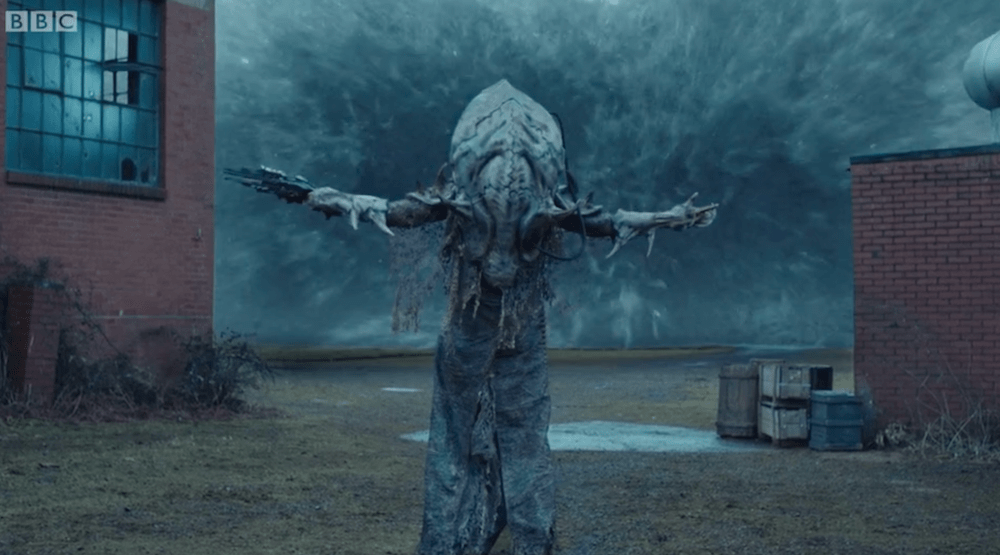
The Fisher King himself is both successful and something a failure. He is genuinely creepy creation, massive in size, skeletal and spikey like a modern-day Koquillion, towering over Capaldi in their head to head scenes. Ultimately though we don’t get to know that much about him, possibly this is an attempt to make keep him as an enigmatic creation? I am assuming that this is deliberate approach, but if it isn’t there isn’t much excuse over two 45 minutes episodes. The final image of him standing in the soviet village looking up as the dam breaks and the water sweeps him away is really very striking though.
Lost in Translation
Amongst the running around, ghosts and paradoxes it deals with love and loss and grief. At first the crew’s loss of their friend Moran, made explicit when the Doctor is getting a bit carried away about the ghosts. Then Bennett’s loss of the woman that he loved, O’Donnell, but didn’t have the courage to tell until it was too late, staring forlornly at her eyeless ghost in the Faraday cage:
BENNETT: What do I do now?
DOCTOR: I don’t understand.
CLARA: I do. You keep going. You have to. Take it from me, there is a whole world out there. A galaxy, a life. What would O’Donnell have wanted?
Clara reflecting there on wisdom gained from her own grief and the loss of Danny. Finally we have Cass discovering via Bennett’s words and Lunn’s signing that her love for Lunn is reciprocated:
BENNETT: Lunn. Will you translate something to Cass for me?
LUNN: Of course.
BENNETT: Tell her that you’re in love with her and that you always have been.
LUNN: What?
BENNETT: Tell her there is no point wasting time because things happen and then it’s too late. Tell her I wish someone had given me that advice.
Her childlike look of joy when she realises and the way she almost jumps on him is really rather lovely and quite moving. It isn’t a big showy emotional moment, it is small and intimate, it isn’t needed, but adds another layer to this splendid story.
This is just very good Doctor Who – with a set of interesting characters, scary, thoughtful and intelligent. It is also slightly like pick and mix Doctor Who – base under siege, time paradox, ghost story. If not quite as good as something similar like the Waters of Mars, it isn’t too far off it and the excellent character work raises it above the norm.
 A Journal of Impossible Things