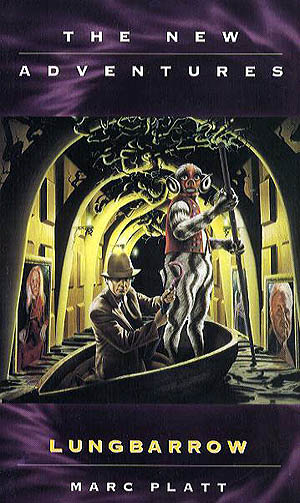
‘… and Rassilon, in great anger, banished the Other from Gallifrey that he might never return to the world.
Then there was great rejoicing through the Citadel.
But the Other, as he fled, stole away the Hand of Omega and departed the world forever.‘
‘The little figure had slowed and finally stopped a few feet from the bier.
There was a figure lying silhouetted inside the glass coffin. The Doctor stood, head bowed, for a moment and then walked solemnly up to the casket.
‘Quences,’ he said as he peered over the top of the bier at the figure.
Chris waited awkwardly, watching Glospin, until the Doctor turned and beckoned him over.
‘Chris, you know, don’t you?’ he said quietly.
‘Yes, Doctor. I told you. This is your home.’
The Doctor sighed. ‘Yes. This is my home – the ancient House of Lungbarrow in the Southern Ranges of Gallifrey, where I grew up.
A wild and beautiful setting for the worst place in the Universe.’
He gestured at the coffin. ‘And this was Ordinal-General Quencessetianobayolocaturgrathadadeyyilungbarrowmas, to give him his full title and decoration.
He was the head of the Family and my benefactor.‘
Home Truths
There comes a point in life (well maybe), probably in your 20’s where you rarely visit home – maybe only for weddings, funerals and christenings. You have moved away and started to make a new life for yourself, maybe re-invented yourself a bit – surrounded by new people – your future. Everything at home seems like the past, not the future, claustrophobic, old memories and old stories of the old you. For most of us this phase passes once your new world is secure and your two worlds reconcile in your 20’s or 30’s – the selfishness of this earlier period is necessary to allow you to establish your own place in the world. Some never leave and some never return.
The Doctor has been at this stage in his life for hundreds of years, but towards the end of his 7th incarnation, the past is catching up with him and it is time to visit home. Not just Gallifrey – he’s been back before and faced his old schoolmaster and fellow ex-pupils, rather to his home – the House of Lungbarrow and meet his family – his cousins who bear a resemblance to the cast of Gormenghast, his old friend and mentor (a giant robotic fur covered beast – called Badger), the overgrown sentient furniture that moves and bites, giant automated house staff and weird creatures that he created in his youth. He is also very, very late (over 600 years!) for a family funeral and the deceased has been waiting for him so that he can read his will for a very long time.
‘How did he die?’ asked Chris.Glospin raised an eyebrow.
‘He’s not dead,’ said the Doctor. He tapped the panel.
‘This is a static field generator.’
‘Very good,’ said Glospin. ‘The Kithriarch is waiting in stasis.’
‘Waiting? Why would he be waiting? What for?’
‘You,’ said Glospin. He turned to Chris.
‘The Doctor is six hundred and seventy-three years late for Quences’s deathday.
The poor old man refused to read his own will until his favourite was here.
The whole Family has been kept waiting all that time.‘
So a couple of confessions. I’ve started Lungbarrow a few times and never made it past the first few pages – one of the reasons why I was keen to cover it here and secondly, well it only sort of tangentially fits in this thread. It is an ending of sorts, has a funeral and follows in the wake of the death of a companion – Roz. It also pre-figures the death of the Doctor, ending as it does on Romana dispatching the Doctor to collect the Master’s remains from the Skaro and leading into the TV Movie – but I am stretching somewhat. It also features the ending of the ‘Cartmel Masterplan’ and in some ways the New Adventures Doctor Who range – there is only one more book to go and that is not a Seventh Doctor book. Actually another Seventh Doctor book was released after this one, bizarrely (well for unforeseen reasons) the one where Roz actually dies (‘So vile a sin’).
First some history – Lungbarrow was one of the original script ideas for the slot that Ghost Light ended up taking in Season 26. Like Ghost Light it would have been confined to the single location of the house and avoided the other Gallifrey-based scenes in this novel. The story seems to be that JNT decided that Lungbarrow was just a bit too much. too soon. I think he was probably right – it makes more sense in this context. It means though that in the absence of season 27, the ‘Cartmel masterplan’ on TV amounts to nothing much more than a few hints at the Doctor’s past in Remembrance and Silver Nemesis (‘more than just a Time Lord’, ‘The Hand of Omega is a mythical name for Omega’s remote stellar manipulator, a device used to customise stars with. And didn’t we have trouble with the prototype’). So now, with 12 more years of new series mythology, it is easy to view this as an alternative view on the Doctor’s beginnings, I don’t think that it explicitly contradicts anything much, but then I’m pretty comfortable that all of this stuff sits together without needing to construct a coherent timeline out of it all.
Marc Platt is one of my favourite Who writers – I like ‘Ghost Light’ – but absolutely love ‘Spare Parts’, ‘Loups-Garoux’, ‘The Silver Turk, ‘Paper Cuts’, ‘Auld Mortality’, ‘Storm of Angels’, ‘Butcher of Brisbane’ etc. There are other stories that I don’t think work so well – but I love his imagination and the clever details he puts into stories – in some ways reminiscent of Robert Holmes. He also seems to have a love for using nature and natural history in his imagery (very much in evidence here), which I very much approve of. Here we have that imagination at work, the House of Lungbarrow – grown rather than built, populated by grotesques, automata, orchid/lizard hybrids, taffle and fledershrews and an awful lot of fungi. Sometimes here it is just too much and the weirdness of the house and it’s occupants just seem to wander down some blind alleys, but it is at least always interesting and imaginative and well clever. On that subject ‘cleverness’ – that is a core aspect of Doctor Who for me, even at its most basic – an alien invasion, base under siege type story (which I love), it should have some aspect of cleverness to it – even if this is just through the Doctor.
‘The Worst place in the Universe’
Lungbarrow is the Doctor’s worst place in the universe. Back in the 80’s we saw Ace’s worst place in Ghostlight. I had a think about what mine was – instantly I thought of Bracknell (apologies if you live there), where I once had to work for a year – a cultural blackspot. However the place I eventually came up with was a bit more interesting than a Thames Valley commuter town – a beach at Pond Inlet in the Canadian High Artic – strewn with the remains of dead Polar bears, Huskies, Ringed Seals and freshly butchered Narwhal – in the low mist, walking there was like a glimpse of hell.
Anyway, back to Lungbarrow – and this is where it gets a bit complicated!
A cunning plan?
So the Cartmel Masterplan, that great idea to make the Doctor more mysterious by explaining everything about him! Which isn’t as it turns out what it was all about after all. This all unfolds over the course of the book – although the foundations are set in an earlier Marc Platt book – ‘Cat’s Cradle: Time’s Crucible’ (not a favourite). We are introduced from the start to ‘The Other’ – the mysterious third member of the triumvirate that came to rule Gallifrey in the old times alongside Rassillon and Omega – before the ‘Intuitive Revelation’ banished the old time and ushered in the new – bound to the rational, scientific leadership of Rassillon. ‘The Other’ is the one that isn’t quite the Doctor, but is friends with the Hand of Omega, he’s sort of the brains behind the throne, standing in the shadows. As things escalate and the followers of Rassillon enact their own version of ‘The night of the long Knives’, ‘The Other’ escapes. When the victors (the followers of Rassillon) write the official history (as Borusa says ‘ It doesn’t have to be entirely accurate’) – the fate and even the name of ‘The Other’ has been lost to myth. I’ve hear some say that these are Time Lords gods – they aren’t it is all much more political than that and more, well ‘human’.
All of this comes down to Gallifreyan reproduction. Not an area that I’ve especially wanted to delve into to be honest. Here new Time Lord ‘cousins’ are woven from the family Loom from raw genetic material – Gallifrey has been sterile since the female ruler – Pythia was ousted by Rassillon and after her death her followers left Gallifrey to form the Sisterhood of Karn. Anyway, each House has its compliment of 45 cousins and when one dies another is woven from the family loom. The Doctor apparently was also woven – but it appears some of his genetic material was from ‘The Other’ – who ‘died’ throwing himself into the Loom to spite Rassillon’s plans. He is called ‘snail’ or wormhole’ by his family – as unaccountably he has a navel, indicating maybe his birth was more natural. Susan is the last naturally born Gallifreyan – but not a contemporary of the Doctor, rather Grand Daughter of ‘The Other’. The Doctor rescues her from the old time of Gallifrey in his first journey in the TARDIS and she recognises him as ‘The Other’ – her Grandfather. We get to see the First Doctor leaving Lungbarrow behind, with the Hand of Omega and taking his first trip in the TARDIS – as ever breaking all of the rules and travelling back into Gallifrey’s own history. Well we see this through the eyes of the Doctor’s friends, almost in a dream – so I suppose you can chose to believe all of this or not.
‘Hooded in a black cloak, he pushed the scroll into the open beak of the great stone owl that guarded the Chapterhouse gate. The alarms were still sounding as he made his way across the Citadel’s broad edifice. The rainswept bridges and walkways were deserted. No one steps out on Otherstide night.
He carried one bag with him. A few belongings and keepsakes. The rest he left to the guards and the scavengers. He hurried along the windy colonnades known as Gesyevva’s Fingers and paused on the wide square where the ancient memorial to Omega stood. For a moment, he saw a shape flit across the burnt orange sky above the monument.
The TT embarkation port was on Under-level 15 of the Citadel. A group of watchful citizens was seated in the waiting zone. Several were busy trying far too hard not to be conspicuous.
‘Agency guards,’ mused the Doctor to himself. He ducked into the dry dimension dockyard on the next level up. On a neural construction palette stood a gleaming new TARDIS ready for service installation. A technician’s chart listed its immaculate specifications and latest safety precedent – a remote recall override system. ‘A type fifty-three?’ complained the Doctor. ‘You’re not getting me out in one of those new-fangled soulless slip-abouts.’
In a far corner, surrounded by junk, was a dull grey, battered old TT booth with an obsolete Type 40 marker on the door.
The key was in the lock.
As the Doctor stepped inside the doomed TARDIS, he heard a fresh clamour of alarms from close by.
Beyond its tight dimensional gate, the ship’s interior opened out impossibly. Its spacious console room was gloomy and neglected. A cobweb lifted and rippled on the central console. Several panels had been lifted off to expose the complex inner circuitry. The Doctor tore away the cobweb and blew off the dust. Instantly, the sluggish hum of power edged up a tone. A gold light began to glimmer weakly behind the honeycomb of roundels that covered the walls.
The place felt welcoming. The Doctor put down his bag.
There were banks of instruments around the room and a couple of overturned chairs. Beyond a door, there was the glimpse of a shadowy passage leading deeper. He pondered the control panels with a degree of glee and selected the brass button marked DOOR.
There was no response. The power was all but drained. The light guttered and the ship’s hum died. The Doctor drummed his fingers in frustration.Something whooshed. The black box was suddenly hovering beside him.
‘Yes, I wondered when you’d catch up with me,’ he said. ‘So you think you can come along too, do you? Well, that’s all very well, my friend. But since we have neither the luxury of a pilot nor of any power, perhaps you can suggest a way to fly this thing.’ The box whirred. Its lid opened a crack. The white furnace inside winked at him. He could feel its energy softly saturating the air. The ship gradually began to hum again. A more confident, assertive hum. The light in the room began to rise. A screen attached to the ceiling flickered into life, showing a group of Agency guards moving methodically across the dock area outside. One of them carried a gun.
The Doctor pressed the DOOR button again. This time, the heavy double doors buzzed and swung shut. The central glass column of the console juddered. The complex instruments inside turned back and forth. Lights twinkled among the circuits.
By now, the ship was throbbing with energy. ‘Remarkable, remarkable!’ enthused the Doctor. ‘All this power, from an ancient antiquity!’
There was a loud clang. On the screen, he could see the guards gathering around the ship.
‘Well, it appears that my future is in your hands … or should I say Hand, eh? Hmm?’ His shoulders heaved with little gusts of mirth. A light showed beside an unmarked dial. The Doctor glanced at the box. It gleeped at him. He reached out and gave the dial a twist. The air grated with the roar of engines. An undulating grinding like something tearing open the fabric of reality. The glass column rose and fell, its inner carousel of instruments turning. Switches and levers adjusted by themselves. The ship jolted and the screen picture vanished. ‘
Family Values
In the centre of the story is the Doctor’s family. They are a very strange bunch. The dead or ghostly Quences – head of the family and the one who realised that the Doctor was the only hope of ever rising above the level of supplying clarks to the Capitol. Satthralope – the malevolent old housekeeper who hasn’t moved for 70 years and bears a certain cobwebbed resemblance to Miss Havisham. Cousin Innocet – the only really likeable cousin and probably the best defined of the family, still close to the Doctor. Of the others the main ones are Glospin – the Doctor’s rival who hopes to inherit from Quences will, Arkhew and Owis (the Doctors illegal replacement cousin – who spends most of his time eating the local wildlife). The Doctor is the black sheep of this dysfunctional family, which is quite amazing really – he has disappointed Quences, although in the end the part where he finds out that the Doctor actually became Lord President instead of the minor cardinal he dreamed of for him is rather priceless.
Old friends
I think what surprised me about reading this book, is that I expected it to completely re-write Gallifrey in the image of Mervyn Peake, but it doesn’t – it is much more clever than that, at least in book form, the TV version would probably have been quite different in this respect. If Robert Holmes rebuilt Gallifrey in his own image, Lungbarrow mainly builds an extension to it – it keeps the President, the Chancellor, the Castellan, the Panopticon, the Chancellory Guard, the CIA and the academies, alongside side our friends, Leela and Andred, Romana and two versions of K9 (rather glorious that), but off to one-side in the capitol. Meanwhile the Doctor has an adventure in a very different aspect of Gallifrey – the houses, so it is in the spirit of building on our knowledge rather than completely tearing it up.
I was also quite surprised at how familiar all of this is – through Marc Platt’s Big Finish Doctor Who Unbound story – the rather brilliant ‘Auld Mortality’ for Geoffrey Bayldon’s alternative, ‘stay at home’ First Doctor. So I had already met Ordinal General Quences, Badger, the Drudges and cousins but didn’t really know that they had come from Lungbarrow. Likewise Leela and Romana on Gallifrey – Romana as a reforming, outward looking President, opening Gallifrey to the universe and looking to heal old wounds. All of that is in a number of New Adventures and Big Finish stories – not least the ‘Gallifrey’ series. So maybe I was just more warmed up for all of this than I was expecting – certainly than I would have been if this has been part of Season 26 on TV and confined to the house.
The book also rather cleverly balances old and new. Both Leela and Romana are nicely drawn here – Leela struggling to find her place in her new world and Romana a force of nature setting about Gallifrey with a reforming zeal. And if it takes your fancy – and it will for some – there is a girl-on-girl fight between Leela and Dorothee (Ace), after which there is some degree of mutual respect. Ace/Dorothee gets to meet herself and it seems that she doesn’t entirely approve of what she became in the NA’s – unsurprising, I don’t particularly either. K9 gets to meet himself as Leela’s Mk I meets Romana’s Mk II and they do the equivalent of sniffing each other’s arses. That makes me happy far more than it really should as a grown man!
‘Memory capacity increased by seventy-one point one per cent,’ he announced aloud.
He already recognized the designation of the analyst. As his optic circuits restored vision, he saw the analyst itself. It was the unit he had been in occasional conference with over the past five days. The sensor from the analyst’s angular metal head was extended to engage the extended sensor from his own.
They wagged their tails and ears at each other and retracted sensors.
‘All systems reactivated and reprogrammed,’ said K9 Mark I.
‘You are K9 Mark II.
”Affirmative. Program complete,’ said K9 Mark II.
‘You are K9 Mark I.’
The two robotic dogs circled each other, ‘sniffing’ at each other’s credentials. Eventually they pulled apart. ‘All data assimilated,’ they chorused unnecessarily. ‘Next objective: to find and retrieve the Lady Leela,’ declared K9 Mark II. ‘Affirmative,’ agreed K9 Mark I, and he led the way as the junior version rolled back to let him through.
I don’t know what it is about K9 – I never paid him much notice to him growing up, but his image and voice now can utterly transport me back to childhood – a sort of weird nostalgia for something that I didn’t like all that much at the time. I remember blubbing in our house at the end of ‘School Reunion’, I can’t say whether it was me, but there was definitely blubbing. I’ve just listened to a rather joyful Tom and Lalla audio where Henry Gordon Jago gets to introduce K9 on stage as his new star act – it makes me very happy that such a thing even exists.
It isn’t only Romana who is going to have a big impact on the future of Gallifrey – Leela is pregnant. I didn’t really think Andred had it in him – but there will be a half human/half Time Lord on Gallifrey once more and the curse of the Pythia will be be broken. Who knows that might explain the TV movie?
Who killed Ordinal general Quences?
For a story that at one point looks like it might be about a CIA coup on Gallifrey (that plotline just sort of peters out), it actually shifts at least partially to a uniquely Gallifreyan murder mystery, Cousin Innocet and Arkhew have seen what looks like the first Doctor killing Quences with a double-bladed knife (2 hearts). The resolution to who killed Quences, how and why is a uniquely Time Lord one. I won’t reveal what happens here, but it is satisfyingly resolved. After wandering a bit, the main plot is also quite nicely wrapped up, it is ambiguous enough for you to decide on what the Doctor’s relationship with ‘The Other’ is and ends in a sentient house committing suicide – which doesn’t happen that often in fiction!
To be honest there are so many aspects of this book that I could have talked about that I haven’t had time to. Somehow I don’t think I’ve entirely done it justice and may need to re-read it myself to work it all out. Read it for yourself – it won’t be for everyone, but I would have though that even those who don’t like it would at least admire its imagination.
Eighth man bound
Eighth man bound
Make no sound
The shroud covers all
The Long and the Short
And the Old and the Loud
And the Young and the Dark
And the Tall
So this pretty much wraps up the Seventh Doctor for the books or rather he rides off into the sunset for BBC books adaption of the TV Movie and then into the BBC Past Doctor Adventures (PDA) range and Big Finish. Lungbarrow ends with him heading off to collect the Master’s remains for Skaro with 96% chance of death! Or rather it hints that he has forgotten to nip off and become Merlin first to fulfil that part of ‘Battlefield’, so maybe he goes the long way around. His marvellous new ship interior (from the TV Movie) is modelled on the house of Lungbarrow itself and the fledershrews move in (those bats in the Cloister room from the film). It is a bit of measure of how quickly, after years of prevarication, that the TV Movie came together in that Lungbarrow came out nearly a year after the TV Movie aired, the Virgin licence was about to expire and the first BBC Eighth Doctor book (‘The Eight Doctors’) came out a couple of months later. So the TV movie was almost old news by this point and the novelisation of it came out 12 months earlier than Terrace Dick’s book.
In some ways it is a fitting way to leave him. It wraps up the plans of Andrew Cartmel, Ben Aaronovitch and Marc Platt and also the New Adventures as a whole. Before I leave them however there is one more story to tell – the last of the New Adventures to feature the Doctor, one that features old friends and old enemies and captures some of the zeitgeist of the times:
 A Journal of Impossible Things