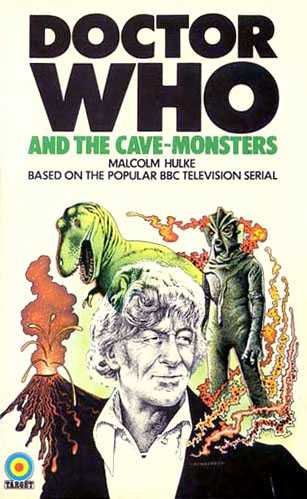
“Okdel stood watching as the last of the young reptile men and women took their turn to go down to safety in the lift. The gleaming metal doors of the lift were set in rock; the doors slid open and shut soundlessly, taking another group of Okdel’s people to safety below the ground. Across the valley the sun was already setting, and its last light made the green scales of the young people shine brilliantly. Okdel wondered when he would see the sun again.”
More than content with just being one of the best Target books, ‘The Cave Monsters’ is rather an instruction manual for children. A lesson in tolerance and respect for other cultures, an exercise in seeing different points of view and a warning of what happens when those with extreme views get their own way. As a member of the British Communist Party, one who has sacked from a job at party HQ (he called Scotland Yard from their offices), who left the party, rejoined and left again. Who was never really accepted or wanted by the party leadership after a series of events and comments in letters. If the party viewed him with suspicion, he had his doubts as well. He is rather like the Orwell of ‘Doctor Who’ in that regard and his books reflect that – despite being written for children they aren’t simple of clear polemic Rather they paint s world in shades of grey, where living together is difficult and hard work and requires a leap of faith, one that isn’t always possible. Where people aren’t just one thing and often aren’t all they first appear. In short it is a distillation of everything that Mac Hulke gave to the children of my generation. Some of them occasionally seem to forget this.
Oh and it also has a map of the research base. I like a map in a book. And dinosaurs. And reptile men. I’d like some graphs and a few tables as well, but you can’t have everything.
“K’to said, ‘Are all the animals safe?’ It had been decided to take a male and female of all the more useful reptile animals. ‘What?’ said Okdel, lost in thought. ‘Our animals,’ said K’to, ‘are they in the shelter?’ ‘They went down first,’ said Okdel, ‘I made sure of that.’ He paused. ‘A pity we are taking none of the little furry animals.’
‘You are a strange man,’ said K’to. ‘The little furry animals are dirty. Insects live in their fur. In any case, this event will rid our planet of the mammal vermin. When the planet draws away our atmosphere, even only for a few minutes, all creatures on the surface will suffocate and die.’ Morka came up beside them. ‘Okdel keeps one of the furry animals as a pet,’ he said. ‘Is that not true, Okdel?’ ‘It amuses me,’ said Okdel. ‘Your pet will have to die with the others,’ said Morka. ‘We shall be better off without them.’ ‘They raid our crops,’ said K’to. ‘Our farmers will be glad to see the end of them. But I am sorry about your pets, Okdel.’
‘You only say that because Okdel is the leader of this shelter group“ said Morka. ‘The little furry animals revolt me! They grunt, they have families, and they are fond of each other.’
‘It is that quality which makes them interesting,’ said Okdel. ‘In the zoo I have noticed how they touch each other, and put their limbs round each others’ necks.’ ‘Yes,’ said Morka, ‘and press their lips to each other’s faces! It is disgusting!”
I touched on the morality of the story in my review of the TV version, but really we only see a hint of that, an inkling that the Silurians want any sort of peace in that. It really just amounts to the conversations between the Doctor and the Old Silurian leader and that is about it. And then he is killed by the Young Silurian, while the scientist watches, uncaring. It is hard to have the same faith in them that the Doctor seems to have – especially as their next act is to unleash a virus aimed at wiping out mankind, followed by an attempt to destroy the planets climate! It is possible to understand the Doctor’s perspective, trapped as he is on Earth at this time, but with the TV version it is hard to share his motivation.
In the book though, we are privy to their thoughts. To the nostalgia of Okdel (the Old Silurian leader) for his own world and old life. We also see the world through the eyes of a Silurian – even our friends the Doctor (Frock Coat), the Brigadier (Fur under nose) and Liz (the female!). Whilst the Silurians become more sympathetic or at least understandable, the humans in the book become less sympathetic, harsher somehow. All of which makes for a better balance between the protagonists.
Making Britain great again
Even with the human protagonists, we understand them better. Major Barker ‘slipped up’ in Northern Ireland and wants to make amends.
He sat back in his bed and closed his eyes again. This time instead of seeing soldiers in brilliant red tunics he saw himself one rainy day in Londonderry, Northern Ireland, leading a group of soldiers who were trying to pin down an IRA sniper. The sniper had already shot two of his men dead, and wounded a third. The Major carefully worked his men into a position so that the sniper was completely surrounded. Then he called upon the sniper to surrender. A rifle was thrown down from a window, and a man appeared with his arms raised. As Major Barker called on his men to break cover and arrest the sniper, shots rang out from a sniper in another building, instantly killing the young soldier next to Major Barker. Without a second’s thought, Barker aimed his revolver at the sniper standing with his hands up in surrender, and shot him dead. For that moment of anger, Major Barker had been asked to resign from the British Army and to find another job.
He is convinced that ‘communists’ are causing the problems – something Hulke was used to – he was hounded by authority a few times in his life as a communist, investigated by the security services – although written off by them and the CPGB as a crank. Barker here though is full in full-on Brexit supporting taxi driver mode:
‘Miss Shaw, England was once the heart of an empire, the greatest empire the world has ever known. But the bankers and the trade-unionists have destroyed that great heritage. Now we are alone, backs to the wall, just as we were in 1940, only there is no Winston Churchill to lead us. The whole world is snapping at us like a pack of hungry wolves. But the day will come, Miss Shaw, when England will rise again…’
The ballad of Mathew and Phylis
Doctor Quinn (Mathew) is single, having lost his wife in a car crash, his ambition motivated by his far more famous scientist father. Miss Dawson (Phylis) has spent most of her life caring for her ailing mother – all of which explains her feelings for Dr Quinn and air of desperation. Her mother’s health and devious nature holding her back from finding someone or progressing in her career when opportunities arose. Their relationship is finely drawn, Miss Dawson rather keener than Quinn. Dr Quinn ambitious and rather full of himself, Dawson rather embittered. Quinn is prepared to kill the Silurians once the have given him want he wants and is shown deftly manipulating Miss Dawson into keeping quiet for him. Stripped of the affable performance from Fulton MacKay, he comes across as quite a nasty piece of work. In a change to the TV serial Quinn is killed by Morka in from of Miss Dawson – she is knocked unconscious and ends up like Spenser the technician drawing on the walls.
The high price of army cable
We are even provided insights into the relationships between the Doctor, Liz and the Brigadier. Liz is as exasperated with the Doctor as he is with the Brigadier, which is hinted at in the TV version. Also, the world of bureaucracy that the Brigadier fields so that the Doctor downs’t have to deal with it, all encapsulated in this exchange:
‘We couldn’t just leave the cable, could we, sir?’ asked Sergeant Hawkins. ‘Government property,’ said the Brigadier. ‘But hanging about like this, sir,’ Hawkins persisted. ‘We could get trapped again by a roof-fall.’
‘If we are trapped again,’ said the Brigadier, ‘that is something I could explain to my superiors. But if I lose one foot of that wretched telephone cable, there will be an investigation into the waste of public money.’
All of which leads their party to be attacked by a Tyrannosaurus Rex!
‘What about the cable, sir?’ said Sergeant Hawkins. ‘That’s right,’ said the Brigadier, ‘what about it?’ He grinned at the Sergeant. ‘For once, let’s forget about government property and look after our own necks!’
The Brigadier and the soldiers ran as fast as they could down the passageway towards freedom.
Carl Jung, coelacanths and cave art
Hulke never talks down to his readership. For example, we get the story of the discovery of the paleolithic cave art at Lascaux, how a particle accelerator works, continental drift and the re-discovery of the coelacanth. And in the midst of it all, we young readers also had a lecture on Jung of all things!
‘Do you know,’ asked the Doctor, ‘what Jung meant by “the collective unconscious”?’
‘Jung?’ said the Brigadier, ‘the psychologist fellow?’
‘It’s the memory that animals inherit,’ said Liz Shaw. ‘You know the way a dog walks round and round before lying down, because it thinks it is treading flat the tall grass that dogs lived in millions of years ago.’ ‘Or the way salmon always return to where they were born in order to breed,’ said the Doctor. The Brigadier was fast losing his patience. ‘Doctor, Miss Shaw, this is all very interesting…’
‘But you want to know about the power losses?’ said the Doctor. ‘Thank you,’ said the Brigadier. ‘Now let’s get back to the point.’ ‘We must first decide,’ said the Doctor, ‘what the point is, and I believe it is connected with our inherited memory of something from long, long ago. There is something close to this research centre which is touching on the depths of Spencer’s memory—not his own conscious memory, you understand, but instead the inner parts of his mind which come from man’s ancestors of thousands, perhaps millions, of years ago.’
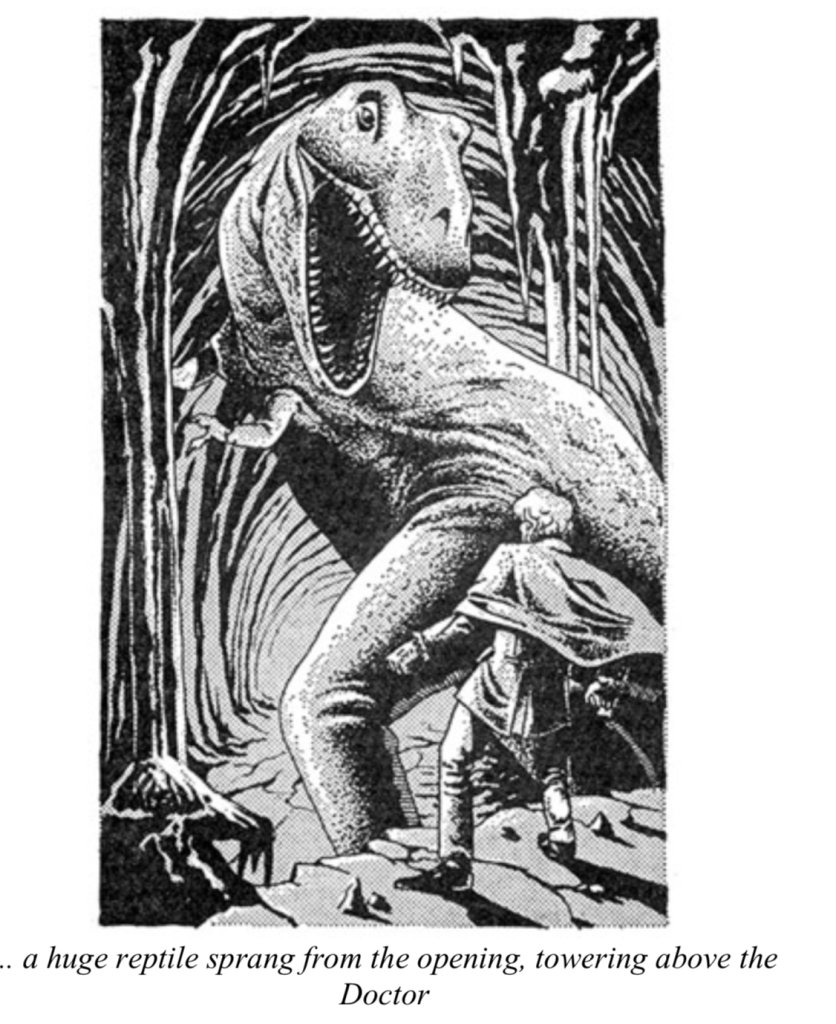
Luckily amongst all of this educational heft, there is still plenty of Dinosaur and monster goodness for the younger readers – including this very exciting illustration of the Doctor facing a Tyrannosaurus Rex in the caves:
A lizard at the United Nations
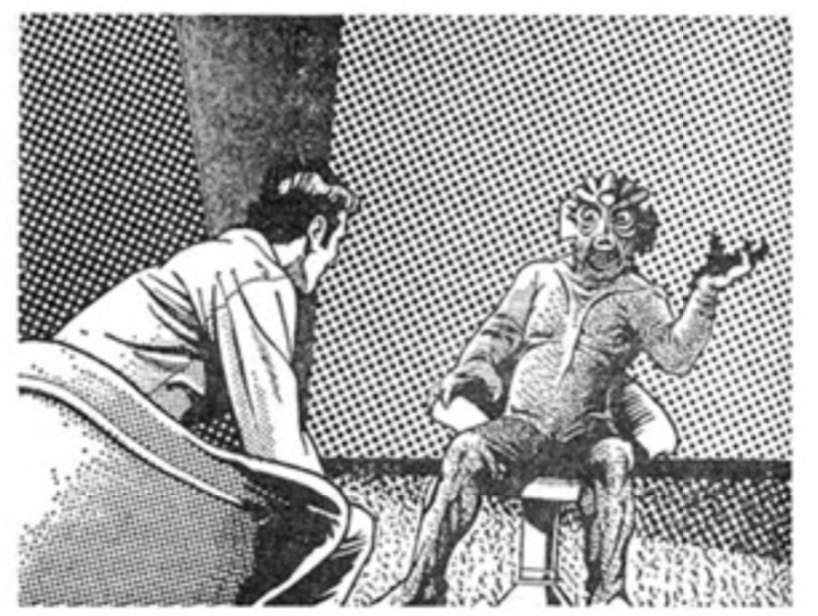
We see the world through Okdel’s eyes and understand how his age makes him wary of rebuilding an entire work or his sympathy for the ‘little furry creatures’ feed into his different attitude to the humans. And also his sense of loss that his civilisation no longer exists:
‘We have cities,’ said Okdel, ‘great domed cities in valleys waiting for us to return.’ ‘No,’ said the Doctor. ‘This must be hard for you to understand, but there is no trace of your civilisation on this planet. The Earth’s crust is always moving. You are fortunate that this shelter has not been crushed to pulp by some internal movement of the crust.’ Okdel seemed deeply affected to learn that his civilisation had completely vanished. ‘Nothing of us has been found?’ ‘No,’ said the Doctor. ‘Only some fairly small versions of your animals—the lizard, the crocodile, and the snake.’
Okdel swayed slightly from one side to another, and from the depth of his throat there came a gentle whining sound. The Doctor thought this must be the reptile man’s way of showing grief. Then a single drop of liquid slid from one of Okdel’s eyes. The old reptile man was crying. ‘I am very sorry,’ said the Doctor. ‘It must be sad to realise that you are so completely forgotten.’
Ultimately though the opportunity for peace is lost to the warmongers on each side.
‘You do understand the caves must not be touched,’ the Doctor said. ‘I want to return here next week with a team of scientists to try to make peaceful contact with the reptile men. There’s a living museum down there, and if we can get on friendly terms with them there’s a great deal we can learn about the origin of life on this planet.’ ‘On my honour,’ the Brigadier said. ‘If I so much as see a reptile man, I shall go out of my way to be nice to him.’ ‘You don’t really take this seriously,’ the Doctor said. ‘These creatures have as much right to this planet as you have. I’m going to ask the Prime Minister to have it put to the United Nations that the reptile people be formally invited to share the world.‘
And the ending:
‘He’s sealed them in,’ the Doctor said quietly. Liz nodded. ‘He had to. They’d never have accepted sharing this world.’ The Doctor felt anger rising in him. ‘We’ve lost the chance to find out now,’ he said. ‘We shall never know.’
The Doctor started up the car again and continued along the main road in silence.
Okdel’s world
The real triumph of the book though is the world building that Hulke provides for the Silurians. Such is the quality of work that Hulke puts into this, we feel sad when Okdel is killed and the chance for peace is lost.
Okdel saw the two third eyes before him turn to a brilliant red. The pain raced through his old limbs. For a moment he remembered himself as a tiny reptile baby, breaking out from its egg. Then his mind went blank and he was dead.
I’ll leave the last word to Okdel, saying farewell to the world he knew:
“Okdel turned and looked again across the valley. The sun was now deep in the western horizon. He wanted to take a last look at the metal domes of the city glinting in the fading sunlight. It was a pity that so many animals were to die. Nearby a huge lizard was quietly munching leaves from a fern. But there was only room in the shelters for a selected few.
Okdel turned to follow the others. Then he heard a familiar sound, and paused to look back into the valley. About twenty of the furry animals were racing across open ground, babies clinging to the backs of some of the females. As always, they were calling out to each other, grunting and chattering. Sometimes Okdel imagined they were trying to form words. He was certain that his own pet furry animal understood many of the things said to it, even though it only chattered and grunted in reply. He had released the pet two days ago, so that for what remained of its life it would enjoy freedom to climb trees and race across open spaces.
‘Okdel!’ Morka was calling from the lift doors. ‘We must go into the shelter’
“Okdel slowly walked towards where Morka and K’to were waiting. Just before stepping into the lift, he looked again across the valley to see the tip of the sun as it sank below the horizon. It was the last time he was to see the sun for a hundred million years.”
 A Journal of Impossible Things