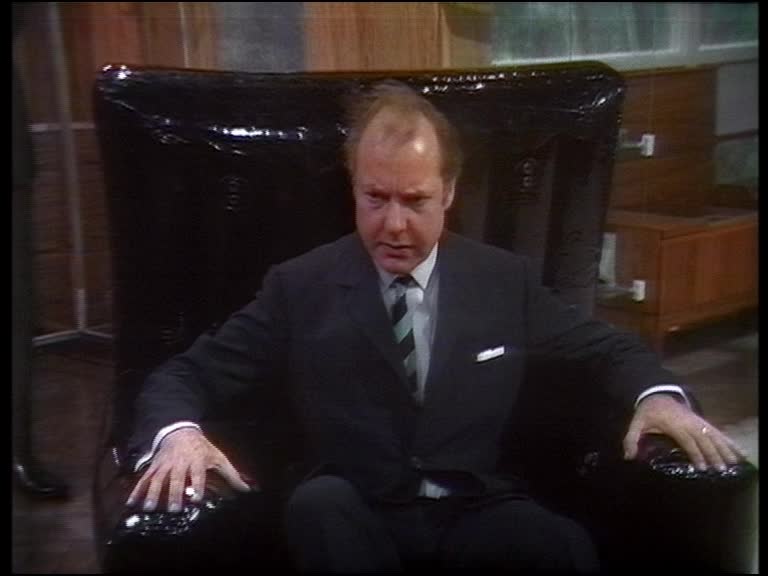
Sylvia, will you check Mister McDermott’s entitlement on termination of employment, please?
There is a shift that happens in the writing of Robert Holmes which starts with ‘Spearhead from Space’, but becomes really apparent in ‘Terror of the Autons’ – a mining of horrific, macabre concepts and dark set piece moments, but one that is combined with a dark, almost cynical humour. It almost has a gleefulness in its own sense of irresponsibility, of wrongnesss, something that I think chimes with young minds and feels like it dovetails nicely with the work of others across generations – the Brothers Grimm or Roald Dahl for example. A real sense of the grotesque. There is no real sense that this might happen in his scripts for ‘The Krotons’ or ‘The Space Pirates’, which are largely free of horror or scares or that much else of interest to be honest. It is what Holmes’ did next that would revolutionise ‘Doctor Who’ for a generation, when it would become teatime horror stories for us tots.
“I don’t do domestic”
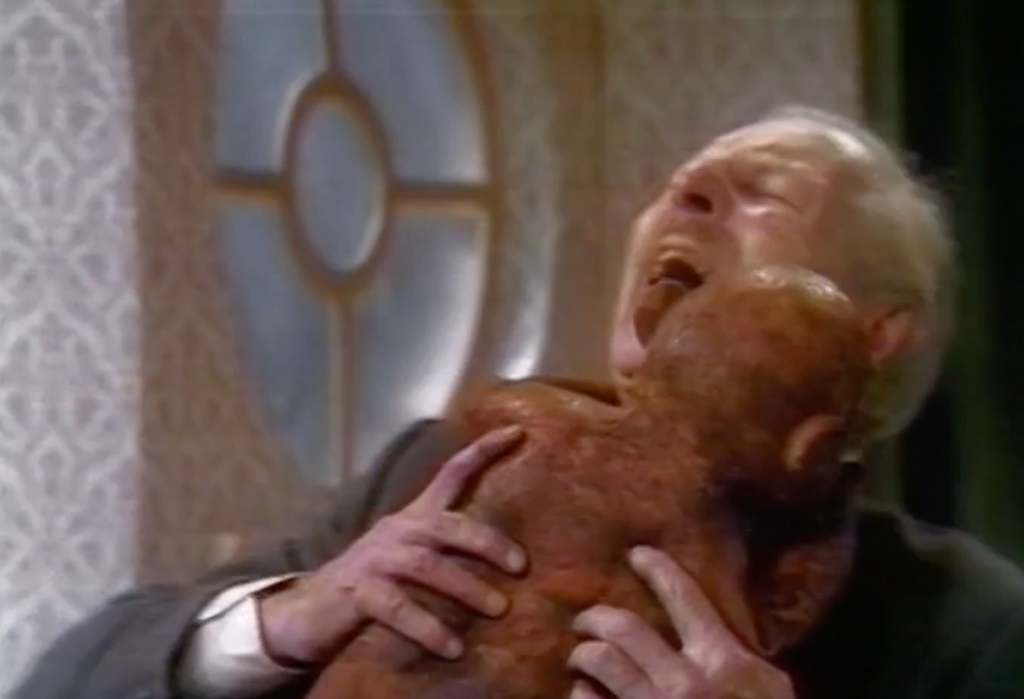
Sometime, while conceiving ‘Terror of the Autons’, Robert Holmes discovers a formula that is so spectacularly right for ‘Doctor Who’ that we think it is used far more frequently than it actually is. If anything, it works too well, and he and the production team learn a lesson from the furore that follows the story, one that leads them to promptly abandon the approach for good. That idea – finding horror in the domestic, in normal lives and every day objects was deemed far too much for their young audience. It is an approach that is only really picked up again when Russell T Davies revives the show, but in the early 1970’s it means that even as the Doctor is exiled to earth, he largely sticks to the adult worlds of research centres and military bases so beloved of the era. It is somewhat ironic that Holmes discovers this on the watch of Barry Letts, in a story that Letts even directed – Barry, that most responsible, sensible and reasonable of men. And yet it was he who shot those gleeful scenes of plastic killer policemen and living plastic chairs that swallow their occupants whole.
Luckily for us though, Holmes is a writer with many strings to his bow – not just horror, but satire, world-building, politics, character and rich, ripe dialogue and although he later returned to the horror, particularly when freed of the constraints imposed by Terrance and Barry, he relocated it to the ‘safer’ more remote worlds of gothic mansions, of history or planets in the far future. But the home, the home was safe from attack, at least until the comedy wheelie bin in ‘Rose’ hoves into view. The next time Holmes and Letts collaborated, it would be in the much safer sci-fi world of ‘Carnival of Monsters’ – what horror and violence there were, confined to the fantasy worlds of the miniscope, far from the exerience of us impressionable kids.
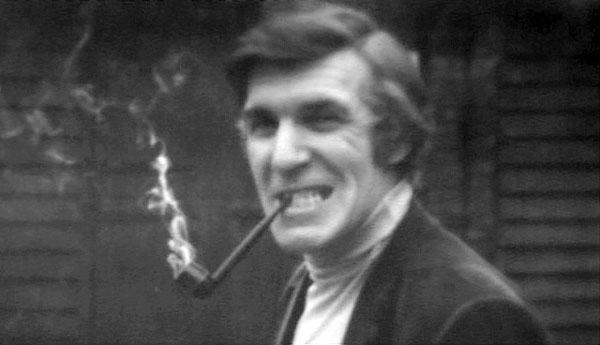
When I think of him now, it is very much Holmes’ trangressive, anti-authoritarian heart that stands out. I imagine him, laconically puffing on his pipe, as he imagines all the ways in which he is going to ‘scare the little buggers to death’. To that aim, across this story we see a myriad of deaths, each more bizarre and unsettling – and domestic. Its aim is to scare children. It is as simple as that. Sure, he uses the story to also rail against a sea of 70s plastic crap that he hated – those blow up chairs and bean bags his tall, angular, frame struggled with at parties in 70’s homes, those hideous plastic troll dolls, popular for some unaccountable reason in the early 70’s, of trimphones or plastic flowers given away with soap powder. But at the heart of it is something quite wrong, something that the authority figures of any well-adjusted civil society – parents, education, government, religion would surely think was a bad thing – scaring young children. ‘Terror of the Autons’, despite the cosy world of UNIT it ushers in, feels like a child’s nightmare, a colourful cheese induced, grotesque dream – simultaneously bright, overlit, ridiculously colourful, but bent horribly out of shape and twisted into a weird macabre hybrid of styles. A feeling reinforced by the disturbing, off-kilter, electronic score.
So, why then did I love it when I was a small child, why did stories like ‘Terror of the Autons’ make me a fan of the show for life? I’m a good citizen, I’m not violent on any way. I don’t commit crimes, I pay my taxes, have pensions, a steady job, I’m happily married, I don’t even like horror as a genre. So, why do I find something that is clearly ‘wrong’, so right?
That idea of transgression, of enjoying something that we really shouldn’t – of the inappropriate, of finding bad things happening to other people thrilling or funny is rather out of favour. Killed off by the progressive, rather than reactionary elements in society, which would be very surprising from a 1970’s perspective, where imposing your own morality on TV and film was very much a conservative, religious, right wing pursuit. I won’t dwell on the reasons why things have changed, they don’t especially interest me, I’ve lived through the changes and understand the reasons and the steps taken to get to where we are now. Instead I wanted to examine what it was that made this so enjoyable, how watching something that was ‘wrong’ and ‘unwholesome’ was so right. There is an aspect to this story, where comedy and the horror are so close in conception – two sides of a coin – and Holmes, I think, mines both of these expertly. The deaths in this story are horrific, but simultaneously also quite funny. I come from the time that gave us ‘Terror of the Autons’ and all of those other Holmes stories that push things far too far, that ‘wrongness’ of enjoying something that is inappropriate is something that I’ve never really thought about much. These stories aren’t even a guilty pleasure for me – just a unapologetic pleasure, they are hard-wired into me – weirdly also my ‘happy place’ in times of stress. That can’t be right can it?
When I did stop to think about this, I actually began to examine it in a comedy context and appropriately enough, via the work of a future showrunner and writer. Steven Moffat, in his earlier life as a comedy writer, finds humour in this very very idea – the laugh in a completely inappropriate context – the ‘Giggleloop’ in an epsiode of his 90’s sitcom ‘Coupling’. Thinking, say during a minute’s silence at a funeral, just how inappopriate it would be to laugh at this point, then having planted that idea in your head, your brain goes into an escalating loop, such that it is impossble to actually stop yourself from laughing for real. You know it is wrong, but you laugh anyway. That crossover between the horror and comedy in an inappopriate context is also a key component of say, the work of Mark Gatiss and his friends in ‘The League of Gentlemen’. It takes inspiration from many sources – but it feels like the work of Robert Holmes (or Nigel Kneale for that matter) pushed much further into an adult world – mining the comedy of horror and the horror innate in inapproriate comedy. That wasn’t the world that Holmes is operating in though. I know a lot of what Robert Holmes wrote for me as a youngster is wrong – wrong for the audience, wrong for the timeslot, but the wrongness of it is just right, I love it, it makes smile, it made me happy and still does.

I often liken Holmes to Nigel Kneale – they are similar in their output and outlook in some ways – anti-authority, slightly cynical, the lyrical use of language and a brilliant instinct for the scare. Kneale is a more spikey, difficult figure than the more laconic Holmes, but they are my two favourite TV writers really. And yet Kneale hated this – he really thought that what ‘Doctor Who’ did to children – that the scares it invoked were completely wrong and irresponsible. That coming from a man who had terrified a nation with his work. I think he regarded ‘Doctor Who’ as purely a children’s show. And yet the irony is, that almost every contemporary fan of Kneale’s work, comes to it via Robert Holmes. They had much more in common than Kneale ever thought.
Kneale would have hated Mary Whitehouse and yet agreed with her about ‘Doctor Who’. What those opposing the use of horror and violence in the show never really stopped to properly consider was what the young audience thought of it. We loved it. It was a peek into a world that we shouldn’t be seeing, an adult world, this was no Children’s TV production of Victorian posh kids and a wardrobe or magic garden. This was adult characters in an adult world, getting shot or blown up or melted or transformed into monstrous creatures. It was meant for us and yet no real quarter was given to the fact that we were so young – the ‘hiding behind the sofa’ was real – we really did that, we so much wanted to watch and yet we barely could through our fingers or a position of safety in our front room. It was perhaps this violation of that place of safety – with thoughts of killer dolls or telephones that did for ‘Terror of the Autons’, it broke the fourth wall and let in horror.
But what did it do to us in the long run? Well I’d argue nothing much really. At worst ‘Doctor Who’ fans grew up to be pernickity, argumentative, ‘too clever for their own good’ pedants inhabiting internet fora! They haven’t destroyed the world or hurt other people or designed killer furniture. Quite the opposite. The worst thing it did for us, was make us slaves to this programme for life. If anything, the worst dammage it has done to me is in regard to my finances. Just how many copies of ‘Spearhead from Space’ and ‘Terror of the Autons’ do I now own? Multiple books, audio books, VHS, DVD and now Blu-Ray’s.
So, I sit here now watching my newly minted Season 8 blu-ray, watching McDemott smothered once again by a tar black plastic chair, it flowing over his suffocated corpse. Or a hideous (newly CGI) plastic doll strangle Farrel Snr to death or a plastic film coating Jo’s mouth, threatening to suffocate her. I know now, as I did then, that all these things are wrong, but they are simultaneously very scary and very funny. And very, very Robert Holmes. So, wherever you are big man, may your pipe be full, your imagination be full of nightmarish, ghoulish horrors and well, thanks for everything. You still continue to thrill, excite and make me laugh and anyone who want to tell me that is wrong is welcome to come around to mine and sit in this shiny black, plastic chair that I’ve just bought and explain why.
 A Journal of Impossible Things