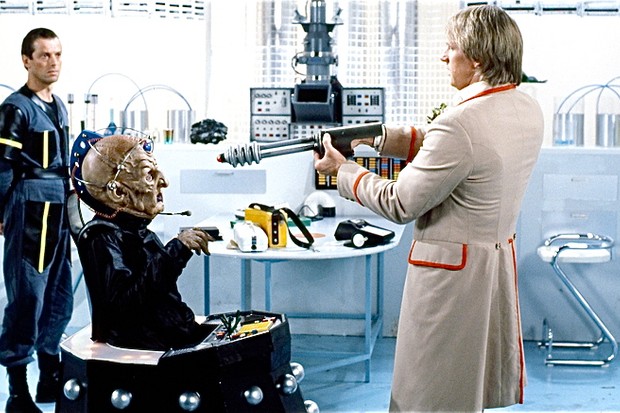
‘I’ll say one thing for you, Eric. Your stories are totally predictable. You’re like a deranged child, all this killing, revenge and destruction
The theory goes like this – Earthshock changed everything. It was all returning monsters and continuity after that. Then Resurrection changed everything it was all shoot-em-ups and huge death counts after that. Or the theory goes like this – Caves of Androzani changed everything – it was all mercenaries and cynical stuff after that. And all of that pandering to fans – continuity, returning monsters and flashback sequences – makes the show more niche and is a big factor in what eventually leads to cancellation. Bollocks – I really don’t buy any of that – sorry.
There are just good stories and not so good stories, well made stories and stories that aren’t so well made, Doctor’s and companions that are well cast and work together and those that aren’t and don’t. If returning monsters and continuity was such a big issue for the general viewing audience why hasn’t the new series been cancelled again by now? We have had masses of returning monsters and tortuous continuity for years now – again and again, every year more and more – this year we have The Daleks, Missy, the Master and others already announced, even a tiny glimpse of the Movellans and who knows what else will turn up by the end. The series re-started very light touch for the less committed viewer, then we had returning monsters, returning companions, Time Lords, flashback sequences etc. Eventually this all culminates in The Magicians Apprentice – Daleks old and new, Davros, the war on Skaro from Genesis, UNIT and the Master. Really? That is any less tortuous than the Eric Saward 1980’s stories – Earthshock, Resurrection, Attack of the Cybermen? No it really isn’t – it is however better made and generally better written.
To blame the likes of Earthshock or Resurrection for the cancellation and ‘hiatus’ is in my view to paraphrase the Doctor ‘arrant nonsense’. The show was cancelled because a) the regime at the BBC had changed and they hated it, all executive level support was lost and b) because by Season 22 it looked terrible, had a regular cast that didn’t work, it wasn’t written well enough and had a producer who wanted to move on, should have moved on and wasn’t for some reason allowed to move on. If you want a sneak peak at why the series was eventually cancelled after the mortal wound was inflicted in ’85 take a look at the final story of Season 21 – it provides all the ammunition that Grade or Powell needed.
This is my version of what these stories (good or bad) actually do – they provide balance. Doctor Who in 1982 was at a bit of crossroads – the ratings magnet that was Tom Baker had left, cleverly and let’s give JNT credit here had cast the hugely popular Peter Davison – an actor who was very popular with people outside of Who’s usual core audience. The stories themselves, well they still owe a lot to Chris Bidmead’s version of the show. Now I like these stories very much – I’ve reviewed quite a few of them, but they lack a hook or pace or action or anything much for the less committed audience – they are thoughtful, quite slow, very talkie and along with set design, costume and incidental music they have a sort of soft, reflective, pastoral quality. There are lots of these across seasons 18,19, 20 and even into 21 – past Earthshock and Resurrection and deep into Saward’s time as script editor. Keeper of Traken, Logopolis, Castrovalva, Four to Doomsday, Kinda, Black Orchid, Snakedance, Mawdryn Undead, Enlightenment, The Awakening, Planet of Fire etc. Season 20 without ‘The Return’ or ‘Warhead’ or whatever Resurrection would have been called is quite a strange beast and the original Peter Grimwade version of this would at least have injected some much needed pace and action into the anniversary year and provided balance. It works in that context.
Elsewhere in the early 80’s things were changing in the world of science fiction Film/TV. Science Fiction in cinema had exploded from 1977 onwards after Star Wars and the expectations of not just the likes of Michael Grade, but with the audience as a whole had radically changed. Before these the best effects you were going to see as a child were from Ray Harryhousen films – stop motion stuff or at a push possibly Gerry Anderson (Space 1999 etc.). But it isn’t just about effects – it is also about the type of storytelling – the pace and levels of action and the big set pieces. The impacts of this aren’t felt straight away, but then you then have the mass audience switch from Doctor Who to the glossier US production Buck Rogers during Season 18, followed by the reaction to this – the move to Monday/Tuesday night in season 19 and the new Doctor, which brings the ratings back up to much more respectable, if not quite season 17 levels. It wasn’t that people expected Star Wars from their TV shows, just that they expected more. Doctor Who has to react in some way to this change in the zeitgeist, but absorb some of this (those elements that it can afford) into the shows core DNA – but still do things in a typically ‘whoish’ way. So we start to have thrilling adventures with set piece battles and butch space captains – but instead of Harrison Ford, in Doctor Who these are played by Beryl Reid with a red rinse. It didn’t last long.
All of which leads us to ‘Resurrection of the Daleks’. First of all, I don’t think this is anything much like Earthshock. Ok, I know it has the same author, was supposed to have the same director and has a sort of butch-ness to it, However Earthshock was quite a straightforward story given scale by the return of the Cybermen and the death of Adric and injected with pace by a very capable director. The plot basically was the Cybermen want to destroy the Earth to stop a conference aimed at building an alliance against them, when one method fails they try another method, In some ways it is the most straightforward plot of any Cyberman story – certainly in comparison to the likes of Wheel in Space. It also has a small, well-defined, if not hugely engaging cast of characters. Resurrection by comparison doesn’t really have one plot it has lots of them, all sort of happening at the same time and tangled together. It has a huge cast of characters – most of who die very quickly and are therefore not worthwhile investing much of your time in.
In short it is Doctor Who’s first proper attempt at an action packed blockbuster sci-fi adventure film. It has some quite impressive set pieces for its time and budget, but not much of a coherent plot to hold them together. Now I am a bit of an art-house film type person, Ok a bit snobbish I’ll admit it, so it is very rare that I see a big blockbuster film. I don’t like much in the way of sci-fi fantasy film – you could probably guess the ones that I do like – Blade Runner, Solaris, 2001 etc. I do occasionally out of interest watch a big sci-fi/fantasy action film on a flight or on TV if I find myself alone with time on my hands – just out of interest, a peak into a world that I don’t normally visit. The last one I saw was one of the Avengers films, no idea which. They make me sad. Sad that so much money and talent – acting, production design and build and effects should go to produce something quite so vapid and worthless. The randomness of the action barrelling from set piece to set piece with little to connect these seemingly random events, things just sort of happening to allow yet another fight sequence that looks like a computer game. There is a sort of brainless ‘ it will do quality’ about the most important thing – the script. Now Resurrection isn’t anywhere as bad as that, at least I don’t think it is – those films are the product of 30 years more ‘development’ in that space. Resurrection at least has some worth – but it is the nearest thing I can think of from Doctor Who to those films. I personally think it is aiming more for the Doctor Who version of ‘The Empire Strikes Back’.
So, stepping back from all of this, there are parts of all of this that I really rather like. The start is brilliantly Euston Films – Shad Thames looking grim, British and wet as the policemen gun down the fugitives from the time corridor and an unfortunate tramp. Tramps don’t have a long life expectancy in Doctor Who do they? or I suppose for that matter, sadly in the real world. These sequences are straight out of The Sweeney or Long Good Friday and are really tightly directed. I really rather love them – give me 2 episodes of this please, I would be very happy. Being shot on film gives them a really classy quality and Mathew Robinson deserves a fair bit of praise for these. Likewise the sequences with the Army bomb disposal squad – these are well acted and directed and the sequences hunting the Dalek mutant are tense and scary – directly lifted from Alien or the John Carpenter remake of The Thing, but repurposed for a Doctor Who audience. The problem is these are a side-show not the main piece here. Which is the prison station and Davros and for me therein lies the problem.
So we switch the station where Davros is being held prisoner after the events of Destiny. The station has that falling apart weariness of day-to-day living in space, which was big back then – it’s just a normal job. Alien seemed to trigger that off and Doctor Who had done it a few times – starting with Warriors Gate, it was a newish thing back then. It can work really well – or alternatively just make everything quite dreary. We have people in space moaning all of the time – we don’t care if your job is crap – most of us do crap jobs. Don’t take us out into space and keep showing us how dreary it is – Terminus is the worst culprit for this. Or at least do it better than this and in a more entertaining way. It is nice to see a multi-cultural crew, this was the part of the 1980’s when things really started to change for the better on that front as a new generation of black and Asian actors start to come through – it has to be said though that they aren’t all that brilliant here though, not Rick James bad – just straight out of drama school and inexperienced – and most of them (Mercer aside) die quite quickly in a hail of Dalek fire or deformed horribly by the poison gas. The death toll in the first episode must be up there with any in the programmes history.
The sets are all pretty decent – perhaps not quite matching the decrepit description give in the script, but let’s talk about costume design. Lytton and the trooper reveal the influence of Star Wars on this – they are straight out of the Death Star and are pretty decent. However the Dalek ‘hats’ – they are just bloody awful – absolutely ridiculous – I remember thinking that at the time. And Tegan’s got a new costume. Really around this time you have to ask what is going on with the costume department or maybe the producer – she appears to be dressed as an erm, how to say this delicately – a ‘Lady of the Night’. Was that the look they were looking for? The leather skirt means that every time she has to reach down for something, well I’m sure I saw the moment where Rodney Bewes gets an eyeful in one scene. Then there’s Davros – that mask isn’t great – how can it be worse than the sculpt John Friedlander did nearly 10 years earlier? So a bit of a mixed bag – some good some not so great.
The plot threads – time corridor, Dalek duplicates to de-stabilise Earth, bomb disposal squads, release Davros from prison, cure Movellan virus, assassinate the Lord President of the Time Lords, Tegan leaves. All Eric had to do was write that list on a piece of paper to realise it is too much. Stick to a couple of them and develop them a bit better. I’d personally stick with the bomb disposal squad and the contemporary Earth stuff that looks like The Sweeney, Lytton and his police henchmen and a few Daleks. But then I like The Sweeney. And if you add Daleks to it, it is bound to be better isn’t it?
Peter Davison is good as usual and at least gets a decent set of scenes with Davros, not quite the equivalent of the ‘small things’ speech from Earthshock. He works rather well in this context – an innocent, decent man in amongst all this death. Without him it would all just be too much as indeed it was a year later. Davros, again like the Cyber Leader in Earthshock, manages to get under The Doctor’s skin. Turlough is short changed again, spending most of his time wandering about the station and apart from the entertainment of how she’s gong to deal with running around in those heels and that skirt, Tegan doesn’t do much other than the end scene. Maurice Colbourne is great as Lytton, while Terry Molloy is decent enough as Davros – not Michael Wisher, but good enough. The rest of the cast are a mixed bag.
That’s it I’ve run out of things to say about it. No great insights really, my analysis is Eric was trying to do Star Wars on a budget. There are some good bits, some not so good bits and the plot doesn’t completely hold together. It is well directed, has lots of pace and action, some good set pieces, some of the acting is a bit substandard in places and some that is decent and the plot needs focus and a trim of the unnecessary elements. Lots of people die, almost everyone, I don’t care hugely for any of them so there isn’t a huge impact, just lots of deaths. It is there for people who like that sort of stuff and I suspect that lots of teenage boys did, I am sure I did and in that respect it did its job. As for contemporary reaction – it came top of the DWM Season Survey that year, beating Caves of Androzani and Gary Russell in the review in DWM 89 called it a ‘flawless classic’. So there you go – it was popular with fans at least at the time, but has fallen out of favour since. If you want something better from that season watch Frontios or Caves of Androzani. If you want to watch something considerably worse watch Twin Dilemma.
 A Journal of Impossible Things