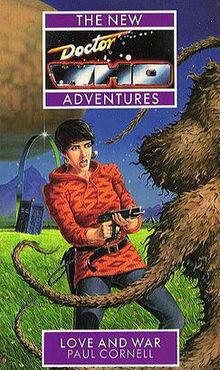
Shada by Douglas Adams (every year!)

The following review was written in Cambridge – in May, but not May week- unfortunately Northern Rail were as confused as the TARDIS – faced with a new timetable boasting more trains, they panicked and decided to cancel most of their existing trains and in fact they now don’t seem to realise that they are supposed to be a train company any more, more that that is an optional extra to the other things they do (mostly cancelling trains). I also failed to persuade my partner to re-create the punting scene on the Cam in front of Kings. Something which I have to say has disappointed me more than it really should:

Wordsworth, Rutherford, Christopher Smart, Andrew Marvel, Judge Jefferies, Owen Chadwick.
Who?
Owen Chadwick. Oh, yes. Some of the greatest labourers in the history of Earth have thought here.
Newton, of course.
Oh, definitely Newton.
For every action, there is a equal and opposite reaction.
That’s right.
Oh, yes. There was no limit to Isaac’s genius.

‘Shadaaaaa’ (old school Tom reference for those who don’t get it!), for a story that never made it to air, it is curiously ubiquitous. I first saw footage from it at a convention in Birmingham 1982, then the clips used on Children in Need night 1983 as part of ‘The Five Doctors’, then large chunks of it were reused in ‘Dirk Gently’s Holistic Detective Agency’ (1987), there was the VHS release in 1992, the rather wonderful Big Finish audio with Paul McGann and Lalla and James Fox playing Chronotis (2003), the DVD re-release (2013) and the Gareth Roberts novelisation. (‘Hello Honytonk’ – Gareth channeling Dick Emery in one of the finest reactions to a ‘Doctor Who’ villain ever!) (2012). And so you would think I would know it pretty well by now. With this in mind, when ‘Shada’ came along this time around, I must admit it caught me flat-footed, feeling rather ambivalent. It has taken me a while to buy it and watch it – I thought I knew everything about the story, why did I need another version? Well as it turns out, I was completely wrong and the new Blu-ray is a little thing of wonder and beauty and made me really fall in love with the story. It cheered me up in all of it’s 1979ness and while 1979 might be more of a table wine, sometimes your best times are with a rough bottle of French red and some old friends.

The story of ‘Shada’ and its cancellation are well known and covered very well in the documentaries on this and the DVD release, so I won’t dwell on them. It is such as shame though, whilst I don’t think the story is in the upper echelon of Who stories, it is clever, literate, fun and thoughtful. It manages, like a lot of Douglas’s work, to be very clever and deeply silly at the same time. It would also have rounded off season 17 very nicely, poor old ‘Nightmare of Eden’ and ‘Horns of Nimon’ had their budgets cut to the bone so that ‘Shada’ could be afforded, only to see that cancelled. Graham Williams and Douglas Adams sadly bow out on a partially complete story that can’t be transmitted and a final complete story which was never intended to be a finale which is stylish in places, but desperately cheap and shoddy in others.

The decision to set the story in Cambridge is inspired. It provides a beautiful location, actually on that subject I wonder why ‘Doctor Who hasn’t done this more often – why Bath or Edinburgh or Oxford or other similar British locations have never featured? It also fits in with a story that Douglas Adams apparently once pitched called ‘The Doctor Retires’, re-imagining this story as another eccentric, old Time Lord instead. The choice of location is astute though – Douglas Adams and Cambridge fit each other like a glove, he was born there in 1952, he went to university at St Johns College, graduating (his academic efforts sound rather like the Doctor’s) in 1973. So Cambridge is part of his DNA and it is unsurprising therefore, that when faced with another gap in the schedule to fill, that he would turn to what he knew, imagining that a Tine Lord could easily retire to rooms in a college at the university for hundreds of years without being disturbed.

I’d always imagined that the Doctor would do exactly that – retire like Holmes to his bees in Sussex or Quatermass to the Highlands. The references to Cambridge alumni are a pleasing mix of the obvious and obscure. Just what percentages of internet searches for Owen Chadwick and Christopher Smart are from ‘Doctor Who’ fans do you think? Douglas misses some of the more obvious scientific alumni – Paul Dirac or Roger Penrose (from his own college ), Alan Turing, Watson and Crick or Darwin and from the world of literature his choice is massive Kit Marlowe, E.M Forster, A.E. Houseman through to Terrance Dicks! Can you imagine it :

’Terrance Dicks’
‘Who’
‘Terrance Dicks, one of the great novelisers (sic) of our time. Oh yes there was no end to Uncle Terry’s genius!’
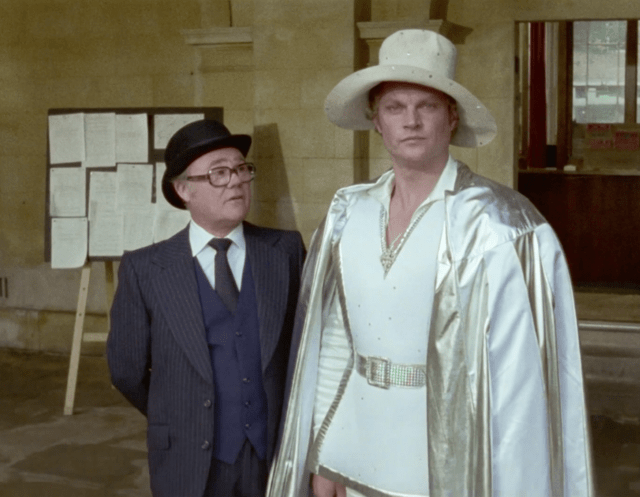
So the plot, well retired Time Lord Professor Chronotis has brought back the ‘Worshipful and Ancient Law of Gallifrey’ back from his home planet and this artefact of Rassillon, possessed of immense powers is now sitting on his bookshelf in his rooms at St Ced’s College Cambridge. Two students – Young Chris Parsons (surely the everyman Douglas Adams representative in this piece) and his friend Claire Keightley (‘it’s Claire’, sigh) are dragged into this world, as Chris accidentally borrows the book. Teutonic, duelling scar sporting sci-fi nutter Skagra is also looking for the book. We get to visit Cambridge, a scientific station in the future, an advanced invisible space ship, two TARDISes, the vortex and the Time Lord’s own prison planet later and a plot that involves possession, mind extraction and an awful lot of tea! I have to say I prefer the scenes in Cambridge, but the bouncing between locations does at least allow the plot to stretch to 6 episodes, as does the sheer brio of Adam’s storytelling and dialogue and the relationship between the Doctor and Romana (or Tom and Lalla for that matter).

Fables of the reconstruction

So what do we gain from the animation/audio reconstruction here? Well most obviously we get the whole story, with the original cast. It tells the story in a way as close to the original intent as is currently possible. In the VHS/DVD release there are big gaps in the story, with bits of narration from Tom, which while entertaining in their own right, mean that we don’t hear or see whole chunks of the story. The animation works fine for this, surprisingly well actually – it never feels jarring for me when the actual footage switches to animation. And well, if techniques and costs improve in the future and there is still interest, at least a full audio recording of the story now exists. The effects are sympathetically done by Mike Tucker and his team, fitting the original footage. The same is true of the incidental music, which feels authentically season 17 – the main cue obviously referencing Dudley Simpson’s work in ‘City of Death’. We also get the bonus of an opportunity to say farewell to Tom in his scruffy, battered, yellowing, but still magical old TARDIS, in his old season 17 costume. Now for a lot of people this won’t mean much, but for the generations that grew up with Tom, it is almost unbearably poignant – more of that in the next part.

Skagra and the Universal Mind
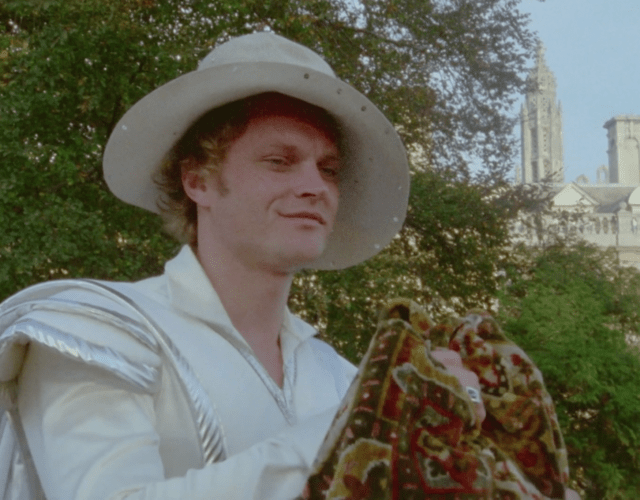
That title sounds rather like a 70’s prog-rock band – which is rather appropriate, since Skagra dresses in a silver/white jumpsuit and cape combination that Rick Wakeman would be proud of – well it is part prog rock parts early 80’s disco – Boney M also sprang to mind (references for the youngsters there!). I love the extra details of the carpet bag and white hat! Part way through Skagra decides he’s had enough of looking like he should be on a Eurovision stage and changes instead into Man at C&A (another youth reference – I’m on fire today – down with the millennials). Christopher Neame though does a surprisingly good job on this – he is hugely camp, vain and arrogant, but he never pushes this too far – dialling it back just enough to fit the tone of the piece and hold his own with the 3 Time Lords here. I can imagine Colin Baker in the role, but maybe going a bit too large – like his turn as Bayban the Butcher in Blake’s 7.

Skagra is apparently a:

‘Geneticist, astroengineer, and cyberneticist, and neurostructuralist, and moral theologian’

Moral theologian – he’s a complete ¤¤¤¤!

Skagra struts his way through the streets of Cambridge in his silver finery and floppy hat, deliberately being setup as the anti-thesis of the Doctor – humourless, nasty, hugely arrogant and representing order and uniformity. His sentient ship is rather nicely done as well, although I preferred the rather breathy Hannah Gordon version from the BF audio. There are some nice moments between the ship and the Doctor ‘Dead man do not require oxygen’ and then her gushing that ‘He has done the most extraordinary things to my circuitry’. His Krargs however are really quite rubbish – fitting in with the overall season 17 vibe of the Mandrells, Erato and Nimon. There is quite a bizarre scene – I don’t know if it just very poorly directed or whether the unfinished nature of the piece plays a part in it, where the Krargs attack the scientists and the Doctor and Chris basically run away, which then cuts to a corridor scene of Chris pulling the Doctor out of the room by his legs. It is just really odd.

‘The universe shall be me’

The book provides the key to Shada – the Tine Lord prison planet. Skagra is working on mind transference and wants to travel to Shada to take the mind of Salyavin, a Time Lord who could transfer his mind into anyone else’s at will. Skagra wants the whole universe to have his mind, to be him and think his thoughts – the ultimate in Aryan supremacy and ethnic cleansing – everyone becoming Skagra and thinking his thoughts. Its’s a pretty scary thought and one thing you can’t accuse Skagra of is failing to think big. In some ways it reminds me of the Master and the immortality gate in ‘The End of Time’ – the whole world replaced by the Master, so maybe it isn’t only Douglas Adams that can re-use his unused ideas.

‘He stole our brains!’

Which is one of my favourite quotes from ‘Doctor Who’ – it is the use of the word brains rather than minds that sounds brilliantly schlocky. Anyway, to facilitate all of this the story features that old ‘Doctor Who’ standby – the machine – in this case the sphere which extracts the mind of it’s victims and then stores them somewhere handy for Skagra to access. Later we’ll even have a mind battle with the Doctor wearing a colander with wires attached, in a similar fashion to ‘Web of Fear‘ or ‘Brain of Morbius‘. Along the way the sphere attacks not only the scientists at Think Tank, the Doctor and Chronotis, but also some poor bloke (who can’t act) fishing and the driver of a car, who Skagra presumably strips of his clothing for his new beige look. More frightening than the sphere or Skagra and his mad plan though is Salyavin and the way he casually takes over and augments Claire’s mind to help jump-start his TARDIS.

PARSONS: Let me just get this right. You say that he just, well, just walked into your mind?
CLARE: Well, sort of. It’s as if he just barged in through the front door and started shuffling all my thoughts about.

He goes from lovely, bumbly, eccentric old Professor Chronotis to Salyavin in an instant – in retrospect that scene rather reminds me of Professor Yana switching straight into the Master in ‘Utopia’, dead fish eyes and all. Salyavin/Chronotis is past all of that though – but it is interesting to see how much of the old Time Lord Criminal is still in there – the eccentric old professor act is just that – an act.

The Ballad of Tom and Lalla
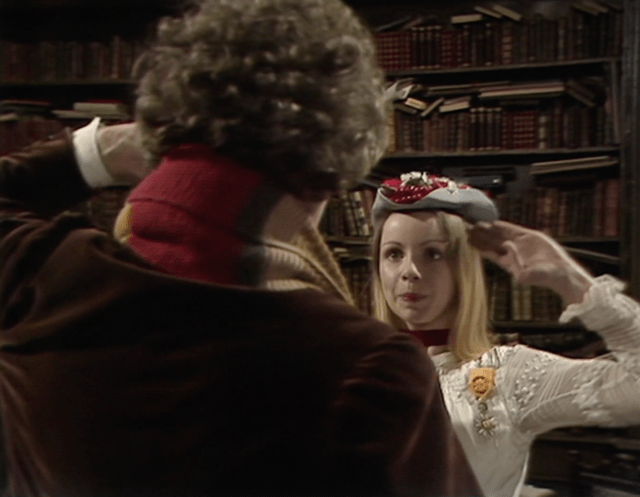
This TARDIS team, are quite wonderful at times, but it is sometimes difficult to know where the Doctor stops and Tom begins and likewise Romana and Lalla. I think they both recognise that now, that the fiction of the show and their real lives just became a bit too entangled together. It works wonderfully on screen though. Although he sometimes complained that the cast took the material too far, Douglas Adams was lucky with the characters and actors that he inherits – Tom and Lalla at this particular moment in time are perfect for this sort of smart, breezy, literate story-telling. Their relationship feels more complete than any of Tom’s other companions – Sarah aside – it is different than that though less best friends and more like partners. It feels like a variation on ‘Doctor Who’s take on Steed and Mrs Peel. Sometimes smart and clever, almost flirtatious sometimes child-like, whatever it is a winning combination.

What is interesting about Tom’s performance in this version of the story, is that in the studio sessions for the additional visual scene, he seems rather infirm and ensure, but when sat down in the audio sessions the sheer force of his personality is almost overwhelming. His voice is steady and clear and he just sounds like his old self, his performance by turns commanding and silly. I shouldn’t be surprised, I listen to most of his Big Finish performances and last saw him in person at Excel in 2013, he was on good form despite looking quite frail in ‘The Day of the Doctor’. Lalla, I last saw reading poetry with Richard Dawkins at Ledbury Poetry festival last year – she always had a slightly superior, forceful, haughty quality to her voice, mixed with the girlish quality that has largely been lost over the years.

I think my new favourite scene in Shada, is the one where the Doctor pins a medal in Romana’s blouse and they salute each other – they look utterly in love at this point – both thinking how wonderful the other is, Lalla/Romana beaming and Tom looking at the camera, as if to say wow, I am one lucky bugger.

In that vein, ‘Lalla – A bit more poise on Saul Bellow!’ is possibly the best stage direction I’ve ever heard! It is very BBC, a time when even cheap sci-fi fare for children was made by intellectuals! The studio sessions are well worth watching, hidden amongst them is something that stirs memories almost as long ago as the cancellation of Shada itself. 1982 I think, when JNT brought the remains of ‘Shada’ to the Panopticon V convention in Birmingham – in my memory they still had the timecode running on them – or maybe I’m mistaken. There is a moment, placed here in the pre-titles sequence, when Caldera and the other Monty Python type scientists are given the stage direction ‘Writhe!’ – cue much twitching and kicking of legs – dying fly style. I can still remember the hall erupting with laughter at that point! It is brilliantly rubbish in a way that only the Graham Williams era can really do. Ramshackle, funny and sometimes very, very clever – it is unique really and the older I get the more I appreciate it.

Claire and Chris

As a neat counterpoint to the Doctor and Romana, we have Claire Keightley and Chris Parsons. Both of whom are very intelligent physics students at Cambridge doing research, but end up mostly running around after our two Time Lords or the Professor looking a bit lost. Or at least until Chronotis upgrades Claire’s mind. Chris, I suspect is Douglas’s identification figure in all of this – his Arthur Dent equivalent, but that slightly gets lost in the TV narrative as this is a story about ‘Doctor Who’, not Chris Parsons. The Gareth Roberts book revolves much more around Chris and Claire and there is quite a bit around their not quite on relationship – of which there are hints in this, for example ’It’s Claire’, sigh as Chris calls her ‘Keightley’. He writes their relationship in a similar manner to Craig and Sophie from his story ‘The Lodger’.

‘Just one little bit of timelessness and spacelessness over there behind the tea trolley.’

Hitchhikers and Dirk Gently both routinely feature the juxtaposition of bizarre science, philosophy and big universal sci-fi concepts against the backdrop of the exceedingly ordinary -tea, towels and sofas wedged in stairwells, council planning departments and telephone sanitisers. And we have that again in ‘Shada’. The Professor’s rooms are actually his TARDIS and the quote above is a prime example of this – the Doctor trapped in Chronotis’s TARDIS gets Claire and Romana to open up a corridor to his own TARDIS, which is being piloted by Skagra – with an entry point just behind the tea trolley. All of which just feels like classic Douglas Adams. This sequence in the old version was set against the background of Tom’s time tunnel title sequence as the space/time vortex – although it didn’t look great, I quite missed that in the new version. The end scenes featuring the policeman, Wilkin and the Professors disappearing room and then the dematerialising TARDIS are another example of this juxtaposition.

Overall, the structure of the story quite reminded me of ‘Stones of Blood’ – it starts out as a story of strange goings on in English location with an eccentric older academic and then switches to something else – a space station in hyperspace or Shada and both have a plot strand around justice and how it is served. If the final episodes of ‘Shada’ had been completed, we would even have had some tatty old monster costumes dragged out of retirement to represent the inmates, again similar to ‘Stones of Blood’ and the prison ship in hyperspace.

Living life trapped with a Doctor Who fan

Ultimately the story is one of the triumph of individualism and plain silliness against uniformity and humourlessness. It is a familiar theme of ‘Doctor Who’ – the replacement of the individual self, of free will and self-determination with order and logic and tyranny – fascism basically. It is a particular theme of the Troughton Era – the Cybermen, Macra or the Master Brain – but it also runs across the history of the series – WOTAN, BOSS or the Infinity Gate. In the end, rather appropriately Skagra isn’t killed or destroyed or placed in a cell in Shada and left to rot – instead he is trapped with a ‘Doctor Who’ fan for eternity. I suspect that our loved one’s might slightly know the feeling!

SHIP: I am very much afraid I can no longer accept your orders. You are an enemy of my Lord the Doctor.
SKAGRA: I am your lord! I built you! Release me, I command you. And launch instantly!
SHIP: Do you know the Doctor well? He is a wonderful, wonderful man. He has done the most extraordinary things to my circuitry.
SKAGRA: Release me!
SHIP: Truly wonderful. If you like, I will tell you all about him.
SKAGRA: Let me out! Let me out!

I was recently wathching The 5ish Doctors, which is rather wonderful. That end scene of ‘Shada’ now reminds me of Colin Baker’s family, locked in, being forced to watch one of his stories! I wonder how much our respective parters feel slightly like that at times. I was struck by the similarly slightly ‘ah bless’ sense of indulging a small, slightly over-enthusiastic child that many partners of Doctor Who fans must have. Anyone else recognise that? Anyway, so instead of universal domination and uniformity and order, Skagra is trapped with someone extolling the virtues of his nemesis – that exponent of individualism, freedom and anarchy – the Doctor, which is almost the exact opposite of what he wanted, rather a fitting end from one of the least appealing of ‘Doctor Who’ villains.

Elsewhere, you suspect that Chris and Claire might possibly get together, Chronotis is alive again and still happily making tea, Wilkin gets to upset a policeman, the Doctor and Romana and their dog are off travelling the universe and all is right with the world. But it isn’t really – dark days are coming for Tom, next time we’ll see him he will be asleep in a deckchair on Brighton beach, looking ill and much older, his hair will have lost its curl, entropy taking effect, Romana will be off making her own way in the universe (as will Lalla) and eventually the Fourth Doctor will die surrounded by young strangers, crushed by a fall from a radio telescope, but all of that is for next year, for now the party is still in full flow.

…But there is more from this release. For one last time, Tom dons the scarf and gives us one last mad speech.

For a generation of us, who grew up loving Tom’s Doctor, that is almost unbearably poignant – it is simultaneously joyful and a slightly sad marker of the passage of time. Redolent of a time when we were all Time Tots – sorry a bit crap that line I know – but I couldn’t resist!

So thanks Douglas, Graham, Tom and Lalla and to all of the team who worked to create and then re-create ‘Shada’ as best they could so many years after it was scrapped. It cheered me up and made me happy for a while and you can’t ask for more than that.

Douglas Adams and the fundamental interconnectedness of all things

I love deadlines. I like the whooshing sound they make as they fly by.

Hundreds of people who’ve never written before send in ‘Dr. Who’ scripts. They may have good ideas, but what they fail to realise is that writing for TV is incredibly complicated. They have no idea how difficult it is and what the financial commitment is.’

I seldom end up where I wanted to go, but almost always end up where I need to be.’

(sound familiar that one?)

When Douglas Adams wrote ‘Pirate Planet’ and ‘City of Death’, I was a youngster – 9 or 10. I didn’t know who he was, his name would have flashed up on the opening credits, but he wasn’t Terrance Dicks or Malcolm Hulke and his name wasn’t on a Target Book spine, so how would I know him? Robert Holmes was still a mystery after all. By the early 1980’s I knew who he was – he was the man who wrote ‘Hitchhikers Guide to the Galaxy’, my new almost favourite thing on TV and in all sorts of odd and unexpected ways he has wound like a thread through various aspects of my life.

Surely most people would agree that apart from being very funny, Douglas was also a very clever fellow? OK, he wasn’t good with deadlines, often had writers block and tended to reuse things when he was stuck (like a lot of Shada in Dirk Gently for example) – he certainly isn’t alone in that though. On the other hand he was a wildly inventive polymath, able to write and talk about an eclectic range of subjects and someone that his many friends agree was great company. In his work we get science, humour, politics, literature, philosophy and a great deal of original, often lateral thinking. In some ways Douglas, despite often being represented in his own work by an everyman figure, was very like the Doctor.

When Robert Holmes received the story outline for ‘Doctor Who and the Krikketmen’ – I think he probably knew there was talent there – but wild and undisciplined, something that would take a too much hard work to hone into a workable script. Anthony Read also recognised that talent and with a dearth of scripts available, he gave Douglas his chance to write ‘The Pirate Planet’. By some strange quirk of fate he was soon the show’s script editor. Whilst Douglas’s stories have sound plots and structure – surely the requirements of a script editor include being able to deal with deadlines and imposing discipline on writers – Douglas might have been the least qualified person on the planet to do that! However, one way or another, in a very British sort of way it all vaguely works in a haphazard, slightly ramshackle fashion Something that I appreciate much more now than I ever did in my younger years.

I think quite my favourite extra on any Who DVD is part of the ‘City of Death’ extras It is an ‘interview’ with Douglas from his garden, while he has a beer and tells a story. It is the story about an ad-hoc trip he and director Ken Grieve did to Paris when the rest of the crew were filming ‘City of Death’. Feeling left out, they made their own way over, on arrival they found Tom staring into Lalla’s eyes and an exhausted crew not really up for a night on the tiles. What followed was what we used to call a ‘large’ night out and once they’d run out of Paris nightspots an attempted trip to West Berlin in the early hours! Adams even made it back to TV centre for work the next morning, taking great delight in telling everyone that it as one of those nights when you find yourself in Paris at 4am!

Aside from ‘Doctor Who’, one of my other main interests is wildlife conservation. I’m lucky enough to have travelled with and to know someone who knew Douglas well, having travelled with him and showed him species around the world that were threatened with extinction. What was initially a single article on the wonderfully bizarre Aye-Aye of Madagascar in 1985, became a radio series and eventually the book ‘Last Chance to See’ in 1990. It took Douglas Adams and zoologist Mark Carwardine to South America, Africa, New Zealand and Asia to look at the state of a series of endangered species and some of the conservation efforts or sometimes lack of effort to conserve them. The species ranged from the Northern White Rhino, the Aye Aye, the Baiji, the Kakapo, Komodo Dragon, the Juan Fernandez fur seal, Mountain Gorilla, Mauritius Kestrel and Rodrigues Fruit bat. It also lead to some brilliant stories about Douglas – the book was predictably very, very late (barely started) and had to be finished in a hurry after a trip to a villa in the South of France, supposedly to knuckle-down and finish it resulted in one extra page! Those travels also converted Douglas to become a life-long conservationist, working amongst others with ‘Save the Rhino’. In the aftermath of his untimely death, I found myself at a number of the yearly ‘Douglas Adams lectures’ in aid of the charity and others including ‘The Diane Fossey Gorilla Fund’ – the guest lecturers are an eclectic mix from his friend Richard Dawkins, to Richard Leakey, Steven Pinker and Neil Gaiman.

Since the original ‘Last Chance to See’ there have been some positives – with for example the Juan Fernandez Fur Seal (which didn’t quite make it into the book) and what looks unfortunately like only a temporary increase in Mauritius Kestrel numbers, but sadly since then one of the species featured the Baiji (the Yangtze River Dolphin) has become extinct, the first and unfortunately unlikely to be the last cetacean extinction of the 21st century. The last male Northern white Rhino also recently died, sounding the death knell long-term for this sub-species. If you haven’t read ‘Last Chance to See’, I would strongly recommend it, to my mind it is Douglas’s finest hour – the radio series is also very entertaining if you can find it, as is the follow up series from 2009 when Steven Fry (a friend of Douglas’s) joined Mark Carwardine to find out what had happened to some of the species since the original trip .

Personally it has in part shaped my life, studying conservation and influencing my own travels. Like Douglas, I’ve also travelled with Mark to quite a few places and had some great times – snorkelling with Whale sharks and Manatees, Whales and Dolphins, travelling down to Antarctica and seeing Narwhal in the North West passage. It’s been a joyful part of my life and I’m not sure it would have happened without Douglas and ‘Last Chance to See’. Instead of Svalbard where I should be right now, I am I writing this rather appropriately from Cambridge, where Douglas was born and went to University. More of that later.

‘The knack of flying is learning how to throw yourself at the ground and miss.’

We lost Douglas far too young. I wonder if he would have written for the show again? I can’t help thinking that Russell would have at least asked him back. Imagine that – commissioned for series one, deadline passes, series 2 definitely, erm maybe, can you change Rose for Martha – great, oh maybe better make it Donna, look how about one of the specials? Oh well, it’s a nice dream. If only Douglas hadn’t discovered the gym – the ultimate sad irony. He is much missed and the world is a much sadder place without him.

Anyway, one of the marvellous things about ‘Doctor Who’ is the breadth of storytelling styles and techniques used. Sometimes you feel like something dark and scary, sometimes an alien invasion of earth, sometimes something touching and emotional and sometimes you just want something very silly indeed. When that happens then Douglas and more especially Season 17 is always there for you – a bohemian piss artist, his beautiful, intelligent, accomplished and rather posh female friend and their know-all robot dog – in adventures with a flying robot parrot, a giant green penis, monsters with flares and some blokes in black tights balancing on high heels in a ramshackle panto featuring Malcolm Terris’ underpants. Whilst we’ll always have Paris, we’ve never quite properly had Cambridge until now – my next review is the newly animated ‘Shada’.

Deadline by Rob Shearman (2003)

I so much wanted to be a great writer, Philip – an artist, a genius. It’s what geniuses do. Wagner, Picasso, Dickens, had affairs, treated their wives, their children like ¤¤¤¤. They had the right. I wanted to be like them, rise above the right and wrong. Only the art mattered. But the thing is, I was wrong. I wasn’t a genius. I didn’t produce the Sistine Chapel, I produced 14 episodes of Juliet Bravo. I gambled my family away on a dream of posterity when it turns out I was a hack all the time. I could have had a family, could have had a grandson, all these years.’

I’m a nice man, Dad. I could be really worth knowing.”
“You kill guinea pigs.”
“It was only a little one.”

If you wanted to see me, you could have called! You didn’t need to set rodents alight!’

‘A universe without the Doctor, it scarcely bares thinking about…’

So, from a story where the Doctor never left Gallifrey (‘Auld Mortality’) – to a story where the pilot script was never filmed. Imagine that, where would we be, what would we be doing? Maybe reading the official ‘Juliet Bravo Magazine’ and marathoning all 6 series from the very beginning – in order of course, so you can properly experience it how it is meant to be seen and chart its every progression, apart from a few of us who like to watch them all jumbled up like crazy paving. Arguing about which incarnation of Juliet we liked best – Stephanie Turner or Anna Carteret and whether re-casting her as a man for the new series is a good idea or not.

We would still be writing in praise of the classic Robert Holmes episode – ‘A Breach Of The Peace’ (with Bernard Horsfall and Alan Lake) or his prodigy Chris Boucher ‘Where There’s Muck…’. And stories directed by Christopher Barry, Pennant Roberts, David Maloney, Graeme Harper, Tristan DeVere Cole, Peter Moffat or the great Ron Jones. The latter would probably make one of the great directors of a ‘scientific romance’ in my view – if only he’d had the chance. Martin Bannister though, whatever happened to him? Maybe Benjamin Cook can track him down for an interview after all these years?

Derek Jacobi is the Doctor

Oh the possibilities again. What if Doctor Who was played by Derek Jacobi, or written by Martin Bannister (author of 14 of the worst episodes of ‘Juliet Bravo’) or was never commissioned at all? Well after the glories of Hannibal and the Alps and the infinite possibilities stretching out before us – the ¤¤¤¤e of real life descends and crushes them all under its boot – thanks Rob! This play (it is a play – it could easily have aired on BBC Radio 4) is a black comedy, ‘An Adventure in Space and Time’ written by Pinter or Ayckborn or possibly Rob Shearman. All misunderstandings, loss, a longing for something better and people just missing each other and left alone and unhappy and slightly bitter.

Martin is based on 3 people I think – Robert Holmes, who wrote for ‘Juliet Bravo’ (like Rob Shearman I have a hard time believing that he wrote ‘normal’ stuff as well), Christopher Bailey – the ‘Holy Grail’ of Doctor Who interviewees, who Benjamin Cook tracked down to interview for DWM (issue 327 in March 2003) which is mirrored in one of the scenes here, where Martin is disastrously interviewed for ‘Juliet Bravo Magazine’ and Rob Shearman himself – a playwright and winner of the Sunday Times Playwriting Award, and his plays ‘Breaking Bread and ‘Easy Laughter’ are referenced as Martin’s work here. Martin isn’t very nice though – a misanthrope, who has let down his family in the hope of creating great art, misjudged everything in his life and achieved little in return – ultimately ‘Juliet Bravo’ was the pinnacle. The comedian Dylan Moran once talked about ‘releasing your potential’, he said ‘stay away from your potential, it is potential leave it alone – it’s like your bank balance you never have as much as you think’. Every writer must have that moment surely? Or every actor who ends up in a corporate video or advertising a treatment for vaginal dryness, incontinence pads or funeral insurance (never watch the ‘Drama’ or ‘Yesterday’ channels in the UK – the adverts will slowly send you insane). While your potential is locked away in a room untapped you can always pretend that it exists, or like some other things in life it is larger than it actually is – if only you’d had the breaks. To those who try by the way, I have every respect – at least you give it a go.

So, it is 2003 and Derek Jacobi is playing Doctor Who (well almost) – any idea how thrilling this was? We hadn’t had Doctor Who on TV for 14 years and when we had, well lets just say that no matter how much you loved them, the last couple of incumbents (McGann excepted) weren’t really at the highly regarded end of the acting profession spectrum, never mind the pinnacle. To hear Derek Jacobi say ‘Close the doors Susan’ or ask whether you have thought about ‘building castles out of alien sand?’ was and still is utterly thrilling.

As thrilling as was the announcement months after this that Christopher Eccleston had been cast as the new Doctor. I had seen Jacobi on stage a few times before this and he was never less than mesmerising. Years later I think the best performance of his, at least that I saw was as Lear in Michael Grandage’s 2010 production at the Donmar Warehouse. He speaks very highly of Doctor Who as well – along with Coronation Street it was always something he wanted to be in. I saw him interviewed a few years ago at the Cheltenham Literary Festival, he was a very engaging and rather humble person and very happy to talk in amongst all that he has achieved, about playing The Master. This was all before or of that – and before his excellent performances of the War Master for Big Finish, if only it had also been opposite John Hurt as the Doctor – I think at that point you could just cancel the programme and I would be happy.

Jacobi is superb here as Martin, from raging misanthrope, disappointed and bitter – a failure as a writer, husband and father to a lost, confused old man, hoping for a new beginning with his newly found grand child to TV’s Doctor Who, travelling with Susan, Barbara and Ian back in history or off to alien worlds. Those opening scenes with Jacobi as Martin interjecting authorial notes (almost in the manner of Sydney Newman) over re-worked scenes of the Doctor meeting Ian and Barbara for the first time are superb (‘lets just assume that unless I say otherwise he says everything mysteriously’). They bleed into a nurse waking Bannister at a care home (‘you really are a mucky pup aren’t you?’), switching effortlessly back to fantasy with a mysterious green stain in his room (alien intervention or just a sad inevitability of life in a care home?) ! Or the visitor to the home – is it Ian Chesterton or Philip, Martin’s estranged son?

All of this bleeds together so that we are never sure which is fantasy and which if anything is real. Doctor Who is Martin’s escape from reality, the programme that got away – Ian Chesterton is blurred with his son, Barbara Wright his nurse and his wardrobe leads out into other worlds – back to the time of Hannibal (a nice link to ‘Auld Mortality’, along with musings on the life and imagination of writers , which was a few releases before this one) or a the dead planet of the Supreme One (a play on The Perfect One from ‘The Masters of Luxor’ possibly combined with the Zarbi Supremo from the first annual?). Or possibly it is just a wardrobe, in a care home where a fallible, lonely, slightly bitter old man lies in bed?

‘The horrors of isolation’

‘I am a good husband, a good father, I work really hard at it, I’m better than you. I decided I’d do everything better than you – for me it would work, I’d do everything different. Whatever you did, I’d do the opposite. A good husband – I’m good at it – I won’t find it funny when my wife dies. I won’t make stupid jokes. And if my son ever told me he hated me, because I do, Dad, I really hate you, if my son ever felt about me the way I feel about you, I’d die of shame.’

The scenes as Philip, Martin’s son visits him are a mixture of the really uncomfortable and absurd. Martin left his mother and him when they were young, after a string of affairs and to concentrate on his writing. This all makes quite painful listening. At first Philip tells us that the hates his father and has grown up to be everything his wasn’t – that he has a great relationship with his own wife and son. This façade crumbles as it becomes clear that Philip’s wife has left him and his ‘every other Saturday’ relationship with his teenage son isn’t all that great. We then have the absurdity of Philip pretending that his Mum has died, as an excuse to see his father again – the ashes of a dead Guinea Pig taking her place.

‘You were crap and I’m crap too!’

When Martin does meet his grandson Tom, the teenager spends all of his time playing computer games and is sick of people (like his Dad) trying too hard to be friends with him. All of this mundanity – the basic daily grind of being in a family, relationships that fray or fall apart, things said that should have remained unsaid that aim to hurt. In the end, maybe Martin just prefers ‘the horrors of isolation’ of his plays and the home he lives in and his fantasy world of TARDIS’s and time travel to all of this? I would suspect that we’ve all done this before – used the programme as an escape route? Whenever life is crap – well ‘City of Death’ works quite well to cheer you up, no matter how crap life life gets we’ll always have Paris.. or Vortis or Devil’s End, take your pick.

‘We are so alike, we write, we have bladder control…. We’re kindred spirits’!

The other main cast member here is Jacqueline King (years before Sylvia Noble) as Barbara Wright – who is either the nursing home carer or a history teacher who travels with Doctor Who. She is very good in this – playing the loneliness and bitterness of ‘real-life’ Barbara. When she finds out that Martin is a writer she subjects him to her poetry (we’ve all been there), even here he misreads her signals and loneliness – her desire for friendship for something more and manages to make a mess out of this too. The whole play is basically about missed connections and opportunities – between people and also in the case of a lost TV series and a life for Martin that never was.

‘That’s just bonzer!’

One of my favourite parts of the play is when Sydney Newman suddenly appears to Martin – who can’t remember if he was Australian, Canadian or American – so his accent wanders all over the place ‘bonzer!’ He’s going to bring back Doctor Who on the 40th anniversary of it not being made! No bug-eyed monsters though. And this is where I think Deadline is very clever – this is our creation myth – Sydney Newman, Donald Wilson, Verity Lambert, David Whittaker, Mervyn Pinfield, Waris Hussein, Anthony Coburn – and all of the others – the cast (present and absent) of ‘An Adventure in Space and Time’. ‘Deadline’ subverts that – reduces it to a possibility – Sydney Newman and Martin Bannister – with a mention of Verity, the vagaries of memory or the flights of fancy of an old and dying man.

Hiding in a wardrobe

Deadline’ is itself a clever title referencing the fears of an author and the time of life that Martin Bannister finds himself in – shuffling slowly towards the exit. Unfulfilled potential or potential that never existed. Is it all a fantasy, is Martin a fantasist, deluded, losing his sanity or dying or just a lonely old writer filled with regret and self-loathing? Whichever way, it is bleakly funny, unnerving, sometimes uncomfortable, awkward, absurd and sad, a bit like life really. Doctor Who as a fantasy escape from the bleakness of reality – surely that applies to all of us to some extent doesn’t it? As it is, we are left at the end of ‘Deadline’ with an old man hiding in a wardrobe in a care home, exploring the universe with the grand daughter that he never had.

Deadline’ seems to be quite a divisive play, unusually I had a scan of the reviews of this story out of interest and I think that is pretty much borne out by them. Some seem to absolutely revile it – even going as far as calling it disgusting and some love it, I’m not sure if there is a middle ground with this one. I am in the latter camp, as a one off piece I think it is beautifully performed, absurd, dark, uncomfortable and very clever, but I wouldn’t want to revisit it that often as with that pathos is a sort of self-loathing and bitterness – an edge that you don’t often find with Doctor Who. It works for me – I could imagine why it wouldn’t for everyone. For me it is clever and interesting, rather than necessarily something to completely love and cherish – for that we now have ‘An Adventure in Space and Time’. If the new series hadn’t been announced just as ‘Deadline‘ was released and we’d never had John Hurt or Christopher Eccleston or Michael Gambon or David Suchet or Claire Bloom or Simon Callow or Carey Mulligan or Bill Nighy or Lesley Sharp or David Morrissey or any of those other amazing performances – at least for one moment in 2003, we had Derek Jacobi playing the Doctor and he was fantastic!

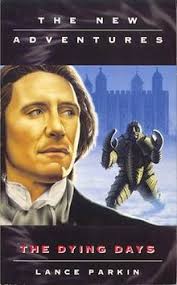
The Dying Days by Lance Parkin (1997)

‘Today, after over twenty years, the human race returns to Mars. This would be a cause for celebration regardless of which nation had got there. But it isn’t, I am sure, jingoism to suggest that we are all particularly glad that it is the United Kingdom that got there first.’ – applause – ‘Twenty years ago, the British space programme was a clear demonstration that our country still had the know-how to be a world-beater. I was a young man when Grosvenor and Guest planted the Union Flag at the foot of mighty Olympus Mons. My heart still swells to think of it: British astronauts staring up at the mightiest feature of the solar system, a mountain almost three times the size of Everest’

‘London. This is Mars Lander. We’re down and safe.’

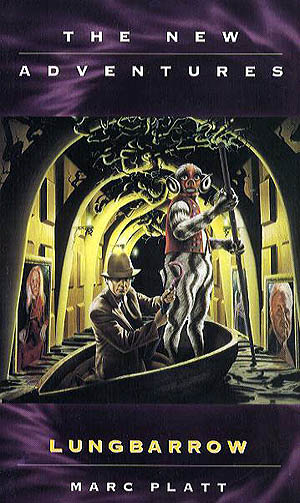
So, ‘The Dying Days’ is the final Virgin New Adventure book to feature the Doctor (the series continued for a while with Benny) – the BBC having taken the licence back in the aftermath of the TV Movie. The story fits after ‘Lungbarrow’ and also after the TV Movie – although to my mind I prefer to think of it as an alternative Eighth Doctor introduction story (the Big Finish adventure ‘Storm Warning’ also fulfils this role admirably). What feels like an age ago, I covered the ‘TV Movie’, as positively as I could, I could equally on a different day have posted something very similar. I think my perspective on the ‘TV Movie’ comes from years of enjoying the Eighth Doctor at Big Finish and at least some of the books. If ‘The Dying Days’ is what we could have had instead, well I take it all back – give me some of this please, as it exactly the sort of story I love – contemporary Earth, an invasion of London, echoes of ‘Ambassadors of Death’ and future echoes of ‘The Christmas Invasion’.

The Dying Days’ is set in swinging 90’s London, features an Ice Warrior invasion of Britain, lots of political intrigue and action, Benny, the Brigadier and a politician who bears a strong resemblance to Francis Urquhart from ‘House of Cards’. It is terrific stuff and British to the core – in many ways it is by design the anti-TV Movie. I could imagine it as a 90’s TV mini-series – maybe striped in instalments across a week like Torchwood ‘Children of Earth’ or a British version of ‘V’. The title is redolent of a few things – the end of the Virgin range (‘Licence Revoked’ was another possible title), an original version of the story that would kill the Doctor, the dying days of the 20th century and a Tory regime, but also the dying days of Mars a planet with more past than future and a race whose days are numbered without access to new resources. It could also refer the dying days of empire – there is more than a whiff of Brexit about this story – more later.

‘Things can only get better’

To talk about ‘The Dying Days’, I feel that I have to talk a bit about 1997, about what that year meant – because well, the story is suffused with the 90’s and manages in some ways to pre-figure what was about to happen a month after its release. The timing is almost as perfect as ‘Monster of Peladon’ and the ’74 miner’s strike. This feels very relevant to the book for me, but it is also quite self-indulgent (again), so skip if you want to:

Back in 1997, a band that later included the future Professor Brian Cox told us that ‘things could only get better’ and to be fair they only could. Let me paint a picture of Britain at this time – a chronically underfunded rail system – which would eventually lead to people dying pointlessly in a series train crashes and derailments, winter after winter where the health service couldn’t cope and people died on waiting lists or on trolleys waiting for a bed, city centres full of homeless people, towns and cities in the north of England, Wales and Scotland where generations had been put out of work, without the hope of a better future. Everything was ‘efficient’ in the sense of it cost the taxpayer less, but nothing actually worked, even the things that did still just about work had no resilience and fell apart at the slightest sniff of a problem – a problem that took years to make better and is really becoming an issue again now. That year, many years too late really, Britain voted for change. To be fair aspects of the country had improved a bit since Thatcher had been deposed, but it was a hideously slow process under Major. Many of us had grown up despising and detesting politicians. In Doctor Who terms, I would have been with the crowd of the oppressed masses on the roof in ‘The Sunmakers’, cheering as Gatherer Hade was chucked off a very tall building. Not especially proud of that – but I mention it because it illustrates the strength of feeling against these people – they were evil and were considered as nothing less than the enemy.

1997 would change all of that (at least for a while), the sheer thrill of it – that night when all of the votes were spread along a table and it was clear that future of the Tory right -Michael Portillo (best known for his documentaries about train journeys these days – but a politician who was widely reviled at the time – a man whose father had supported the Spanish republic and despite that his son became a Tory) had been soundly beaten by a much younger Labour candidate Stephen Twigg. The Tories weren’t just out of power for the first time since I was 10 – they had been completely annihilated.

Why is that relevant to the ‘Dying Days’, well the spirit of that year suffuses the story and more directly, well somewhere on election night sat Tim Collins, a massive Doctor Who fan (he of the Earthshock DVD ‘Putting the Shock into Earthshock’ feature) and Tory MP (how does that work – answers on a postcard, talk about missing the point) reading ‘The Dying Days’ in an attempt to read all of Virgin New Adventures while there was still a Tory government. Yes, that’s right, the steadfastly left-wing and terminally ‘right on’ Virgin New Adventures – square that circle if you can. His world fell apart while reading this book. Even that attempt to salvage something from the General Election would end in defeat, as later that month, the much delayed ‘So vile a Sin’ was finally released – perhaps that was Ben Aaronovitch, whose father Sam was secretary of British Communist Party, final victory over the Tories?

So, in May 1997 the Blair government breezed in on a wave of optimism and Britain was suddenly hip again. Social occasions at No. 10 had guests like Noel Gallagher and Jarvis Cocker and one of my heroes, Alan McGee, head of Creation records – home to most of my favourite bands. This is all reflected in ‘The Dying Days’, not least at the party at the National Space Museum set off Trafalgar Square to celebrate British astronauts setting foot on Mars for the first time since the ‘Mars Probe’ days. Is there anything more 1990’s than a society event with the Spice Girls? Well yes, one that also includes Gillian Anderson, Jarvis Cocker and Chris Evans. Oh and the scientists Stephen Hawking, Richard Dawkins and his wife Lalla, Oh and Patrick Moore being interviewed alongside Bernard Quatermass, while Ralph Cornish looks on. Bernard is a curmudgeonly about the space programme as he was in the final instalment of the Quatermass and had his own brand of Martian to deal with in his time. These scenes are joyous – the Doctor even gets to talk to Jeremy Paxman!

The Dying Days’ is part ‘Ambassadors of Death’, part ‘V’, part ‘House of Cards’, part ‘X-Files’ and with a bit of Bond action thrown in. It is also a 90’s version of ‘War of the Worlds’ – a Martian war machine in the home counties – red mist substituted for red weed. Like the other Virgin novels that I have reviewed in this thread, it is a signal of something to come – in particular its use of contemporary news readers and reporters, it’s setting right in the heart of the capital and even some of the action set pieces feel very much like an influence on Russell T Davies’ earthbound stories. ‘The Dying Days’ is also that rarest of beasts – ‘Doctor Who’ for the 1990’s and it feels very much part of that decade – and I rather love it.

Life on Mars

‘My crew were killed by Martians.’ Alexander Christian paused. ‘I was the only survivor. I ran back to the capsule and launched it, leaving behind the bodies of my crew. I radioed Earth, warned them about what I’d seen. And when I got back I was arrested and thrown into a mental institution.’ He took a deep breath. ‘Do you know how difficult it is to get out of a mental ward when you have to convince two doctors that you are sane, but you’re too stubborn to let them hear what they want? I did see a Martian city. I’ve never doubted it for twenty years, not once. Of course they think that I’m mad. You have to help me convince the government that there are aliens out there. But you think I’m mad, too, don’t you?’ He looked up at Alistair again, frowning. ‘You don’t think I’m mad. Why not?’ ‘The British government has known about the existence of extraterrestrial life for over a century. Twenty years ago I was the commanding officer of a United Nations task force that tried to contain alien incursions. Describe these Martians,’ the Brigadier ordered quietly.

The book as I said earlier tied into ‘Ambassadors of Death’. The story starts with the British Mars probe missions. The last of these British national hero, Alexander Christian arrives back with a crew that he had apparently slaughtered. He is quietly sentenced to life. The Mars probe programme stops and the message is sent that Mars is a dead world and not worth anyone exploring further. In fact, Christian, a former comrade of the Brigadier has been framed for the murder and as the book unfolds we begin to find out why and what happened on Mars in the 1970’s/80’s (delete where applicable). His story intersects with the Doctor and Benny as the flight he is being transported on crashes near their house in Kent. Later he meets his old CO, the Brigadier and later again gets to face the man responsible for his time in prison – Greyhaven.

House of Cards

‘Everything is wonderful, Staines. There’s an Englishman on Mars, the FT index is up ten percent on the day and I’ve just been interviewed by a lovely American girl younger than my granddaughter who gave me her telephone number.

Something else that is brilliantly 1990’s is the character of Lord Grayhaven and his affair with the American TV reporter Eve Waugh (bit too on the nose that for me!). This is very much based on Francis Urquhart in the original BBC series ‘House of Cards’ and his relationship with the young journalist Mattie Storin. I can really imagine Greyhaven being played by Ian Richardson. Greyhaven also has something else added into the mix – a very Doctor Who villain – Tobias Vaughn. Like Vaughn he is smooth and urbane, he has a plan relying on an invading alien race, a plan to dispose of them when he is finished, which then doesn’t quite go to plan. Grayhaven is a mixture of scientist, entrepreneur and politician, he manipulates everybody – the home secretary Staines, the astronauts landing on Mars and in the orbiter, the British people and even the Ice warriors.

A Very British Coup

At the heart of the book is a coup. This is lead by Greyhaven and his second in command, Staines, who use the Ice Warrior’s arrival in the skies above London on a pre-text of avenging the desecration of Martian graves by the British astronauts, to take power. In a similar ploy that ‘Aliens of London’ uses (I’m sure Russell has read this?) the Prime Minister is killed and the cabinet away – so Staines takes over. The Royal family are smuggled away to Canada (by Ancelyn from ‘Battlefield’) and as the Ice Warrior leader Xznaal takes the throne, Greyhaven becomes Prime Minister. The EU, US and Britain’s supposed allies stay clear once they realise that the Martian Invasion is only of Britain. This setup echoes Mac Hulke’s original script for what would become ‘Invasion of the Dinosaurs’ and has very similar influences.

I think that the coup by the forces of the right fascinates us, partially because of the ‘what-if’ of a Nazi invasion in 1940/41, but also because Britain is traditionally very stable politically. No extreme right group has ever had any traction for example, even UKIP never had a single MP and Mosley having been a Conservative and Labour MP before forming the BUF, ended ignominiously, his black shirts defeated at Cable St and with him interned during the war. These coups tend to be represented in British fiction by the reactionary rather than the fascistic – making Britain great again, tying in with the post-war decline of the country’s influence, financial, cultural and political power. Maybe this focus on the reactionary is because of the (as it turns out true) rumours of a plot to launch a coup against the Wilson government, supposedly placing Mountbatten in charge of the country or possibly this relates to the alternative history of the Second World War where the appeasement posited by Halifax succeeds instead of Churchill. Whatever, it is a much-mined, fertile area for fiction.

The events following the arrival of the Martian ship are all to plausible. Dissent and rebellion in the North, a conscious echo of the English Civil War – York is referenced, tacit acceptance by those whose lives haven’t changed that much. An international community, relieved by a new government which is ostensibly acting reasonably and aliens who only seem to be interested in Britain, lulled into complete inactivity. While behind the scenes the atrocities and reprisals start. Luckily, in the absence of the Doctor – missing presumed dead in a Martian chemical attack, there is someone ready to ‘take his country back’ in. a way that I wish we currently could from the clowns who used that phrase in 2016.

Old friends and old soldiers

He fixed her with those eyes of his. ‘We were alone in your tent, on a planet called Heaven. The Hoothi had been destroyed. You were packing, ready to leave. There was a Japanese fan in your hand. I asked if we could be friends and put my hand on your shoulder. You asked me not to touch you. You said that I was very tactile, but you weren’t and that you’d prefer it if I didn’t.’

One of the things that ‘the Dying Days’ gets right is that there are enough old friends to ease the new Doctor in. This is a trick that ‘Robot’. ‘Spearhead from Space’, ’The Christmas Invasion’ and ‘Deep Breath’ all use. Other introduction stories go against this – particularly the ‘Eleventh Hour’ to great effect, but here after the shock of the new of the TV Movie it works very well. We see the new Doctor, not just through the eyes of Benny, but also his oldest friends – The Brigadier. It is also justified here, as the story has to wrap up the ‘New Adventures’ and set Benny on her way to her own solo series.

Actually, there are pretty big similarities with ‘The Christmas Invasion’ and this story in other ways – the British space probe, a long absence of the Doctor, allowing things to get out of hand, but also giving big plot strands to Benny, the Brigadier, Bambera and also the forces against them – Lord Grayhaven, his toadying Home Secretary Staines and the Ice Warriors – particularly their leader Xznaal. The triumphant return of the Doctor, believed lost, to defeat the invaders on a massive spaceship hanging above London is another similarity and is a triumph precisely because his prolonged absence has shown us what the world is missing and allowed the coup/invasion to succeed. There are also parallels with ‘Aliens of London’ – an assassinated Prime Minister, a cabinet away and an interim Prime Minister who takes over in the chaos of an alien spaceship over London. ‘Dying Days’ is considerably better though in my opinion.

Taking our country back

I am the commanding officer of the force that will liberate London. Not just from the Martians, but from those that betrayed you to the Martians. I serve Xznaal, Greyhaven and the rest of their Provisional Government notice: this is their last day in office. Our army is already mobilised. It is a small force, but it is larger than Henry’s at Agincourt, and we have right on our side.’

The speech finished, the broadcast cut to live coverage of the Queen’s address to the United Nations. She had been informed of the effort to retake London and had given it her blessing. Her speech began by wishing Lethbridge-Stewart and his men luck.’

There is also a part of this book that might well be my happiest Doctor Who moment. Brigadier Alasdair Gordon Lethbridge Stewart, retired head of UNIT, a man bypassed for promotion to General for political reasons, leads the forces to recapture London,. The moment where he addresses the oppressed nation and serves notice on the provisional government just makes my heart so glad – I almost cried. He was my childhood hero you see and in my imagination I could just picture Nicholas Courtney reading this speech.

Prior to this he has galvanised the remaining troops, many of whom regard him as a joke and relic of the past in a way that their current leader just couldn’t and in a way that mirrors the galvanizing effect he had on the beleaguered troops in the in his very first story ‘Web of Fear’. It is in the same vein as that moment in ‘The Poison Sky’ when Colonel Mace, after being the subject of a succession of disparaging remarks from the Doctor calls in the Valiant to disperse the Atmos gas and takes charge, leading his troops against the Sontarans. Here, the Brigadier is magnificent, but still ultimately has to rely on the Doctor to defeat the invaders. He also gets to save the country (and the world) in the full glare of the public, no hiding behind D-notices. He is a hero pure and simple and it is time that the rest of the world knew it.

The original time travelling archeologist

On Heaven, in her tent, the Doctor had pleaded with her. Ace had just left him. His voice was trembling and urgent at the same time. He couldn’t travel the universe fighting monsters alone, he had told her: the magic dragon couldn’t be brave without the little boy. Without his companion, he had nothing to be brave for. In that moment, Benny had seen the real Doctor. Behind all the tricks, behind all the plans and dark expressions and all his righteous indignation there was a little man who thought the universe ought to be a friendlier place. Dorothee had never seen that, or if she had she hadn’t understood it. She’d have laughed: ‘Yeah, sure, Professor, everything would be great if we were all nice to each other. Very profound’. It’s easy to be cynical, but it’s hard to be nice. The Doctor had been a man who once in a while needed protecting from the universe he was protecting. The Doctor needed looking after, he wasn’t carefree. And he certainly didn’t have sex appeal and boyish charm. And now that little man had gone forever. The new Doctor looked up at her and waved, grinning. Benny smiled back, trying not to look like she was spying on him.’

Benny is also back and she gets some great stuff in this story. Her knowledge of Martian culture and history comes in particularly useful. She gets to be the expert and UNIT and even the Doctor bows to her superior knowledge of Martian history and culture. We also get to see the new Doctor through her eyes, Lethbridge Stewart of course has seen it all before, but whilst Benny understands regeneration, she hasn’t yet met a Doctor quite like the Eighth. Her Doctor is gone and replaced by a handsome, dashing, but more haphazard replacement. So, whilst she is less impressed by his lack of Machiavellian plan to defeat the coup and invasion, she also thinks phwoar! Her presence neatly wraps up the 7th Doctor’s adventures and sets the new Doctor on his way. It is also a reminder of what a terrific character Paul Cornell created all those years ago – a fully rounded person – someone who despite being an archaeologist from the future who we instinctively know – someone who likes a drink and laugh, who is brave and clever and intuitive, but also vulnerable and fallible. The device of her diary is inspired and makes us privy to her private thoughts and works extremely well as a framing device. There is even an in-joke as one of the other guests at the party assumes that she is Emma Thompson – who’s character in ‘The Tall Guy’ was one of the main influences on Benny (that film also features one of cinema’s great sex scenes by the way – certainly one of the funniest).

The Ice Lord and the Haywain

The portrayal of the Ice Warriors in this is really quite interesting. Xznaal in particular is simultaneously a thug and an aesthete. We are privy to his thoughts and his senses. We view the ridiculous aspects of British culture and tradition through his eyes – the coronation ritual or parliament for example. We also feel his reactions to the temperature, humidity and gravity of the planet, the smells of London and the life bursting out of the planet, in contrast to the dead world Mars. Ultimately though Xznaal is a warrior without honour – resorting to chemical weapons and the firepower of the Martian ship. Under Xznaal’s regime, prisoners are rounded up and used in experiments involving the red gas – which feels like the scenes from ‘Rise of the Cybermen’ involving the homeless. Having shown an interest in British culture, he starts to appropriate items from the National Gallery (in an echo of Goering – or possibly the British Museum), one of which is Constable’s ‘The Haywain’. Later in the story, having grown bored of it, he uses it as a tea tray, which cleverly echoes the fate of the Haywain as an image adoring tea trays and place mats!

Martian life is nicely sketched – the rival clans and the history of Mars – the decline in natural resources and the vigour of the species. Again, we get hints that Xznaal and his Argyre clan are acting alone – the others, once informed, rally against them. Even in his own ranks, his chief scientist rebels against the genocidal use of the red gas. Lance Parkin very cleverly manages to make the Martians brutal and sympathetic at the same time. An intelligent species, which like humans has both good and bad aspects, where individuals are complex, not one-dimensional. As a result, Greyhaven’s revenge against Xznaal is horrific and brutal in its own right.

Absence of the Doctor

After an initial burst of action, the new Doctor is held back until the ending in a very similar way to the way the 10th Doctor is treated in ‘The Christmas Invasion’. His impact is similarly striking. In a number of the BBC Eighth Doctor Adventures, I struggle to see Doctor that Paul McGann created. No such problem here, he is brilliantly sketched in – a young, dashing, charming, slightly ramshackle adventurer, with a strong moral sense. He is brilliantly conceived as an antidote to the increasingly Machiavellian, hawkish Seventh Doctor. I can’t imagine that was a deliberate choice by Phillip Segal and Mathew Jacobs, but it works brilliantly – not just here or in the ‘TV Movie’, but also in ‘Storm Warning’ and it continues in Big Finish to this day – the Doctor who is a hero – dashing, good-looking and fun, but will not fight in the war.

99 red balloons

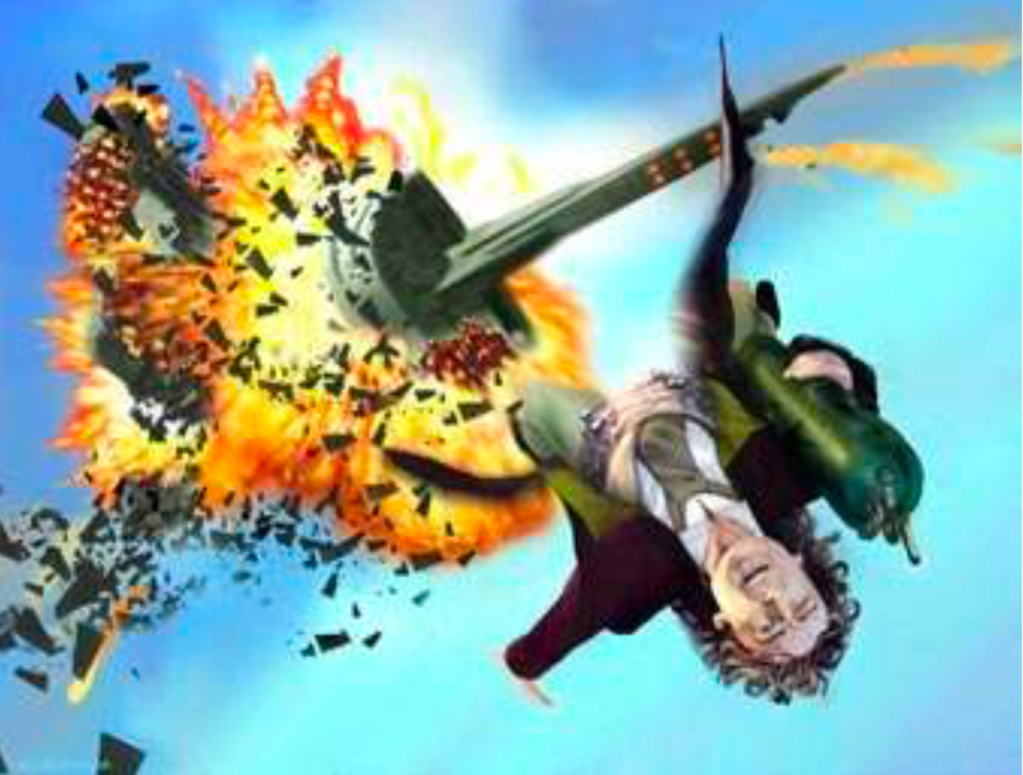
The ending is brilliant – the new young Doctor battling with Xznaal on the Martian ship kilometers above London. All life on Earth is at stake and in the final battle, he shows a degree of ruthlessness. ‘The Dying Days’ culminates in a brilliantly absurd action sequence with the Doctor falling from the exploding Martian ship high above London, on his way down to earth he constructs a parachute and crash mat, using only some bin bags and curtain rings! It is brilliantly improvised and exactly the sort of action sequence that belongs in ‘Doctor Who’ – very silly and thrilling at the same time.

Elsewhere it is time to wrap the stories of the various characters. The Brigadier finally gets the recognition he deserves from a grateful nation and monarch, Benny gets a new job and well let’s just say she finally gets to do something that she has been thinking about for the whole story!

Queen Elizabeth sat on the coronation throne, the Imperial State Crown on her head, restored to its former glory. The Recoronation would clear the constitutional way for the election of a new Parliament.

Representatives of every nation on Earth were calling ‘God save the Queen’. The European Union, the United States and the Japanese had made generous reconstruction grants, although Britain would continue to remember their inaction during the Dying Days for some considerable years. There was a great deal that needed doing, especially in the northern cities. Things were changing, there was a new sense of optimism, of hope for the future. Perhaps it would get worse before it would get better, but everyone knew that it would get better.

Behind the various ambassadors and heads of state stood the senior military men and other heroes of the Invasion. Outside, the crowds were cheering again, the sound percolating through the thick walls of the Abbey.

It’s a shame the Doctor couldn’t be here.’
‘Oh but he is, Doris.’
‘Where?’
‘See that chap with the scarf and the tin dog?’ Lethbridge-Stewart pointed across the aisle.
‘Oh yes. Is the blonde girl with him?’
‘Judging by her dress-sense, I would say so
.’

A couple of people leant over, stern looks on their faces. Alistair smiled back at them. When they recognised him, they mumbled their apologies and returned their attention to the ceremony. Montserrat Caballe had taken her place in front of the choir and now began to sing the Recoronation Aria, the specially-commissioned piece by Lord Lloyd-Webber. Future historians would count this as the first moment of the New New Elizabethan Age, when British art and literature entered a brief, but prolific resurgence.

Alistair glanced over at Brigadier Bambera. His successors were going to do sterling work, probably even better than him. But he liked to think that he’d set a high standard for them. Hopefully in years to come, people would say that he had lived up to his illustrious ancestry, and that by and large he’d done a good job. He knew that he’d had a good innings, and despite the old saying, he’d neither died nor faded away. Retirement wasn’t so bad, not on those terms. And that’s why, in the middle of a packed Westminster Abbey on one of the most important dates in British history, despite everything that had happened, General Alistair Gordon Lethbridge-Stewart found himself roaring with laughter.

“The Dying Days’ – exactly the sort of ‘Doctor Who’ we should have had on our TV screens in 1997. It is a brilliantly 1990’s Doctor Who story and a fitting end to the New Adventures Doctor Who range. Benny would spin off into her own adventures, but the Eighth Doctor would resume in the BBC books range (with ‘The Eight Doctors’) and in the excellent DWM comic strips. Years later in 2001 Big Finish would pick up his story in ‘Storm Warning’. The spirit of 1997 couldn’t last, it didn’t, we are stuck again with a Tory government. Times change, but the same mistakes are being made all over again – which I suspect is just the curse of getting old. Sir Alastair may have gone permanently to Geneva, but his daughter is going strong – fighting the good fight with UNIT. And elsewhere, the Eighth Doctor is still out there – travelling with Liv and Helen or with Bliss – still refusing to fight in the Time War.

.

Damaged Goods By Russell T Davies (1996)

Bev lay awake, hoping that Father Christmas would come, but the Tall Man came instead.

She could hear his voice in the front room, but her mother’s crying drowned his actual words. Mum had been upset all day, ever since she came home. Her mother had different sorts of tears – mostly anger, like when the kids from the Quadrant threw cigarette butts through the kitchen window; like when Carl got lost in the crowd on Jubilee Day, except he wasn’t lost, he was drinking cider with Beefy Jackson’s gang; or like when Dad left. But tonight, this was a crying Bev had never heard before.

Many years later, Bev would cry the same tears herself, and only then would she recognize what they meant. Only then, when it was too late.
..
Bev did not notice the man at first. He stood in one of Red Hamlets’ side alleys, next to the skips, in darkness. He must have edged forward a fraction, ambient light revealing a smudged impression of his clothing: a cream jacket, splattered with mud, and a battered white hat. The rim of the hat should have kept his face hidden, like that of the Tall Man, but despite the dark and the distance, Bev could see his eyes. They were looking at her.
Bev forgot her mother’s plight as she stared back at the little man. She thought he smiled at her, just a small smile, but one which gave no comfort. Bev thought of her storybook: of tales in which brave knights battled across swamps and mountains, fought dragons and eagles and witches, all to reach a wise old man who might have the answer to a single question. Bev always imagined that these old, wise, terrible men must have long white beards and flowing robes, but now she realized that they looked like this: small and crumpled and so very, very sad. The man lifted his head – Bev imagined he knew what she was thinking – then he returned his gaze to the two figures beneath the lamplight.


Bev heard the front door click and guessed from the noises that Mum had settled in the armchair. After a few minutes, there came the sound that had first alerted Bev to the mystery, that of her mother crying.

After twenty minutes or so, Bev fell into an uneasy sleep. She dreamt of snow, of tall men and small men, and of terrible bargains being made at night. ‘

Russell T Davies (1996)

I think, actually, when you’re young, you kind if think that all that death and disaster is marvellous and brilliant. You sit there, all grown up, thinking ‘That’s what the world is like’. But then as you get older, you get.. I don’t think you get softer, but you get wiser, and actually the world isn’t all death and disaster.. Well, it is actually! But I now see the point of writing is to find moments that aren’t death and disaster. That actually, happier endings are one of the most beautiful things about fiction, and you don’t need to kill everyone.’

Russell T Davies (2016)

‘For the world’s more full of weeping than you can understand’

The Stolen Child – W.B. Yeats (1889).

Do you ever have a moment when you feel incredibly stupid not having realised something that should have been obvious to you? I’ve read ‘Damaged Goods’ before and I’ve listened to the BF adaptation, all of which contain characters quoting from the Yeats poem above. ‘The Stolen Child’ is a poem that I’ve known and loved since the 80’s. It wasn’t until I typed the name of the poem that I realised the connection with this story – the sentiment fits the content and feel of this story very well, but it is also a very direct and very obvious reference to a plot point – and one that is actually pointed out in the book and BF adaptation, so it isn’t even a sub-text. An example, there are many others, where the act of writing about these stories and having to concentrate on them more, subtly changes your perception and understanding of them.

Anyway to tell you why I feel differently about ‘Damaged Goods’ than when I first read it in the late 90’s/early 2000’s, I really need to tell you something about myself and what happens as you start to get old – some of you may recognise this, some may not, some may be yet to face this or may never.

Way back when – in my 20’s or 30’s my bookshelves were stuffed with everything from Burroughs and Bukowski to Zola, my stock of video tapes was filled with gritty, social-realist drama – from the likes of Ken Loach, Jimmy McGovern, Peter Flannery and Alan Bleasedale. However as you get older, life becomes less certain, the world around you that you once knew and the future you once envisaged changes in ways that you find inexplicable, certainties turn to doubt, confidence to trepidation. This bleeds in, at least for me into my choice of what I want to watch or read – those great, grim social-realist or existential works (old and new) that I once read or watched, I really can’t face any more – I don’t need any more of it. A new Jimmy McGovern series looks great – I know it is, but I pass on it – I need something to keep me cheery, something comforting, re-assuring and uplifting instead.

I’m not alone in this – the same condition afflicts my partner and many of my friends. Don’t get me wrong I lead a nice life – far more so than I could ever have hoped for or could even imagine growing up – so this isn’t just a load of whinging, just something that happens gradually to many people as you get older and become less care-free, adult concerns and responsibilities take over and the people you love pass away and the pillars that once supported your life start to crumble. Nick Hornby writes about it much more succinctly in his book ’31 Songs’ when talking about ‘Frankie Teardrop’ by the band ‘Suicide’, which he loved as a young man, but in comparison now instead wanted to listen to the warming, consoling, comforting pure sunshine pop of ‘Ain’t that Enough’ by ‘Teenage Fanclub’ (my favourite band too) – something that I can completely understand now. He says:

“I need no convincing that life is scary. I’m 44 and it has got quite scary enough already – I don’t need anyone trying to jolt me out of my complacency”.

So all of that was a very long winded way of saying that grim, supposedly real-life stuff can be easier to read or watch when you are younger and more care-free than when life has had a bit of a go at you and you are older! I suspect that the same might be true as a writer – the Russell T Davies of 2017 would approach this book differently than his younger 1996 counterpart – he indicates as much in the interview he gave for DWM when Big Finish adapted this story – I quoted this in the introduction. He muses on the attraction of the dark and gritty for young writers and the change in his writing that occurred while writing ‘The Grand’ and then ‘Queer as Folk’. ‘Damaged Goods’ has all of the grimness and death in spades – far too much really. It is anchored in ‘real life’ – but this is the most extreme form of real life, with very few chinks of light amongst the poverty, addiction and crime. Russell is famously ruthless with his characters in his TV Doctor Who – from Clive, to Raffalo, Lynda with a ‘Y’ all the way through to Harriet Jones – but here the cast are just slaughtered, in a variety of increasingly disgusting, creepy ways and eventually large parts of the city destroyed, one survivor left picking gold teeth out of corpses. It is almost a parody and is far, far too much for me – especially in the context of Doctor Who – the book became attritional, a struggle to reach the end this time around.

As you might expect from Russell, there is also some terrific stuff in this book. If you liked ‘Queer as Folk’, ‘Bob and Rose’ and ‘Second Coming’, then somewhere in ‘Damaged Goods’ is the missing link – a story that if stripped back to it’s core could have been made by Channel 4 or Granada in the late 90’s, probably by Red Productions and Nicola Schindler – I can see the cast, how it looks and it’s sits on my DVD shelf between the other Russell T Davies TV series. In amongst ‘Damaged Goods’ there is a really great story, from someone who was about to become one of the great dramatists on British TV. There is a bit of a problem though, actually there are two main problems for me – there is more than one story and the really interesting one doesn’t feel anything much like a ‘Doctor Who’ story and doesn’t really benefit much from The Doctor’s involvement. Looking for a future showrunner? My advice – have a look at that guy who wrote ‘Dark Season’ and ‘Century Falls’, not this one. There are parallels to be drawn and elements here that would be seen in Russell’s TV Doctor Who – but anyone expecting to draw a straight line from the Perivale of Survival, through the Quadrant here to the Powell Estate and Rose, is likely to struggle and be left scratching their head. The only common thread really is that the locations broaden what modern Doctor Who can be.

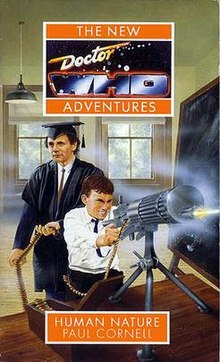
In my review of ‘Human Nature’ I explained that I didn’t really have any knowledge or frame of reference for the world of public schools, well here I honestly have no idea about the world of the Quadrant (the flats in this story). I grew up on a working class estate in Merseyside, not a council estate (some of it was, our bit wasn’t), but the sort where every Dad was a skilled or semi-skilled worker – craftsmen – electrician (my Dad), fitters, carpenters, plumbers, brickies etc. We had the odd middle class person quickly passing through on their way to better things – we didn’t have a lot of stuff or much money, but it is light years from the world depicted in this book.

It may have all been happening a few miles down the road, but that world is a different to the one that I grew up with – albeit in a time of mass unemployment that afflicted my world as much as anyone in the 80’s – as leafy, affluent, commuter town Surrey or indeed where I live now. I wouldn’t dream about writing about this world – I’d feel happier writing about Vortis or Zeta Minor. This is a grim world of drug dealing, gang violence and child prostitution, of illicit sex and guilt, alcoholism and self-harm. It is miles away from my own experience, but here’s the thing – I’m not sure how close it is to Russell’s either. He’s from Swansea and went to Oxford – now you don’t have to be from a world to write about it – but when it comes to living in the level of poverty, crime and depredation depicted here, if you haven’t lived it, it can feel uncomfortably like voyeurism. His writing of this can be really effective, but then you also have some curiously ‘Grange Hill’ BBC ‘street’ sounding things – names like “Beefy Jackson’ – really? It is like putting a character form the Beano into Trainspotting, And here’s another point – it might look similar but it is a very long way from the Powell Estate as well. Winnie Tyler is only similar to Jackie Tyler in that she is a Mum, has the same surname and isn’t well off – more of that later.

In amongst the mix of ‘Damaged Goods’ there is the story of the corpse of drug dealer (‘The capper’ = named after his practice of knee-capping people) possessed and re-purposed by a Time Lord weapon, cocaine that contains traces of the same thing – the n-form – something that was built to destroy vampires in the ‘old time’ and causes death and destruction here on a grand scale. I don’t have much interest in that whole story strand – it is there if you want it, there is also a whole lot of quite horrible body horror that is effectively written and stomach churning and an operatic ending that ties the two stories together in destruction on both a massive scale and a personal level.

The story strand that I’m interested in here (spoiler warning) is Russell’s answer to Wily Russell’s ‘Blood Brothers’ and is what gives the book its title. It is the story of two women – one rich, one poor. The rich one is desperate for a baby after a series of miscarriages and the poor one has twins and agrees to sell one of them. When the one she buys is ‘broken’ and she realises it is one of a pair, the rich one wants to exchange her ‘damaged goods’ for one that isn’t. See what I mean – a really great story – it is an RTD story, a Jimmy McGovern story, a Paul Abbot story – just not especially a Doctor Who story. It was considered for development as a series in it’s own right and I think that it is a real shame that didn’t happen – I would have it on my DVD shelf now. Instead it sits in a pile of ‘Doctor Who’ books and a download from Big Finish and involves the Seventh Doctor and his companions from the future – adjudicators Roz Forrester and Chris Cwej (don’t ask!) who don’t add a whole lot of value to the thing.

The Two Mothers

The two women – Eva and Winnie are the stars of the story for me. Russell really invests in these characters – giving them a history, motivation and he makes them by turns sympathetic and monstrous in some very clever writing.

Eva Jericho is a horrible woman, a monster – the sort you could find in any Conservative Club across Britain. She is wealthy; thanks to her investor husband, who indulges her – he gives her Stephen, he buys her the son she wants. In return she kills him by putting rat poison in his dinner – a scene re-used in ‘The Second Coming’ The passage which illuminates her character concerns the shopping expeditions she makes – buying designer clothes which she then deliberately damages, just so she can take them back to the shop, demand her money back and bully the staff there. She is the sort of women who could purchase a child and genuinely think that she could take back the child after years of sickness to exchange it for one that is healthy.

What Russell does effectively here, not just for Eva but for many of the other characters is to give them a history, a view into why they are the way they are and what brings them to the Quadrant – his character work in this is brilliant. He also shows how small moments in childhood can cause events to spiral out of control. The events of the story are set in motion by Eva being bullied – forced into shoplifting by a childhood nemesis, she is caught and later thinks that this has stopped her being able to adopt a child (it hasn’t). She hits her tormentor with a brick and is punched in the process, which may have contributed to her being unable to successfully give birth. There are moments when you genuinely feel sorry for Eva, the story of her grief and pain over her repeated miscarriages and her care for ‘Stephen’ her ‘adopted’ child and then it flips straight back and you realise just what a monster she is – what she is capable of and this is well before she encounters the n-form. There are echoes of her in the TV series, nothing quite as ‘real’ as her story, but non-the-less she is there in Blon fel Fotch in ‘Boomtown’ or Ms Foster in ‘Partners in Crime’. In some ways what happens to Eva is also similar to Miss Hartigan in ‘The Next Doctor’, not the abuse, but railing against men whilst becoming part of a monstrous technology, possessed of a will that will not allow that technology to subsume her.

Winnie Tyler is the opposite of Eva, but she shares an equally monstrous secret and is similar in that she is by turns magnificent, terrible and piteous. Winnie is a much more sympathetic figure than Eva, despite selling one of her children. She has also become an alcoholic, but that along with the evidence of self-harm on her arms is largely as a response to the guilt that she feels for selling Peter/Stephen. She has effectively been grieving for the loss of her child for many years. She also leaves the money untouched, not wanting her children contaminated by it – despite their poverty – she works instead stuffing envelopes. She is magnificent when trying to protect her children (Bev, Carl and Gabriel) and has lost a lot as result of the bargain she made with the ‘tall man’ one Christmas Eve – we see all of this through Bev’s eyes – but also her passed out next to a bottle. She has our sympathy, but not that of her former friends on the Quadrant who can’t forgive her for what she did that night. Her fate here is just horrible, having taken some of the cocaine that her eldest son Carl had bought to teach him a lesson – she transforms horribly along with him as the n-form activates.

The Twin Dilemma

The story is also the tale of twins – Gabriel Tyler and Peter/Stephen, separated after birth. Gabriel has a ‘glamour’ – a psychic ability to make others like him, other people see him differently – reflecting aspects of them – he literally leads a charmed life, despite growing up in the poverty of the Quadrant. Stephen, as Eva re-names the other twin we only see in hospital, he has been ill most of his life. In a reverse of nature/nurture – the child who lives in the rich household and has everything (including love it has to be said) fades slowly away, whilst the one in poverty and a household of alcohol dependancy and self-harm (but also love) thrives. In this case the two children are psychically connected, but Gabriel is inadvertently sucking the life out of Stephen. It is this ‘vampiric waveform’ that attracts the n-form and which it is designed to remove.

There is a third child here – quite horribly – a lithopaedlan – a calcified, stone fetus. This is a genuine, rare medical condition. Eva has a ‘stone child’ outside of her uterus in an ectopic pregnancy. This is a detail, which is really unnecessary here– it is quite horrible and I don’t really see the point – especially when it makes a ‘guest appearance’. The fate of all three children intersects at the ending. Each of them suffers a quite nasty, horrible fate – Russell is utterly merciless with them. All hope is extinguished.

Queer as Folk

The other interesting story thread – again really not a Doctor Who story but interesting anyway, is the story of Harry and David. Harry an older gay man, in the closet all of his life and wracked with guilt about his nocturnal activities in the cemetery – which is where the story starts, The Capper interrupting a liaison by erupting from his grave. David, in contrast, is young and out there and enjoying his life in the gay clubs of the city. They are brought together by Harry’s recently deceased wife – Sylvie – who is a rather magnificent presence here. She is another great Russell T Davies matriarchal figure – appearing to Harry, who is still grieving for loss, when he needs her and looking after him. Sometime in the past she invited David to sleep on their sofa when he had nowhere to live and he’s stayed ever since. Theirs is a story with a happy ending (God knows it needed one) – David gets some man-on-man action with Chris and both characters actually survive. The appendix to the book suggests that in amongst the UNIT investigation in the aftermath of the incident at the Quadrant that amongst David’s test results a potential cure for HIV is found. Their story is a chink of light amongst the grimness and is also interesting to see Russell writing about gay men, just before ‘Queer as Folk’.

Happy Endings?

And so to the ending. Russell talks of being liberated by the format of writing a novel – that he could write destruction on a grand scale- a whole city devastated, a massive train crashes and spectacle. There are no consequences that he has to deal with in the context of an on-going TV series and no budget constraints. The thing is, I quite like some of those constraints – many of them have made Doctor Who more interesting than big budget alternatives and to me the spectacle and destruction is just a distraction here from the main event – the resolution of the separated twins and two mothers. The N-form and the monstrous army of horrifically converted child prostitutes, cocaine addicts, TV Execs (!) – well it is just too much for me I’m afraid.

It is grim, sad and horrible and at times I think unintentionally funny. I’ll give you an example – as the monstrous Eva is coming to reclaim her ‘son’ – her new ‘Stephen’, she is bleeding, the blood dripping down her legs – it is from her unborn calcified child, lodged outside of her uterus, in the end it is ‘born’ and depicted in graphic detail. Now, I just think why – why is that there – it isn’t needed, it is so bad, so utterly grim and unnecessary that it actually made me laugh. There are lots of other examples of this – Mr Leather who runs the local prostitutes with his wife, celebrates selling the cocaine that evening by having sex with one of his girls – who is 14. They both take the cocaine and as the n-form activates, their heads split open and they are converted.

The body horror is really, really nasty – but child abuse – sorry not for me, you can broaden the scope of ‘Doctor Who’, you can take it to all sorts of different and interesting places, but there are some places where if you push it, it just breaks. This is one of them for me, it cannot cope with the extremes of real life – it can’t cover them in the detail or the seriousness that they require. You could write the Doctor into Srebrenica or the Rwandan civil war, or the killing fields of Pol Pot – it is possible to do that – but it is crass and insensitive and if that is your story, well it is probably best to find another medium for it, rather than bending this one horribly out of shape to accommodate it. Ask yourself what do the Doctor and his world add to those situations and in return what do they add to the Doctor’s world?

Overall, I just can’t escape the conclusion that this story would be better without the involvement of the Doctor and his companions and should just have been it’s own TV series. Roz and Chris – well I can’t tell you anything much about them. I don’t feel like I know them, what they are supposed to be about or why they are here – and I’ve read quite a few of their stories – including their introduction. If anyone knows – in a phrase often used on BBC Children’s shows (Russell’s old show ‘Why Don’t You’ is referenced in the book) – ‘answers on a postcard’. A shame Russell didn’t get to write for Benny – that could have been fantastic and she would have worked well in this I think. His take on the Seventh Doctor is interesting. The Quadrant completely throws him, he finds it difficult to breach the closed doors and get to the heart of the mystery. So this most manipulative of Doctor’s finds himself a bit lost in this world – almost as much as I do.

Anyway, my advice is to read ‘Damaged Goods’ for yourself – reach you own conclusions – you might feel very differently about it from me. If nothing else, it contains a cracking story and along with Russell’s other work it forms an interesting backdrop for the series when it came back – a taste of how it might have been brought back in the 90’s in a much darker, late night slot. It isn’t ‘Rose’ – it is very, very far from it. It is by turns absolutely brilliant and ludicrous, mature and adolescent – a work in progress. It is a story that very much fits the NA brief of ‘too broad and too deep‘ for TV, but for me it really should have been dialled back a bit and in my view required some editing. Which is why on the whole I prefer the Big Finish version of it, the impact isn’t lost, but it is more effectively stripped back to the core story – Eva and Winnie and the twins and provides some hope at the end. It is a more mature piece and far more to my taste, actually I like it a lot.

Lungbarrow by Marc Platt (1997)

‘… and Rassilon, in great anger, banished the Other from Gallifrey that he might never return to the world.
Then there was great rejoicing through the Citadel.
But the Other, as he fled, stole away the Hand of Omega and departed the world forever.

The little figure had slowed and finally stopped a few feet from the bier.
There was a figure lying silhouetted inside the glass coffin. The Doctor stood, head bowed, for a moment and then walked solemnly up to the casket.
‘Quences,’ he said as he peered over the top of the bier at the figure.
Chris waited awkwardly, watching Glospin, until the Doctor turned and beckoned him over.

Chris, you know, don’t you?’ he said quietly.
‘Yes, Doctor. I told you. This is your home.’
The Doctor sighed. ‘Yes. This is my home – the ancient House of Lungbarrow in the Southern Ranges of Gallifrey, where I grew up.
A wild and beautiful setting for the worst place in the Universe
.’
He gestured at the coffin. ‘And this was Ordinal-General Quencessetianobayolocaturgrathadadeyyilungbarrowmas, to give him his full title and decoration.
He was the head of the Family and my benefactor.

Home Truths

There comes a point in life (well maybe), probably in your 20’s where you rarely visit home – maybe only for weddings, funerals and christenings. You have moved away and started to make a new life for yourself, maybe re-invented yourself a bit – surrounded by new people – your future. Everything at home seems like the past, not the future, claustrophobic, old memories and old stories of the old you. For most of us this phase passes once your new world is secure and your two worlds reconcile in your 20’s or 30’s – the selfishness of this earlier period is necessary to allow you to establish your own place in the world. Some never leave and some never return.

The Doctor has been at this stage in his life for hundreds of years, but towards the end of his 7th incarnation, the past is catching up with him and it is time to visit home. Not just Gallifrey – he’s been back before and faced his old schoolmaster and fellow ex-pupils, rather to his home – the House of Lungbarrow and meet his family – his cousins who bear a resemblance to the cast of Gormenghast, his old friend and mentor (a giant robotic fur covered beast – called Badger), the overgrown sentient furniture that moves and bites, giant automated house staff and weird creatures that he created in his youth. He is also very, very late (over 600 years!) for a family funeral and the deceased has been waiting for him so that he can read his will for a very long time.

How did he die?’ asked Chris.Glospin raised an eyebrow.
‘He’s not dead,’ said the Doctor. He tapped the panel.
‘This is a static field generator.’
‘Very good,’ said Glospin. ‘The Kithriarch is waiting in stasis.’
‘Waiting? Why would he be waiting? What for?’
‘You,’ said Glospin. He turned to Chris.
‘The Doctor is six hundred and seventy-three years late for Quences’s deathday.
The poor old man refused to read his own will until his favourite was here
.
The whole Family has been kept waiting all that time.

So a couple of confessions. I’ve started Lungbarrow a few times and never made it past the first few pages – one of the reasons why I was keen to cover it here and secondly, well it only sort of tangentially fits in this thread. It is an ending of sorts, has a funeral and follows in the wake of the death of a companion – Roz. It also pre-figures the death of the Doctor, ending as it does on Romana dispatching the Doctor to collect the Master’s remains from the Skaro and leading into the TV Movie – but I am stretching somewhat. It also features the ending of the ‘Cartmel Masterplan’ and in some ways the New Adventures Doctor Who range – there is only one more book to go and that is not a Seventh Doctor book. Actually another Seventh Doctor book was released after this one, bizarrely (well for unforeseen reasons) the one where Roz actually dies (‘So vile a sin’).

First some history – Lungbarrow was one of the original script ideas for the slot that Ghost Light ended up taking in Season 26. Like Ghost Light it would have been confined to the single location of the house and avoided the other Gallifrey-based scenes in this novel. The story seems to be that JNT decided that Lungbarrow was just a bit too much. too soon. I think he was probably right – it makes more sense in this context. It means though that in the absence of season 27, the ‘Cartmel masterplan’ on TV amounts to nothing much more than a few hints at the Doctor’s past in Remembrance and Silver Nemesis (‘more than just a Time Lord’, ‘The Hand of Omega is a mythical name for Omega’s remote stellar manipulator, a device used to customise stars with. And didn’t we have trouble with the prototype’). So now, with 12 more years of new series mythology, it is easy to view this as an alternative view on the Doctor’s beginnings, I don’t think that it explicitly contradicts anything much, but then I’m pretty comfortable that all of this stuff sits together without needing to construct a coherent timeline out of it all.

Marc Platt is one of my favourite Who writers – I like ‘Ghost Light’ – but absolutely love ‘Spare Parts’, ‘Loups-Garoux’, ‘The Silver Turk, ‘Paper Cuts’, ‘Auld Mortality’, ‘Storm of Angels’, ‘Butcher of Brisbane’ etc. There are other stories that I don’t think work so well – but I love his imagination and the clever details he puts into stories – in some ways reminiscent of Robert Holmes. He also seems to have a love for using nature and natural history in his imagery (very much in evidence here), which I very much approve of. Here we have that imagination at work, the House of Lungbarrow – grown rather than built, populated by grotesques, automata, orchid/lizard hybrids, taffle and fledershrews and an awful lot of fungi. Sometimes here it is just too much and the weirdness of the house and it’s occupants just seem to wander down some blind alleys, but it is at least always interesting and imaginative and well clever. On that subject ‘cleverness’ – that is a core aspect of Doctor Who for me, even at its most basic – an alien invasion, base under siege type story (which I love), it should have some aspect of cleverness to it – even if this is just through the Doctor.

‘The Worst place in the Universe’

Lungbarrow is the Doctor’s worst place in the universe. Back in the 80’s we saw Ace’s worst place in Ghostlight. I had a think about what mine was – instantly I thought of Bracknell (apologies if you live there), where I once had to work for a year – a cultural blackspot. However the place I eventually came up with was a bit more interesting than a Thames Valley commuter town – a beach at Pond Inlet in the Canadian High Artic – strewn with the remains of dead Polar bears, Huskies, Ringed Seals and freshly butchered Narwhal – in the low mist, walking there was like a glimpse of hell.

Anyway, back to Lungbarrow – and this is where it gets a bit complicated!

A cunning plan?

So the Cartmel Masterplan, that great idea to make the Doctor more mysterious by explaining everything about him! Which isn’t as it turns out what it was all about after all. This all unfolds over the course of the book – although the foundations are set in an earlier Marc Platt book – ‘Cat’s Cradle: Time’s Crucible’ (not a favourite). We are introduced from the start to ‘The Other’ – the mysterious third member of the triumvirate that came to rule Gallifrey in the old times alongside Rassillon and Omega – before the ‘Intuitive Revelation’ banished the old time and ushered in the new – bound to the rational, scientific leadership of Rassillon. ‘The Other’ is the one that isn’t quite the Doctor, but is friends with the Hand of Omega, he’s sort of the brains behind the throne, standing in the shadows. As things escalate and the followers of Rassillon enact their own version of ‘The night of the long Knives’, ‘The Other’ escapes. When the victors (the followers of Rassillon) write the official history (as Borusa says ‘ It doesn’t have to be entirely accurate’) – the fate and even the name of ‘The Other’ has been lost to myth. I’ve hear some say that these are Time Lords gods – they aren’t it is all much more political than that and more, well ‘human’.

All of this comes down to Gallifreyan reproduction. Not an area that I’ve especially wanted to delve into to be honest. Here new Time Lord ‘cousins’ are woven from the family Loom from raw genetic material – Gallifrey has been sterile since the female ruler – Pythia was ousted by Rassillon and after her death her followers left Gallifrey to form the Sisterhood of Karn. Anyway, each House has its compliment of 45 cousins and when one dies another is woven from the family loom. The Doctor apparently was also woven – but it appears some of his genetic material was from ‘The Other’ – who ‘died’ throwing himself into the Loom to spite Rassillon’s plans. He is called ‘snail’ or wormhole’ by his family – as unaccountably he has a navel, indicating maybe his birth was more natural. Susan is the last naturally born Gallifreyan – but not a contemporary of the Doctor, rather Grand Daughter of ‘The Other’. The Doctor rescues her from the old time of Gallifrey in his first journey in the TARDIS and she recognises him as ‘The Other’ – her Grandfather. We get to see the First Doctor leaving Lungbarrow behind, with the Hand of Omega and taking his first trip in the TARDIS – as ever breaking all of the rules and travelling back into Gallifrey’s own history. Well we see this through the eyes of the Doctor’s friends, almost in a dream – so I suppose you can chose to believe all of this or not.

Hooded in a black cloak, he pushed the scroll into the open beak of the great stone owl that guarded the Chapterhouse gate. The alarms were still sounding as he made his way across the Citadel’s broad edifice. The rainswept bridges and walkways were deserted. No one steps out on Otherstide night.

He carried one bag with him. A few belongings and keepsakes. The rest he left to the guards and the scavengers. He hurried along the windy colonnades known as Gesyevva’s Fingers and paused on the wide square where the ancient memorial to Omega stood. For a moment, he saw a shape flit across the burnt orange sky above the monument.

The TT embarkation port was on Under-level 15 of the Citadel. A group of watchful citizens was seated in the waiting zone. Several were busy trying far too hard not to be conspicuous.
‘Agency guards,’ mused the Doctor to himself. He ducked into the dry dimension dockyard on the next level up. On a neural construction palette stood a gleaming new TARDIS ready for service installation. A technician’s chart listed its immaculate specifications and latest safety precedent – a remote recall override system. ‘A type fifty-three?’ complained the Doctor. ‘You’re not getting me out in one of those new-fangled soulless slip-abouts
.’

In a far corner, surrounded by junk, was a dull grey, battered old TT booth with an obsolete Type 40 marker on the door.

The key was in the lock.

As the Doctor stepped inside the doomed TARDIS, he heard a fresh clamour of alarms from close by.

Beyond its tight dimensional gate, the ship’s interior opened out impossibly. Its spacious console room was gloomy and neglected. A cobweb lifted and rippled on the central console. Several panels had been lifted off to expose the complex inner circuitry. The Doctor tore away the cobweb and blew off the dust. Instantly, the sluggish hum of power edged up a tone. A gold light began to glimmer weakly behind the honeycomb of roundels that covered the walls.

The place felt welcoming. The Doctor put down his bag.

There were banks of instruments around the room and a couple of overturned chairs. Beyond a door, there was the glimpse of a shadowy passage leading deeper. He pondered the control panels with a degree of glee and selected the brass button marked DOOR.

There was no response. The power was all but drained. The light guttered and the ship’s hum died. The Doctor drummed his fingers in frustration.Something whooshed. The black box was suddenly hovering beside him.

Yes, I wondered when you’d catch up with me,’ he said. ‘So you think you can come along too, do you? Well, that’s all very well, my friend. But since we have neither the luxury of a pilot nor of any power, perhaps you can suggest a way to fly this thing.’ The box whirred. Its lid opened a crack. The white furnace inside winked at him. He could feel its energy softly saturating the air. The ship gradually began to hum again. A more confident, assertive hum. The light in the room began to rise. A screen attached to the ceiling flickered into life, showing a group of Agency guards moving methodically across the dock area outside. One of them carried a gun.

The Doctor pressed the DOOR button again. This time, the heavy double doors buzzed and swung shut. The central glass column of the console juddered. The complex instruments inside turned back and forth. Lights twinkled among the circuits.

By now, the ship was throbbing with energy. ‘Remarkable, remarkable!’ enthused the Doctor. ‘All this power, from an ancient antiquity!’

There was a loud clang. On the screen, he could see the guards gathering around the ship.
‘Well, it appears that my future is in your hands … or should I say Hand, eh? Hmm?’ His shoulders heaved with little gusts of mirth. A light showed beside an unmarked dial. The Doctor glanced at the box. It gleeped at him. He reached out and gave the dial a twist. The air grated with the roar of engines. An undulating grinding like something tearing open the fabric of reality. The glass column rose and fell, its inner carousel of instruments turning. Switches and levers adjusted by themselves. The ship jolted and the screen picture vanished
. ‘

Family Values

In the centre of the story is the Doctor’s family. They are a very strange bunch. The dead or ghostly Quences – head of the family and the one who realised that the Doctor was the only hope of ever rising above the level of supplying clarks to the Capitol. Satthralope – the malevolent old housekeeper who hasn’t moved for 70 years and bears a certain cobwebbed resemblance to Miss Havisham. Cousin Innocet – the only really likeable cousin and probably the best defined of the family, still close to the Doctor. Of the others the main ones are Glospin – the Doctor’s rival who hopes to inherit from Quences will, Arkhew and Owis (the Doctors illegal replacement cousin – who spends most of his time eating the local wildlife). The Doctor is the black sheep of this dysfunctional family, which is quite amazing really – he has disappointed Quences, although in the end the part where he finds out that the Doctor actually became Lord President instead of the minor cardinal he dreamed of for him is rather priceless.

Old friends

I think what surprised me about reading this book, is that I expected it to completely re-write Gallifrey in the image of Mervyn Peake, but it doesn’t – it is much more clever than that, at least in book form, the TV version would probably have been quite different in this respect. If Robert Holmes rebuilt Gallifrey in his own image, Lungbarrow mainly builds an extension to it – it keeps the President, the Chancellor, the Castellan, the Panopticon, the Chancellory Guard, the CIA and the academies, alongside side our friends, Leela and Andred, Romana and two versions of K9 (rather glorious that), but off to one-side in the capitol. Meanwhile the Doctor has an adventure in a very different aspect of Gallifrey – the houses, so it is in the spirit of building on our knowledge rather than completely tearing it up.

I was also quite surprised at how familiar all of this is – through Marc Platt’s Big Finish Doctor Who Unbound story – the rather brilliant ‘Auld Mortality’ for Geoffrey Bayldon’s alternative, ‘stay at home’ First Doctor. So I had already met Ordinal General Quences, Badger, the Drudges and cousins but didn’t really know that they had come from Lungbarrow. Likewise Leela and Romana on Gallifrey – Romana as a reforming, outward looking President, opening Gallifrey to the universe and looking to heal old wounds. All of that is in a number of New Adventures and Big Finish stories – not least the ‘Gallifrey’ series. So maybe I was just more warmed up for all of this than I was expecting – certainly than I would have been if this has been part of Season 26 on TV and confined to the house.

The book also rather cleverly balances old and new. Both Leela and Romana are nicely drawn here – Leela struggling to find her place in her new world and Romana a force of nature setting about Gallifrey with a reforming zeal. And if it takes your fancy – and it will for some – there is a girl-on-girl fight between Leela and Dorothee (Ace), after which there is some degree of mutual respect. Ace/Dorothee gets to meet herself and it seems that she doesn’t entirely approve of what she became in the NA’s – unsurprising, I don’t particularly either. K9 gets to meet himself as Leela’s Mk I meets Romana’s Mk II and they do the equivalent of sniffing each other’s arses. That makes me happy far more than it really should as a grown man!

Memory capacity increased by seventy-one point one per cent,’ he announced aloud.
He already recognized the designation of the analyst. As his optic circuits restored vision, he saw the analyst itself. It was the unit he had been in occasional conference with over the past five days. The sensor from the analyst’s angular metal head was extended to engage the extended sensor from his own.
They wagged their tails and ears at each other and retracted sensors.
‘All systems reactivated and reprogrammed,’ said K9 Mark I.
‘You are K9 Mark II.
”Affirmative. Program complete,’ said K9 Mark II.
‘You are K9 Mark I.’

The two robotic dogs circled each other, ‘sniffing’ at each other’s credentials. Eventually they pulled apart. ‘All data assimilated,’ they chorused unnecessarily. ‘Next objective: to find and retrieve the Lady Leela,’ declared K9 Mark II. ‘Affirmative,’ agreed K9 Mark I, and he led the way as the junior version rolled back to let him through.

I don’t know what it is about K9 – I never paid him much notice to him growing up, but his image and voice now can utterly transport me back to childhood – a sort of weird nostalgia for something that I didn’t like all that much at the time. I remember blubbing in our house at the end of ‘School Reunion’, I can’t say whether it was me, but there was definitely blubbing. I’ve just listened to a rather joyful Tom and Lalla audio where Henry Gordon Jago gets to introduce K9 on stage as his new star act – it makes me very happy that such a thing even exists.

It isn’t only Romana who is going to have a big impact on the future of Gallifrey – Leela is pregnant. I didn’t really think Andred had it in him – but there will be a half human/half Time Lord on Gallifrey once more and the curse of the Pythia will be be broken. Who knows that might explain the TV movie?

Who killed Ordinal general Quences?

For a story that at one point looks like it might be about a CIA coup on Gallifrey (that plotline just sort of peters out), it actually shifts at least partially to a uniquely Gallifreyan murder mystery, Cousin Innocet and Arkhew have seen what looks like the first Doctor killing Quences with a double-bladed knife (2 hearts). The resolution to who killed Quences, how and why is a uniquely Time Lord one. I won’t reveal what happens here, but it is satisfyingly resolved. After wandering a bit, the main plot is also quite nicely wrapped up, it is ambiguous enough for you to decide on what the Doctor’s relationship with ‘The Other’ is and ends in a sentient house committing suicide – which doesn’t happen that often in fiction!

To be honest there are so many aspects of this book that I could have talked about that I haven’t had time to. Somehow I don’t think I’ve entirely done it justice and may need to re-read it myself to work it all out. Read it for yourself – it won’t be for everyone, but I would have though that even those who don’t like it would at least admire its imagination.

Eighth man bound

Eighth man bound
Make no sound
The shroud covers all
The Long and the Short
And the Old and the Loud
And the Young and the Dark
And the Tall

So this pretty much wraps up the Seventh Doctor for the books or rather he rides off into the sunset for BBC books adaption of the TV Movie and then into the BBC Past Doctor Adventures (PDA) range and Big Finish. Lungbarrow ends with him heading off to collect the Master’s remains for Skaro with 96% chance of death! Or rather it hints that he has forgotten to nip off and become Merlin first to fulfil that part of ‘Battlefield’, so maybe he goes the long way around. His marvellous new ship interior (from the TV Movie) is modelled on the house of Lungbarrow itself and the fledershrews move in (those bats in the Cloister room from the film). It is a bit of measure of how quickly, after years of prevarication, that the TV Movie came together in that Lungbarrow came out nearly a year after the TV Movie aired, the Virgin licence was about to expire and the first BBC Eighth Doctor book (‘The Eight Doctors’) came out a couple of months later. So the TV movie was almost old news by this point and the novelisation of it came out 12 months earlier than Terrace Dick’s book.

In some ways it is a fitting way to leave him. It wraps up the plans of Andrew Cartmel, Ben Aaronovitch and Marc Platt and also the New Adventures as a whole. Before I leave them however there is one more story to tell – the last of the New Adventures to feature the Doctor, one that features old friends and old enemies and captures some of the zeitgeist of the times:

Human Nature by Paul Cornell (1994)

Long ago, and far away, in the reign of Queen Victoria, there lived a silver-haired old man, who had a very good idea. He had thought of a shelter for policemen, with a telephone, so that anybody who was in trouble could call for help. And that was clever; because nobody knew what a telephone was, back then. Because there had to be a lot of room inside the shelter; the old man invented a way to make a lot of space fit into it. Because the shelter had to be able to chase criminals, he made it so it could disappear and then appear again somewhere else.

The old man was very clever; but very lonely, and so, before he told anybody else about his invention, he used it to go exploring. He visited another world, a place called Gallifrey. There, he found a tribe of very primitive people.

The tribe of Gallifrey thought that the inventor was a god, and started to worship him, but then he told them not to. ‘I have brought new ideas for you,’ he said. ‘I want to help you.’

And so he told them about travelling through time and space, and about the police.
He taught them how to build police boxes, and he taught them about law and books and civilization.

The Gallifreyans eventually made a wonderful world for themselves, with towers and cities, lords and ladies. The inventor watched over them and advised them on how best to make their world as civilized and law-abiding as the England that he’d left behind.
But as time went on, he became discontented with the place. The Gallifreyans had taken his ideas far too much to heart, and they’d become boring and stuck-in-the- mud. He invented a way for them to start another life when they died, and gave them another heart, hoping that this would make them joyful and happy. But they were just as dull, and now they lived longer. Worse than that, they no longer had children, so there was nobody noisy around the place to ask questions.

Finally, he could take no more of it. He took one of the police boxes and headed back to Earth. The Gallifreyans would chase him, he knew, because he’d broken one of the laws that he’d invented.

But he’d decided that being free was better than being in charge.’

The Old Man and the Police Box
J. Smith 1914 (or possibly Steven Moffat 1995)

In 1995 Paul Cornell wrote his most celebrated Doctor Who novel Human Nature for the Virgin New Adventures range. It is famously a story of the Doctor taking human form and falling in love once described Doctor Who’s version of Superman II. However the novel is actually far denser and more complex than just that – featuring suffragettes and socialists, public school bullying, cricket and machine gun practice, a school boy slowly becoming a Time Lord, premonitions of the war to come, tales of owls and cats, schoolboy soldiers, the story of an inventor visiting a planet called Gallifrey and showing the inhabitants the secrets of time travel and a rather horrific shape-shifting family called the Aubertides. Human Nature is a book that if you haven’t read you might find quite surprising and in the end it is as much about the nature of the Doctor as what it is to be human – his very absence illuminating the former. The book is a terrific read and to my mind a compulsory one when trying understand not just Doctor Who in the 1990’s, but also what was to happen next, when this generation would have the keys to the kingdom.

Being Human

At the start of the book, the Doctor decides to become human – we think to help him understand how his friend Benny is feeling at the loss of someone she loved (Guy de Carnac a French Knight from the previous story Sanctuary). The Doctor’s essence is stored in a biodata pod that looks like a cricket ball and his new persona, a school teacher from Aberdeen, is created from the memories of his companions by the TARDIS – including amongst others, bits of Harry Sullivan! And in his memories he has a long lost sweetheart called Verity. He becomes a teacher at Hulton College School in the village of Farringham, Norfolk in 1914 on the eve of war.

Benny is lodging in the village at a cottage owned by the local museum curator and is posing as John Smith’s niece, down from Newnham College Cambridge for the summer. Actually Benny gets some terrific stuff to do in this book, running around with Constance the local suffragette and battling to survive – she is beautifully written by her creator and still coming to terms with the loss of Guy de Carnac from the previous book. She has been left to her own devices, only knowing the location of the pod (in a tree in nearby woods) and a list of things the Doctor should avoid doing:

Things Not To Let Me Do

1: Commit suicide, if for some reason I want to.
2: Do physical harm to anyone, if you’re aware of it.
3: Eat meat, if you can.
4: Eat pears. I hate pears, I don’t want to wake up and taste that.
5: Leave the area, or you, behind.
6: Get involved in big sociopolitical events.
7: Hurt animals, especially owls.
8: Develop an addiction.
9: Anything impossible.

There is something missing from that list 10. Fall in love

A Love Supreme

‘Well, perhaps you and I could play a hand or two tomorrow evening. Would you like me to cook?’
‘Yes.’ Smith, still failing to open his door, turned and gave her a shy smile. ‘That would be good.’
‘Is there anything you don’t like?’
‘Burnt toast.’

The great joy of the love that John Smith finds in Joan Redfern – a science teacher at the school is that it isn’t some youthful story of desire, although it has elements of that in it, but rather that it is love found when least expected between two middle-aged lonely people. That is something that isn’t very often depicted in our culture, but works extremely well here and is rather sweet and quite touching, despite Benny’s reservations about Joan. He isn’t young and dashing, but rather bumbling, an oddity, rather sweet and funny, not really understanding social conventions and the rules of life in the British Empire. She isn’t young and naïve, but just lonely after the death of her first husband in the Boer War. We get an echo of this when she later touches the biodata pod and her thoughts on how he Doctor differs from John Smith:

Joan took the Pod in her hand. ‘Don’t worry, I won’t run away with it.’ She felt it react, in some odd way, to the new touch. Then she closed her fist round it and closed her eyes. ‘Arthur,’ she whispered. ‘Oh my God, Arthur.’ Then, with a cry, she let go of it.
The Pod fell to the ground. Joan took a step back from it. ‘I saw Arthur, my husband, as he died. And then I felt the Doctor in the sphere. His opinion of it. He was so distant, so… cold. It was as if he was watching that death in my mind, but from such a height. Oh, John, I’m afraid of him, I’m so afraid of him.’

We get to see their first moments as lovers and see their contentment together, as they play chess or go for a picnic. A normal life together. For a while though, before life intervenes in a myriad of horrific ways, we also get the sheer joy of the Doctor happy in love. One of my favourite passages is as he leaves Joan that first evening:

Smith skipped down the lane, his hands in his pockets, whistling a tune that the Isley Brothers hadn’t written yet, a grin that was unwipeable spread across his face.

Up ahead, he glimpsed a street lamp that hadn’t ignited, the last one on the comer before the darkness of the countryside swept in.

He looked up at it and raised a hand, intending to tap the pole.In romantic stories, the gas filament would then ignite. He tapped.

Nothing happened.

Still indomitable, he shrugged, turned and made his way off down the lane. Behind him, a little corner of light sprang up. He glanced back at it and nodded.

‘Yes.

Good and Bad at Games (all of that rugby puts hair on our chest, what can you do against a tie and a crest?)

‘I’ve seen the future,’ he whispered. ‘And everybody dies. ‘

So, I have no idea what goes on at public schools, everything I know about that world comes from TV, films or books. I went to a comprehensive in Merseyside, I say that not as some badge of honour, but just to give some perspective that I am clueless as how to realistic any of the depictions I have seen of how the houses and dorms work, the bullying and the fag system actually are. If we did something wrong we got caned by the headmaster, here it seems that is prerogative of the head of house – an older boy, in this case the horrible, racist, reactionary Hutchinson. There are unwritten rules for boys and masters alike, all based on hierarchy and institutionalized bullying and violence – a preparation for empire. All of which John Smith – in an echo of the Doctor rather sweetly subverts almost by accident:

Missing one’s name in a roll call is a disciplinary offence, sir, under the rules of the school. Aren’t you going to do anything about it?’
‘Why, what do you think I should do?’
‘The standard punishment is ten strokes of the slipper, sir. Perhaps you weren’t aware of it.’
‘Aware?’ Smith looked uneasily round the class. ‘Yes, I knew that. But this is my form room. Can’t I change the rules?’
‘None of us can change the rules, sir. Even if we’d like to. If you’d prefer it, I could administer the punishment myself.’
Smith fiddled with the air, thinking. ‘Yes,’ he decided. Timothy opened his mouth in horror. Last time Hutchinson had punished him, he hadn’t been able to sit down for three days, and couldn’t get to sleep for the pain of the bruises.
Hutchinson stood up. ‘May I have the slipper, sir?’
Smith was fumbling inside his briefcase. ‘I wondered why I had to bring one of these to every lesson. I nearly wore it, but I’d have ended up walking in circles.
Ah!’ With a flourish, he pulled a fluffy pink slipper from the bag, and experimentally slapped it across the back of his hand. ‘Yes… that shouldn’t hurt.’
He looked up at Hutchinson. ‘Ready?’
Hutchinson had walked up to the desk. Now he stopped, stiffly turned and headed back to his place. ‘I think we can defer the punishment, sir.’

Fitting in, playing the game, understanding those un-written laws is everything. Even in his human form, John Smith, the Doctor doesn’t fit in. He is called to the Headmaster for a pep talk, adored by the younger boys but despised by the likes of Hutchinson.

Bullying at school is a real theme of Paul Cornell’s books. It appears in his first book Timewyrm:Revelation, where Ace is confronted again with her school bully Chad Boyle. His latest novel Chalk also concerns bullying in the 1970’s in Wiltshire. It sometimes makes for difficult reading, to see Paul exorcising demons in print – he must have really hated school. The bullying here almost ends in Lord of the Flies territory – Timothy Dean being hung out of an open window, the other boys leave him for dead in his bed, until the morning. In the end only the possession of the biodata pod saves him from death – giving him a Time Lord respiratory bypass system. How else can we read this but a schoolboy wishing to be saved from the pain and anguish of bullying by becoming the Doctor surviving and going on to win.

How many Doctor Who fans have been bullied at school for not quite fitting in, being different, being a swot? Have many not been? Maybe the more recent generations of fans are spared this – I hope so. How many of those bullied knew that they were cleverer than the bullies and there is a better way to win? Paul has talked about this in interviews, but you hear a similar story from other fans – Toby Hadoke for example tells a story of using the quote, ‘you’re a classic example of the inverse ratio between the size of the mouth and the size of the brain‘, to a bully who has chased him and his other Doctor Who fan friend. Timothy isn’t completely alone – there is another outsider – Anand or ‘Darkie Unpronounceable’, the son of a ruler of a minor Indian state is his only friend – two outsiders. This is one of a number of references to imperialist racist attitudes in the book.

Later Paul exacts his revenge on all of this – he turns this school to glass as the Aubertides detonate a fusion bomb and disposes of schoolboys and masters in some really horrific ways.

A tiny metal sphere was imbedded in the back of his scalp. The boy turned back to Smith. ‘What is it, sir?’ Smith stared. I don’t – ‘ Phipps’ face turned red. His lip started to vibrate, as if he was going to burst out crying. ‘I’m sorry – ‘ he blurted out.

And then his head exploded.
The blood slapped Smith straight in the face, covering his chest and hands, a fine spray filling the whole room.
The boys yelled and screamed, falling to the ground. Smith stumbled forward, blinded by the liquid, trying to find Phipps’ body

Above their heads stood the school. Only now it was made of fused glass. Patterns of light from the shimmering cloud scattered through it, rain bowing the gym and the library and the kitchens. Multiple lenses twisted the images and magnified them, the fiery brightness flickering through the Upper School and along the dormitories.

Inside the building there were glass statues, boys captured as they were caught in postures of running or hiding, their bones burst into glass and their flesh fused away.

In the silence, silver dust began to fall.

The Times they are a Changin’

Another clever feature of the book is the setting. The year 1914, the world on the brink of war – that is mined here very successfully – the premonitions that Timothy Dean has of the deaths of the schoolboys and then especially in the epilogue. There are also references to the Boer War and the sort of bullets that one might use on natives rather than Europeans. Rocastle, the Headmaster, so keen to sacrifice himself for the cause of King and Country represents both the volunteers so keen to join up later in the year, but as an authority figure and one educating the young schoolboys and in particular the OTC, he also represents those responsible for sending so many to the war and to their deaths. We see a premonition of that here as he leads the boys into battle against the Aubertides. Rocastle represents authority, empire and the past, something the war would start to change – although I suspect that there are still plenty like him out there, in the cabinet for instance.

There is also change of a more positive sort – referenced by tomorrow’s man socialist Richard Hadelman, the local Labour candidate. Later he is revealed to be the gay partner of Alexander Shuttleworth the museum curator, who has carefully fostered an image as a womaniser and advocate of free love to cover himself. More especially though change is represented through the suffragette movement and the character of Constance Harding who alternates between hunger striking in prison and being released to feed herself up. When she first meets Benny in the Lyons Tea House, only Benny will allow her to sit on her table – much to the annoyance of the other customers. She is used to a life on the run and has access to explosives. In the end her fate is really rather horrible and very sad.

We are family’

The Aubertides – August, Hoff, Greeneye, Serif and Asphasia are an interesting lot. They are a family, rather than a species (similar to The Slitheen in that respect, although totally different in execution). I am guessing that they are maybe more influenced by comics than the usual Doctor Who villains – I can see them in a comic strip far more than on TV, so isn’t that surprising that this is an aspect that was changed to some extent in the TV version. There is variation in them and they each have slightly different specialised talents, but there are maybe just too many of them. Certainly for me, whilst reading this again I kept forgetting who they all were. The exception is probably Asphasia – a little girl with a deadly balloon that is actually part of her. The Aubertides want Time Lord biodata to allow them to regenerate, since they reproduce asexually and within strict limits, regeneration would allow them to reproduce exponentially. During the book they commit some really horrific and quite shocking acts – both against individuals (everything from murder, eating their victims, to the threat of rape) and en masse (the destruction of the school, the biological attack on the hospital etc.). Paul Cornell doesn’t pull his punches here -–a theme running through each of the books I have covered, even ‘Nightshade‘ is far more horrific than the TV series ever could be. We even get to see via the biodata pod what the Aubertides will do if they succeed. We see them and their many children invade Gallifrey and the executions of Flavia and Romana.

Never cruel or cowardly’

Paul Cornell writes brilliantly on the nature of the Doctor – borrowing ‘never cruel or cowardly‘ from Terrance Dicks re-issue of ‘The Making of Doctor Who’, a description or mantra that would later be re-purposed in the show’s 50th year by Steven Moffat in ‘The Day of the Doctor’. Very cleverly the absence of the Doctor illuminates the nature of the Doctor, just as Smith shows us what it is like to be human. It is also raises the stakes in the story, as Benny and the villagers battle just to survive. We get something similar in the TV series ‘The Christmas Invasion‘ for example or ‘Turn Left‘, when we see what a universe without the Doctor is like. The absence of the Doctor for much of the story shows us what we are missing – he might be far from perfect in this incarnation, but we need him and without him things start to spiral out of control. Despite that, rather like the presence of the Third Doctor in season 8, his presence here and decision to become human causes the Aubertides to be in Farringham in the first place and thus indirectly causes the destruction of the lives of so many innocents, but nevertheless, the point still stands.

We also get glimpses of the nature of the Doctor the voyage of change and discovery that Timothy Dean goes on – also starting to become the Doctor. Is it reading too much into this to read it as the young fan becoming a better person as they grow up through their exposure to ‘Doctor Who’?

In the end, the defeat of the Aubertides is very neatly done – the Doctor takes back his Time Lord biodata and John Smith’s humanity is absorbed into the pod. When August takes the biodata pod from the Doctor, he absorbs John Smith and so ultimately John Smith gives himself up so that the Doctor can save the day and Joan, then defeats the Aubertides. This very neat switch gives us something that the TV version does not – it effectively allows The Doctor and John Smith to meet and for Smith to comment on the nature of The Doctor.

.. he believes in good and fights evil. That, with violence all around him, he’s a man of peace. That he’s never cruel, or cowardly. That he is a hero.’

Smith closed his eyes for a moment. ‘It felt good to hear it confirmed. Of course, that’s not a definition of me. That’s you, Doctor.’

The Doctor reached out and touched him on the shoulder. ‘As I believe you said, being me is a state of mind. Six other people apart from you and I have had a go. You were rather good at it.’

That last line for me is echoed in Jackson Lake in The Next Doctor, another human being touched by memories of the Doctor.

Goodbye to all that

Also beautifully written are the scenes in the aftermath of the devastation, where the Doctor visits Joan to say farewell and also in a way says farewell to being human. He is leaving love behind to go back out into the universe and fight his battles.

Could you not become John Smith again?’
‘If I could find another Pod. But such horror followed me. Such – ‘ He dropped his head. ‘That’s not true. I might become a man again, but it wouldn’t be John. And I wouldn’t want to do it. I know everything I am, and that includes the knowledge that I want to be me.’
‘Well…’ Joan let go of his hands, and moved off a little way. ‘I believe that you’re a good man. You didn’t know that your human self would fall in love.’
‘It seems obvious now. What else do humans do?’
‘Go to war.’
‘I did both, then. And I was half successful.’

He paused for a moment at the door and gazed at her face. ‘I hope that one day, when I’m old, when my travels are over, and history has no more need of me, then I can be just a man again. And then, perhaps I’ll find those things in me that I’d need to love, also. Not love like I do, a big love for big things, but that more dangerous love. The one that makes and kills human beings.’ He stretched out a finger to touch her face, but suspended it, an inch from her skin. ‘It’s a dream I have.’

He turned away and walked down the road.

He didn’t look back.’

That is rather lovely and hints of the sadness of The Doctor – everything he has given up to wander the universe and fight oppression and injustice. Later in the TARDIS console room, Wolsey – the cat that Joan has given him, observes him:

The cat could see that the man was weeping… But there was nobody he could tell.

So maybe being human for a while has shown the Doctor what human love, loss and grief is like after all?

The Epilogue

If that ending wasn’t emotional enough when get the really rather beautiful epilogue. This follows the Norfolk Regiment in the Somme in July 1916 including Richard Hadelman (comforting himself by singing The Red Flag to himself as he thinks he is about to die), Lieutenant Hutchinson and Timothy Dean now working for the Red Cross, having refused to fight. As the fateful bomb falls during an attack and claims Hutchinson’s life, Hadelman survives – Dean carrying him back to his own lines and safety. And then it cuts to the present day, in a very moving passage where we see the impact the Doctor has had on Timothy Dean:

The bells of Norwich Cathedral rang clear and sharp on an April morning in 1995. Snowflakes were falling steadily. Above the cathedral blew great billows of them, whipping around the comers of the dark building as if to emphasize the structure’s harsh lines.

From out of the building trooped a handful of very old men in uniform, supported by their relatives and children. The Norfolks who’d fought in the Great War had a yearly reunion in the city, though their numbers grew smaller every time. This might well be the last one.

By the door of the cathedral, at some distance from the marching men, another old man sat in a wheelchair, surrounded by his family.

‘I’m going to be just like you,’ the girl told him.
‘Then you’ll never kill anybody, even when everyone else is?’
‘Never.’ The girl was looking up at him, hushed, as if she was receiving a benediction.
‘And you will never be cruel or cowardly?’
‘Never.’

…
And Timothy lay his head back against his grandson’s hand, his cheek warm against the man’s skin. He breathed deeply, and fell into what would turn out to be his final sleep.
The white poppy had fallen from his lapel in his exertions, and was left, unnoticed, on the pavement as the Dean family went on their way. Just before they turned the corner, the little girl looked over her shoulder and saw the Doctor bending down to pick the poppy up. She looked at him curiously and he gave her a smile.

Then she was gone. The Doctor slipped the white poppy into his buttonhole. ‘So, where do you want to go?’ he asked Bernice, who was shivering in her dufflecoat.
‘Somewhere that sells hot chocolate and crumpets.’
‘After that.’
‘Perhaps we could go and do something good. Help somebody.’
‘We could go back to Guy.’
‘We could go back to Joan.’They looked at each other, and they might have looked sad. But instead they smiled.

The two friends wandered off into the city to find tea and crumpets and warmth.

And somewhere in the sky overhead, for an instant before they dissolved into mist, two snowflakes were the same.

Long ago in an English spring.’

The Left-handed Hummingbird by Kate Orman (1993)

And deep inside him, something Blue was itching, something Blue was wrapping itself around him like a shroud. It was possible, even probable, that he was not aware of it. But the Blue was there, an unnatural colour, a spreading stain in the soft greyness of his brain. ‘

What do the deaths of John Lennon, the sinking of the Titanic, the discovery of the great Pyramid of the Aztecs by workmen in Mexico City in 1978, the Aztec god of death Huitzilopochtli (the left-handed or southern Hummingbird of the title), a hippy flat in St Johns Wood and the deaths of tens of thousands of human sacrifices in Tenochtitlan have in common? Well you’ll need to read Kate Orman’s book to find out, I am not sure that I can completely explain it myself, but it is an interesting, complex and rich book from the Virgin New Adventures range and it is fair to say that it is never dull – switching as it does between Mexico City, Tenochtitlan, New York, London and the Atlantic ocean and back again and possessing for me one of the most striking foes that the Doctor has ever met.

There are 12 books between ‘Love and War’ and this one. The TARDIS crew are the Seventh Doctor, Ace (returned slightly older and more bitter after a stint in the Dalek wars), and Bernice Summerfield. As with most of the New Adventures the continuity to other books in the range can be rather dense and if uninitiated, you always slightly get the feeling that you are missing something. This one is part of a story arc, but I haven’t read the other parts (Blood Heat excepted) for quite some time and in any case it is pretty light touch here – basically someone is altering/manipulating history. There is a lot to enjoy here and in my view it is one of the strongest New Adventures, possibly my favourite.

Arriving in Mexico City 1994, The Doctor, Ace and Benny meet Cristian Alvarez who has contacted them via UNIT when they are in Geneva in 2030. He has met them before (in London in 1968), but they have only just met him – a precursor in some ways to River Song’s tortuous, tangled chronology or even Canton Delaware III. He has witnessed a mass killing spree in the city by killer known as ‘The Watermelon Man’ and sensed the presence there of a force known as ‘the Blue’, previously having witnessed an appearance by it when the Great Pyramid was found in 1978 and also in London in the 1960’s. Cristian is of Aztec blood and that is the link that binds the story together. From modern day Mexico City and the archaeological remains of Tenochtitlan, to the city at it’s height in the 15th century. There are also connections to both ‘Death to the Daleks’ and ‘The Aztecs’. For example, we get to hear the Doctor’s thoughts on the events of the Aztecs as he looks into the archaeological site in 1994:

He looked down into the pit of excavations. The stones loomed out of the night, dimly lit by the street-lights, angular, meaningless shapes. The odour of wet earth mixed with the smell of petrol fumes and garbage. Like all of Mexico City, the Great Temple was sinking into the swamp. This unexpected reminder of the past would eventually be swallowed.

He sighed, remembering the temple in its full glory, remembering Barbara’s futile attempt to change the Mexica. They were a proud people, ferocious, their entire way of life based on war and sacrifice. It had been their constant quest for sacrificial victims that had driven them from one shore of the land to the other. His companion had not known what she was up against when she tried to convert them, tried to do away with the killing. And that had been in their early period, before thousands upon thousands had died under the stone knives. He had tried to explain to her that you don’t just get up in the morning, eat your cornflakes, and go out and change history – change an entire way of life.

Aztec history, mythology, hallucinogens, gods and human sacrifice run through the book and the time periods and locations that it skips between. Something that feels very much like modern Doctor Who.

The Blue, Blue Meenie

The main protagonist is Huitizilin – the Aztec warrior turned God (Huitzilopchtli – The Left-handed Hummingbird and Aztec God of war of the title) with a face half blue, half black. He is something akin to a psychic vampire feasting on the deaths and fear caused by the mass human sacrifices. The ‘Blue’ refers to the change of eye colour affecting people possessed by Huizilin and also the colour that seeps into the world that the victims and those sensitive (such as Cristian with his Aztec roots) perceive when Huitzilin is present. The mutation that caused Huitzilin to become the ‘the Blue’ is later revealed to be linked to an alien technology – the leaking fuel pod of an Exxilon spaceship carried by the Aztecs to a cave whilst on their way to found Tenochtitlan. The Exxilons were established as influencing the Incas in South America in ‘Death to the Daleks’ and so Central America isn’t that much of a stretch for their influence. In the process of mutating, Huitzilin has acquired great mental powers and become ‘time-permeable’ – past, present and future are all the same to him and he is waiting for the Doctor across the years. The connection with the story arc is that his timeline has been manipulated by some unknown agent who is meddling with time.

He really is one of the great Doctor Who villains for me, almost like an Aztec version of Sutekh, but tied even more closely to Aztec myth and story and a living connection to the more horrific side of the Aztecs. The story also rather ingeniously ties him into the myth of the god Huitzilopochtli.

Tenochtitlan 1487

The core of the story (or at least as far as there is one) is the Doctor and Ace travelling back in time to Tenochtitlan 1487 so that the Doctor can meet ‘The Blue’ face to face and find out more about it – resorting to hallucinogens to better perceive and understand his enemy. Benny remains in Mexico City to use her archaeological skills to research Aztec history to look for the Blue. The sequences in Tenochtitlan are fascinating – Ace rescuing an Aztec sacrificial victim and them journeying into the jungle in search of the source of the Blue – finding an Exxillon space craft in a cave, with ruptured fuel pod leaking radiation. The book is full of glorious detail about the Aztecs and the prose is rich and always interesting and surprising. It has a disorientating feel that I rather like – like being far from home in a hot, oppressive, strange country, taking strange unfamiliar drinks and drugs and slightly losing everything in translation. The easiest way to illustrate this is via a few short passages:

‘It was hot in the city of the Mexica. In the marketplace, sweat streamed down the faces of merchants, jammed side by side from one wall of the sacred enclosure to the other, each one sporting a halo of customers, all haggling at full speed. There were feathers and precious stones, skins of jaguars and deer, fruit and grain, wood and honey, rabbits and ducks, fish and fowl. And there were the slaves.

The sound of chisels rang out over the enclosure. The stone-workers called to one another, hurrying. They had a task to finish, perhaps the most important in their lifetime. The Great Temple – the very greatest temple – was to be dedicated in three days’ time. And if they did not complete the final work, well, they could see the slaves’ cages in the marketplace.

It was the noise which struck Ace first – a blend of drums and human shouts, the long Nahuatl words running together in a rhythmic pattern. Everyone seemed to be talking at once; they were awash in the sound of barter and gossip. A macaw squawked somewhere nearby, its electric blue and red plumage catching her eye as it shimmered in the heat.

Each merchant had a blanket, or a collection of blankets, and their wares were arranged with geometrical tidiness. Grains formed squares of red and black and white. Different kinds of fruit were separated into neat piles. How did they keep it all in order with everyone so close together, treading on one another’s toes? Ace imagined one person falling over and knocking everyone else down like dominoes.

There is also an extraordinary passage describing how a group of sacrificial feathered warriors commit suicide:

Four suicides. Ace’s mouth opened, but she didn’t know whether to shout a warning or a plea or just a shout. Each of the men wore a plume of white feathers on his head, and wings of large feathers on his arms. They were athletes, heavily muscled, standing with straight backs against the burning blue sky.

The crowd stepped back. As one, the suicides leapt off the platform.

Ace didn’t manage to look away – and then she saw that each of them had a rope tied to his legs. They spun around the pole, descending in rapid, violent spirals, their arms outstretched like the wings of eagles. It was bizarre, and beautiful, and over in seconds, as the eagles hung limply from their ropes, swaying gently back and forth. ‘

We even get an insight into the Doctor’s own thoughts on the horror and beauty of the Aztecs:

‘He had quite forgotten what an extraordinary people they were. Beauty and horror, Susan had said. They built tremendous buildings, they made floating gardens, they surrounded themselves with feathers and flowers and poetry.

And they slaughtered thousands of people in war and on the altar. Hundreds of thousands, by the time Cortés arrived to slaughter them. They tore out the hearts and burned them, peeled off the skins and wore them, ate the best parts of the flesh.

Somehow it seemed logical that whatever had assaulted them in 1994 might have sprung from this archetypal horror. There was a feeling in the air like the fizzing of sherbet, the tang of the approaching storm. He wondered if the Aztecs felt it as well.

In a similar manner to Ping Cho telling the stories of the Hashashins in Marco Polo, here we get the myth of Huitzilin’s story narrated by an Aztec priest – Achtli:

Coatlicue became magically pregnant when a ball of hummingbird feathers fell out of the sky near her,’ Achtli was chanting, almost inaudibly. ‘She was sweeping, cleaning the temple, and she tucked the feathers into her skirt. When she looked again, they had vanished. When Coyolxauhqui learned that her mother was pregnant, she became so jealous that she gathered together her brothers, the stars of the southern sky, and they resolved to slay Coatlicue.

But Coatlicue’s brother helped her escape to snake mountain, and her un- born child spoke to her from the womb, asking his uncle how close the pursuing army was, telling his mother, “Don’t be afraid; I know what to do.”’
‘A telepathic foetus?’ whispered Ace, but the Doctor waved her silent
.

When Huitzilopochtli was born, fully formed but for his withered left foot, he put on his battle gear. He picked up his feathered shield, he painted his face with children’s paint, he wore plumage on his head. On his left foot he wore a feathered sandal. His legs and arms were painted blue.

And he picked up the Xiuhcoatl, the turquoise serpent.
He struck his sister Coyolxauhqui with the Xiuhcoatl,
Send her tumbling down the mountain:
He cut off her head.
And left it lying on the slope of the snake mountain.
Her body went rolling down the hill.
Her hands fell here,Her legs fell there
.’

Later we get the ‘real world’ version of this – Huitzilin uses the Xiuhcoatl – a powerful, very precise Exxilon weapon to destroy his sister’s army, taking over the Aztecs and leading them to the island in the lake that was to become Tenochtitlan.

And still Huitzilin didn’t move, just stood there with his eyes half-closed against the glare of the noon sun, as if listening to a voice none of them could hear. Abruptly he raised the Xiuhcoatl, as though it were the most natural thing in the world to do. And now there was no forest, no stream. Where the army had been was charred earth and a great billowing cloud of steam that raced up the hillside and exploded into the sky, stinking of lightning and seared rock. Huitzilin’s warriors raised their arms against the scorching cloud, screaming. They’d never seen anything like this before. Huitzilin looked at the little device in his hand, and smiled. It was so simple, easier to use than a toy!

He looked out over the devastation he’d created. The plain, boiled down to the rock, was shimmering with lifeless heat. The vegetation at the base of the mountain was scorched and shrivelled, and here and there he could see parboiled corpses littered amongst the cooked trees.

He spotted the multicoloured shield part way up the mountain, and went jumping and running down the slope. Everything was covered in warm dew, and the air was like a steam house. But it felt good. He found Coyolxauhqui face down in the dirt, her back and legs seared by the steam. He pulled her to her feet. She tried to scream, but her throat was burnt, and her scorched eyes were full of madness.

‘You see, little girl!’ he spat in her face. ‘Everything you’ve built I’m tearing down. Everything you’ve done I’m wiping out. All the stories they’re going to tell, they’ll tell about me, not you, and then they’ll tell them the way I want them told.’ Laughing, he devoured her, the air trembling with the power of his hunger. He screamed at his men, ‘I’m not going to fight with witchcraft. I’m going to fight with weapons. My orders will be obeyed in every land from the east coast to the west. I’ll protect every border of our land. I’ll make sure we live in luxury. I’ll make our nation glorious, I’ll lift us up to the sky!’ They watched him from the bushes, from behind rocks, shuddering. ‘Our conquests will get us gems and gold and feathers and emeralds and coral and amethysts and animal skins and cotton,’ he said giddily. ‘I’ll have it all. He’d never have to use the weapon again. When they saw what he had done, the Toltecs weren’t going to put up much resistance. And from now on, every warrior would be called hummingbird.

In one sequence, the Doctor takes magic mushrooms to see ‘The Blue’ and the mixture of hallucinogens and the horror of human sacrifice on a huge scale as Huitzilin feeds on the release of emotions and the Blue infects the Doctor are disorientating and horrific. Terrific writing.

‘The possibilities are endless’

You can almost sense the excitement and feeling that ‘possibilities are endless’ that the new authors must have felt – particularly in the early days of the internet making communications between authors and with their audience possible, a time when the show was effectively dead and this was supposed to be the official continuation. Some of the range is weighed down by lots of 90’s popular culture references, characters named after the author’s mates and also a sense of having maybe only one chance to fit everything you wanted to say into what might be your only chance to write. There is also a sense of the authors challenging all of the boundaries of what is possible within Doctor Who and sometimes just going too far for the sake of it – there is an example here – The Doctor taking magic mushrooms and LSD – which I think is fine – it works very well in the context of the story. However sometimes this manifests itself in other books stretching for the adult and only achieving adolescent or bending the format so far out of shape that it is no longer a Doctor Who story – merely a vehicle for the author to be published. That certainly isn’t the case here – what we have is a story that really stretches the format of the show in a series of interesting directions until it almost, but not quite breaks and a very skilful author, who clearly loves Doctor Who.

The book moves dizzyingly from location to location and between time periods, but with the verve and confidence to pull this off. It is a bit like Steven Moffat at his very finest, when it all really works – a very difficult task to pull off. At times it does feel like there are too many elements, too many threads – too many plates being spun. For example, the Macbeth thread – a former UNIT operative who investigates the paranormal, who dies in Mexico in 1994, but they later meet at a hippy ‘happening’ in London in the 60’s. This also applies to the John Lennon connection – his death in New York in 1981 and the attempted attack on the “The Beatles’ on the HMV roof (Huitzilin wants to feed off the huge emotional release) it is maybe an element too far. Each time though the book manages to pull things around though, powering along and it is simply brimming with ideas and with a sort of zest and it is never less than entertaining and interesting.

Another example of the sort of idea that made the leap from Season 26, via the New Adventures and into the new series is the questioning of the morality and perspective of the Doctor. Here we get Huitzilin asking the Doctor about his own role in the deaths of others:

He grinned at the Doctor. ‘Are words your food, world killer? All this talk, and still the healer is becoming the warrior. How many people have you seen die, killer of worlds?’

We see this same aspect in numerous new series stories – from Davros (‘Stolen Earth’, ‘Witches Familiar’ etc.) to the Slitheen (‘Boomtown’), via ‘The Pandorica Opens’, ‘A Good Man Goes to War’ and ‘Death in Heaven’ – the tension between the warrior and the healer present within the Doctor.

We also see a tie in to real world events, which is less explored, for obvious reasons in the TV series:

‘And you left with the Spaniards.’ ‘I’ve travelled the world. Going wherever the action is hottest. I’ve never had to sing for my supper. Disappearances in Chile. Famine in East Timor. China fighting Viet Nam. Rhodesia fighting itself. Terrorists in Brazil. A menu, a great menu spread out for me. I have caused nothing. ‘Nothing?’‘The rioters and the terrorists and the murderers need no prompting from me.’ He laughed again, the flute becoming the beating of flamingo wings. ‘Nothing.’

All of this leads to the finale aboard the Titanic about to encounter an iceberg off Newfoundland. On board is an Aztex codex (‘The Codex Atlaca‘) that both Huitzlin and the Doctor want. The Doctor is fighting ‘The Blue’ that has been within him since Tenochtitlan and Huitzilin is slowly taking him over.

Huitzilin straightened, stretched luxuriously and came across the cabin like a jaguar.
The Time Lord gasped as the Aztec reached down and hauled him into the air by his collar. Huitzilin wrapped an arm around his throat, a ghostly and intangible arm, suddenly horribly real and strong. They were converging. It was happening.

The Doctor reached for the constricting arm, but Huitzilin grabbed his wrist and gripped it so tightly he thought it would break. He tried to kick backwards at the psychevore’s shin, but he didn’t have the strength.

Huitzilin smiled, and sank his teeth into the Doctor’s neck.

Cristián’s hand was resting against something on the floor.
The image in front of him was changing, melting. He could see through the Doctor. The Time Lord was becoming transparent as Huitzilin tore the reality out of him. The scream was growing weaker as the Doctor faded, becoming a ghostly echo, going on and on, just an echo, a memory of pain. Cristián wanted it to stop. It had to stop, it had to stop, it had to STOP – IT HAD TO STOP. Cristián snatched up Anna’s gun from the floor and shot the scream.The Doctor was a ghost. The bullets went right through him.Huitzilin was thrown backwards, stumbling. He dropped his victim, tripping over a chair, tumbling backwards until he struck the wall of the cabin. He roared in pain. Cristián watched, his eyes round as saucers. Huitzilin put a hand to his chest, where blood was sizzling.
‘I always wondered,’ he said, and died
. ‘

So in the end Huitzilin, a ghostly figure who feeds off death on a massive scale, himself dies in the moment when he was starting to come back to life.

Kate Orman is a novelist rather than a TV writer, but I do feel that her work at least indirectly influences the TV series, not least via her influence on the writing of Paul Cornell (she helped plot out Human Nature) and other writers. I don’t know whether the story of Cristian – where the Doctor meets him out of sequence or the general skipping between times and places (Ok if I must – Timey-wimey-ness) had any influence on Steven Moffat (the book pre-dates his experiments with this approach in Coupling – which started in 2000), but it is hard to escape thinking that as you read this book. Anyway, although it won’t be to everyone’s taste, I can’t recommend the book enough – it is rich, dense, layered, disorientating, violent, horrific and very, very clever. I can’t really sum it up sufficiently in this review – it is dizzying.

Love and War by Paul Cornell (1992)

‘So, he called it Heaven in Common Tongue, which meant that the translation fitted with whatever your own particular vision of bliss was. The High Command hadn’t liked that much. They hadn’t liked it either when Hall, once the Dragon Wars had ended and the two species were united against the Daleks, walked into the Draconian Embassy and told the Ambassador about Heaven too.

The Ambassador was old Ishkavaarr, the Great Peacemaker, Pride of a Thousand Eggs. He and the President of Earth were working on a deal then, as they always were, and Ishkavaarr was worrying about it. One night, he woke from a dream, because Dragons do dream, and realised what the missing element was.

He called Madam President in the middle of the night, actually woke her up, and, laughing in his hissing Draconian way, told her that he knew what they both could do.

The key was a world called Heaven.

Heaven was to be the Edge Of Empire, the Peacemaker explained, a place that both sides would love to be able to visit, but neither really needed very much. It had no mineral wealth, no actual tactical value. Not even the Daleks would want it. It was, simply, beautiful. What if the two great powers were to take joint possession, declare Heaven an open world, and use the place to bury their dead?

The President was amused.

Years later, during a lull in the fighting, the leaders of the two powers met one glistening summer morning on Heaven. The grass was blowing lightly in the warm breeze, and small herbivores were gently chewing the cud. The Emperor and President signed several agreements, she wearing the ceremonial robes of an Honorary Prince. Members of their entourages sighed and sneaked off to lie in the sun and fall in love. War made any calm planet into Heaven, but this one seemed suitable for the name.

Before he died, Ishkavaarr wrote: ‘If I may be allowed to be a prophet, I believe that Heaven was given to both our peoples deliberately. There is a purpose in the giving, and a purpose that we may not discover for many years. I believe that purpose is a good and just one.’

In a typically Draconian manner, Ishkavaarr was both right and very wrong.’

Just Like heaven

Heaven is a paradise world at the edge of human and Draconian space, shared between the 2 empires. It is also where they both bury their dead in the on-going war with the Daleks. Capsules containing the dead are fired through the atmosphere from space, landing in designated areas, which are deep with the bones of the dead. The former Heavenites are long gone – seemingly leaving no trace of themselves or what they looked like, except one of their old buildings which is being excavated by a team of archaeologists. Whilst in the markets of Heaven, Draconian merchants mix with IMC security, students, travellers and the Church of the Vacuum (a death-cult that Ace describes as ‘goths’). At the library the ‘Papers of Felescar’ – a book that the Doctor is looking for has disappeared. Ace – who is still travelling with him and has just returned from visiting the funeral of her friend Julian back in Perivale, has fallen in with a group travellers.

Apart from being beautifully written, Love and War manages a very neat trick – it feels like something completely new, whilst being based on a line from a Fourth Doctor story and set in a world built by Mac Hulke in Third Doctor stories, there are humans and Draconians, Daleks, ‘Earth Reptiles’, even Absalom Daak gets a mention! Beyond that though it feels like an entirely new type of Doctor Who for the 1990’s – references to contemporary 90’s indie music, TV, virtual reality and counter culture. We have teenage angst and love and sex and alcohol and death, alongside Time Lord legends and body horror. It is all very ‘New Adventures’ and its influence is still being felt in TV Doctor Who today.

Only one way to live your life

If you are looking for Doctor Who in 1990’s and what it looks, feels and smells like, for my money that is ‘Love and War’ – it is so 90’s it hurts. And that is the thing about contemporary references, some things still work in time and some things like a single from a band that you inexplicably liked just long enough to buy it, before relegating to the dark places of the inside, just doesn’t. I might not understand the New Adventures in the nth degree of detail, but this is my time – I understand it. The music, TV, comedy, it’s tribes and what was happening culturally and politically to British society. So here we have rather brilliant references to the music that I love – ‘My Bloody Valentine’ (‘the noise of death. Like My Bloody Valentine turned up to eleven’ ) as Ace enters ‘puterspace’ (I’ll explain later), references to Teenage Fanclub, Higher than the Sun and a trickster who bears a very strong resemblance to ‘Big Night Out’ era Vic Reeves (‘measuring field mice with an industrial micrometer’, ‘But you couldn’t, could you? You wouldn’t let it lie’). Others, Ace having a ‘Kingmaker’ t-shirt don’t really work now (maybe the others don’t, I can’t judge), if they ever did – were they ever liked? Come on own up – who liked them? How many of you have a tape or single or cd tucked away somewhere?

Another aspect that fits in with this time period perfectly is the depiction of the travellers – or as Ace calls them ‘Crusties in Space’. Despite not being my scene (The Levellers, New Model Army etc.), it is a time I do remember well. In 1994 I moved from the North West of England, heading south where there was work. I ended up in a Cotswolds market town, which was just a bit of a change from Liverpool and Manchester. My nearest cities were (still are) Bristol and Bath and in the early to mid 90’s, when Paul was writing ‘Love and War’, ‘crusties’ or ‘New Age travellers’ were seen all across the west of England – dreadlocked, with dogs on string in the city centres, on the streets, at festivals and protesting at the road builds at Twyford Down in the early 90’s through to the Newbury Bypass in ‘96. One even became famous – an environmental hero in fact – Swampy. They lost the battles, but in the end won the war as the incoming Labour government cancelled most of the other road schemes.

The movement was an odd hybrid of hippy, folkie and punk with a bit of gypsy culture thrown in, not unlike the ‘Planet People’ in Quatermass. Here they are depicted as slightly the wrong side of the law, busking, a bit of thieving, heading out into the stars in convoy, often arriving on new planets before colonists, but also caring, loving and operating an anarchist community – they are the heroes of this book. There is an Irish connection through their names – Roisa, Maire, Cathlan – but the main protagonists are Jan and Christopher. Those two took part in a military drugs trial instead of going to the Dalek War – Jan gained pyro-kinetic abilities and Christopher became sexless, but possessed of mental powers. Jan is good looking, a bit cocky and yes you’ve guessed it Ace’s love-interest this week.

The other very 90’s connection is puterspace – a virtual reality world. The travellers share this space with IMC and the military, but have fashioned their own ‘celtic’ world of the ‘The land under the hills’ and ‘The Great Wheel’ within the virtual reality and have their own avatars. So bear in mind that the internet and AOL where just really starting in 1992, gaming was on the rise and moving out of arcades and IBM’s PS2 PC was only 5 years old when this was written. Computer technology was changing rapidly, but was not yet entirely commonplace in the home or workplace. Fiction was exploring this change, in particular virtual reality worlds where all the rage after William Gibson’s ‘Neuromancer’ in 1984, cyber punk and the movement that would end up with the more populist expression of this – ‘The Matrix’ at then end of the 90’s. Doctor Who had been there before – with its own virtual reality world – the Matrix in 1976, explored again in Trial of the Time Lord in the mid 80’s. It is unthinkable that if the show had carried on into the 90’s on TV that this area wouldn’t have been explored further as well.

Archaeology, time travel, beer and diaries

This is a book about endings and new beginnings as well and introduces a new companion for the Doctor. Before there was River Song, there was Professor Bernice Summerfield, time travelling archaeologist with a diary. Superficially they sound similar, but really they are quite different. Benny is introduced here and is instantly recognisable and well just really well drawn – probably the most full realised companion introduction since Time Warrior and a really skilful exercise in writing for female characters. I now have difficultly thinking about her without hearing Lisa Bowerman’s voice, a very astute bit of casting. After Ace, a slightly more mature (around 30) female character works very well, she has a bit of a tragic past – a legacy of the Dalek Wars, but that isn’t over-played and she is good fun to be with, clever, funny and likes a drink or two. She is more relatable than River – she has self-doubt, less self-confidence in affairs of the heart, suffers from hangovers and is, well more human than River. Through her diary (pre-dating Bridget Jones) we are privy to her innermost thoughts, a device that works very well – actually I think that would work well in the TV series too. She also brings an interesting new perspective on the Seventh Doctor – less of a mentor/pupil relationship and more equal, her maturity working very well with him.

‘The silent gas dirigibles of the Hoothi’

The quote above is from ‘Brain of Morbius’ and refers to the stealthy spherical, gas-filled ships that the Hoothi travel in that are able to avoid detection. I always love that – how a single line in a story, mentioning a species that is never seen or even heard from again, can 20 years later inspire a fan to write something like this book. Here, the Hoothi are a group fungal species that feed on the dead, absorbing them physically and also mentally – old enemies of the Time Lords, who disappeared long ago. Their ship – the spherical ‘silent gas dirigible’ is made of the skin and bone of their victims, full of fungal growth, semi-absorbed creatures and the foul gases produced by putrefaction. Heaven is a trap that they have set – the Humans and Draconians conned into making Heaven a place to bury their dead. This is all food for the Hoothi, who had been harvesting the original Heavenites for years. On Heaven, they have been nurtured by Phaedrus and the Church of Vacuum – a sort of existential death cult. They drift as worm-like spores or filaments, which are then absorbed into their victims, awaiting activation. When they do activate it is quite horrific, rather than the gradual, creeping body horror of Ark in Space or Seeds of Doom – their victims explode instantly into a mass of fungal tendrils.

Ace stared, horrified. On the centre of the man’s chest there was a grey patch of fungus.
And then, suddenly, it spread. One second, Trench had a human face, limbs, hair –And then something inside the old man exploded.Tentacles burst from his fingertips, his head blasted open into a mass of thrashing fungal filaments. The thing roared, an ear-splitting shriek of bloodlust. It sprang straight for the Doctor’s eyes.’

Paul Cornell’s writing here reminds me of Russell T Davies’, in that it is utterly fearless and cruel in who it dispatches and how. The book lovingly builds up the characters and relationships between the characters – Jan and Christopher, Roisa and Maire – but truly terrible, horrifying, nasty things happen to all of them. The ending is truly horrific as the Hoothi activate their victims and the dead rise up animated on the fields of Heaven to convert and absorb the living. The travellers embark on a desperate mission in a shuttle craft to destroy the Hoothi ship, but in process all of them are converted to Hoothi, in front of Ace’s eyes her lover Jan explodes into the fungal form of a Hoothi, as she is ejected in an escape pod.

He reached across to the ignition switch. Something roared. Cathlan was a raging mass of tentacles, struggling to get out of the escape pod. Remains of his jacket clung to the creature as it shot out filaments, grabbing bits of the hold to pull itself up. Fiona was shivering, staring at her hands in amazement. Before the shivers reached a critical pitch, she hit a control, and the window of the pod slammed shut, locking her inside. A second later, the pod was full of grey matter. Patrick leapt up, and his head exploded in a puff of fungus.
The creature turned to Jan, who was staring at the chaos that was happening all around him. His finger hovered over the button.His other hand was scratching his neck. With an effort, he seemed to steady himself, and looked through the telescope. The creature that had been Patrick stood, and watched him look. A great gasp came from Jan’s lips. ‘So that’s it!’ He laughed, biting his lip, and looked straight at Ace. She had been watching the creatures making themselves out of human flesh, like it was a dream
.

‘Can’t push the button,’ he said. ‘I love you,’ she said. ‘I love you,’ he said.

Something terrible happened. And then the door slammed shut in front of Ace. The escape pod blasted out of the ship on explosive bolts, falling away in fire. Ace fell, staring, down towards the planet Heaven. ‘

It is really powerful stuff. Even the regulars come out of all of this battered and bruised, Ace leaving the Doctor after Jan’s death, the Doctor contemplating what he has done to her and Benny wondering if joining him is the right thing to do. The ending for the Hoothi is familiar, but cleverly done. As in the Quatermass Experiment, where the knowledge of Caroon, Green and Reichenheim are all absorbed into the creature or Ark in Space with Dune and Noah, the group aspect is exploited. That group aspect ultimately is the downfall of the Hoothi – as Jan who has been absorbed makes fire (on the Doctor’s order – he is connected as well having absorbed a Hoothi spore) to destroy the Hoothi ship – which is made of skin and bone and filled with gas. Later on Heaven – Ace appeals to her friend Julian, who is also in the group collective, to destroy the last remaining Hoothi.

Ace was encircled by tentacles. They were pulling against her muscles as she strained forward, her boots about to slip off the floor. ‘Julian!’ she shouted. ‘Jules! Are you going to stand up against that thing?’ Ace knew that she was losing the battle, and a fierce sadness shook her. ‘There’s millions of them in there, but you’re the special one! Stand up! For God’s sake, stand up and shout against them!’
Her feet left the floor, and she felt the warm embrace of the Hoothi constrict around her.

A sharp wet tentacle slid towards her face. ‘Remember Scrane End? Remember the lights! It wasn’t a spaceship, out there where the maps stopped, it was a prison! Loads of lights and guards running about, and you were so upset, you said that if that was what was out there on the edge you didn’t want to go there, but there was something else wasn’t there?! Tell me what was there!’ The tentacle slowed, and wavered.

Ace gasped as a tentacle began, almost reluctantly, to constrict about her neck. ‘You turned the Allegro, and skidded past the prison gates, and we shot up off a side road. You were driving like a madman, because you hadn’t wanted to find that, you’d wanted to find nowhere. We raced along this little road, and bounced straight out on to the sand. A beach, the edge of a marsh that lead to the sea!’ Ace was freely weeping, shouting and not caring about dying or anything else except finishing the story. ‘You jumped out of the car, and rolled in the sand under the moon, and you shouted, you said – tell me what you said!’
The Hoothi quivered. Something strong had risen up inside it. From the horrible recesses of its mouth, a powerful voice forced its way out
.

I said . . . we’re okay. We’ve found it! There’s something on the other side!’ The voice broke out into peals of laughter, and the Hoothi shivered. ‘Ace . . .’ The voice waited for a second, grasping for something to say. ‘Goodbye!

‘Bye, Jules!’ Ace whispered.

The core of the Hoothi blasted apart, strands whipping across the room and spattering on the walls. Tentacles and filaments were sent spinning, as the mucoid mass at the creature’s heart exploded. ‘

Love and war and death

So, Ace finds love with Jan and then loses him – ending the book in grief and shock. Their relationship is the sort that you have in your late teens/early 20’s – something that arrives very quickly, hurts someone else in the process, ends as quickly as it starts, is strong and passionate and most likely with someone that to quote the Buzzcocks ‘You shouldn’t’ve fallen in love with’. Most of us have been there and as such it feels more likely than her relationship with Robin in ‘Nightshade’ The book is also top and tailed by a different type of love (starting with infatuation) from her Perivale days, which she has for Julian, who is gay and her loss at his death.

We also have Christopher’s love for Jan, he gives up almost everything for him and between Roisa and Jan and Maire and Roisa. Even Benny talks of her calamitous history with love and boys and the loss of her Mother in a Dalek attack and her missing Father, who she fears she will find amongst the Hoothi. Whilst the Church of the Vaccum embrace death – welcoming it amongst the meaninglessness of life – Phaedrus meeting his mother, who’s death set him on this dark path, in Puterspace. As with Timewyrm:Revelation we also have the Doctor doing a deal with the personification of Death – I think he offers first his own life and then Jan’s in return for Ace’s in his role as ‘Time’s Champion’.

Finally, the Hoothi are more than any other creature in the series (maybe the Fendahl?) linked intimately with death. As horrific as they are, ecologically, the Hoothi are decomposers or detritivores – breaking down and recycling the dead as fungi and bacteria do on Earth. Distasteful and horrific as that seems it is a vital service, the only difference here is that Hoothi also cause the death and on Heaven are farming intelligent species for this purpose – Heavenites, Humans and Draconians alike.

The Oncoming storm

For me ‘Love and War’ is a massively influential book – not just on the New Adventures range – but also on the new series. Some of these influences are obvious – for example we have ‘The Oncoming Storm’ – the name given here to the Doctor not by the Daleks, but by the Draconians, we also get ‘Never cruel or cowardly’ from the Making of Doctor Who – a post-it note on the console to remind the Doctor that:

‘He is never cruel or cowardly. Although he is caught up in violent events, he is a man of peace. ’

Which he needs reminding of here – echoed in stories as diverse as “The Runaway Bride’ and ‘Day of the Doctor’. There is also the start of the Doctor telling us his ethos and the police box as a call for help:

Ah, then you must be interested in law and order.’ The Doctor stopped, and turned to face Bernice.
‘No,’ he said, a slow grin spreading over his features. ‘I like chaos, big explosions, rebellions, that sort of thing. Why do you ask?’ ‘Because I want to know why you go around in a police box!’
‘You know what one is?’ ‘It’s from my favourite era.’ ‘I could have changed it ages ago,’ the Doctor confided. ‘But I like the shape. And the motto. Call here for help. That’s what I do. I let little children sleep safely at night, because I’ve searched through all the shadows and chased the baddies away.
I’m what monsters have nightmares about!’

The book has a wider impact though on the grammar of the series – widening its horizons and what it is capable of covering in stories. In Benny it also gives us a very modern companion, we are privy to her thoughts and feelings and her relationship with the Doctor, which is very different from Ace. It is also a favourite story of Steven Moffat (he wrote a piece about it in DWM once) and the themes of the story do re-appear – for example in some aspects of River Song, there similarities with Death in Heaven as the dead rise up from their graves converted or even in ‘World Enough and Time’/’The Doctor Falls’. You also see it’s influence, especially on series 5 onwards in that it gives us all sorts of throwaway things – the Draconians, Earth Reptiles are all really just passing through – not alien/monster of the week – the world is wider and broader than that.

The story isn’t just about one thing, it is about a whole world and it’s place in the wider universe and what happens to the people caught up in it all. It might take its cue from TV stories such as ‘Frontier in Space’ or ‘Colony in Space’, but it broadens out from there, building a coherent world where you could be a traveller or colonist, a trader, in the military or part of a corporation – going about your life – falling in love, drinking, having sex, trying to earn a living or fighting for your life. On one level I am surprised Paul Cornell wasn’t asked to adapt it for TV by either Russell or Steven (it appears it was mooted for series 5), but I can’t really see how it could be done – the modus operandi of the Hoothi is so horrible and the body horror so strong that I am not sure how it could be done, without losing most or all of it’s power.

I was going to talk more about Paul Cornell and his recurring themes and imagery – owls, churches, love, death and resurrection and Englishness, all of which are present here – but on reflection I will leave that until a later book. I’ll leave you with the conclusion to give you a flavour of that as the Doctor and Benny release a pair of owls from Heaven at the place where Ace and Julian started this story:

The TARDIS door was open, where it stood atop a sandy bank. The low winds of autumn blew across the grass, and the strange inner light of the police box was a white triangle against the grey ridge. ’

The owls in love looked down at the two tiny figures. The woman had taken the man’s arm, and they were heading back to the TARDIS, him telling her that Scrane End wasn’t the best place on twentieth-century Earth. There was a prison here. Ah, Benny was saying, but beyond the prison there’s

The door of the time craft closed, and a noise roared into the night, and then it was gone.
The owls circled, wingtips nearly touching. They were in love, and were making new owl poetry every moment with their flight. They would prepare a nest soon, and put eggs in it. It would never occur to them not to, even in the face of certain death, the same certainty that all life shared.

Their poetry told them that they were different to other life. It was difference, not length, that made their lives what they were. It was a good poem, and this is where it came to an end, when the owls headed inland on the warm air currents of Lincolnshire.

Beneath them, an old Allegro took a corner far too fast.

Long ago in an English autumn.

Nightshade by Mark Gatiss (1992)

Ah, nostalgia. So seductive. So dangerous. And so odd to be feeling it for some of my own work. Nightshade, now looking like the brittle-paged Tenth Planet I had as a kid.What surprises me now, re-reading the book after so many years is how SERIOUS it is. Grim, in fact. But you have to remember that I was reacting against the sort of garish Who of the late Eighties. So I wanted Nightshade’to be an ultra- grim and horrific adventure in the mould of favourites such as Genesis of the Daleks, The Caves of Androzani and Frontios. I liked the irony also that it was a story about the dangers of nostalgia that was in itself, nostalgic. ‘

Mark Gatiss on Nightshade (2006)

Nightshade was the 88h of the New Adventures range, and the first standalone story after the range started with the 4 part Timewyrm arc and then another 3-part arc Cats Cradle, after which they realised that the arc wasn’t really a necessary component to keep readers coming back. We pick up the story with the 7th Doctor and Ace still travelling together. They land just before Christmas 1968 in the village of Crook Marsham, near Marston Moor, 6 miles from York. Strange things are happening in the village. The landlady is haunted by visions of her brother who died when his ship was sunk during the war. In a retirement home Edmund Trevithick, star of the 1950’s TV Science Fiction programme Nightshade, in which he played the eponymous Professor, is disturbed one night after a repeat of his old series by the monsters he fought each week – monstrous insects. Out on the moor the Radio Telescope is being flooded with data, the village phones are all out of action and the local GP has disappeared. Soon the bodies start turning up or at least what’s left of them and all escape routes out of the village are blocked.

So, it is also timely to review this. As I write this, last weekend was the broadcast of Empress of Mars, Mark Gatiss’s 9th TV story, 12 years or so after his first ‘The Unquiet Dead’. Who knows, given the regime change about to happen, it could be his last. Certainly he was allowed by Steven Moffat this season to write the Ice Warrior story he always wanted to, maybe suggestive a sense of an ending. It is interesting to view this story – his first contribution to Doctor Who from August 1992 (that month in comparison I was at Reading Festival for Nirvana and Who was far from my thoughts) through the prism of his work on TV. That nostalgia mentioned in his introduction from the 2006 BBC Website ebook release of the novel, in some ways addresses some of the criticism aimed at him since then – the warm, cosy, nostalgic glow that he imbues many of his stories with. Remember then that in the 1990’s he was just about to start out in the League of Gentlemen – the group that produced some of the darkest, scariest, blackest comedy seen on British TV. Remember also his love for the macabre, for the ghost story and horror. Nightshade contains nostalgia by the bucket load – but in the harshest, most horrific way possible – nostalgia and old memories that kill in the nastiest of ways. If you’d like Mark’s work on TV to be of a darker, more horrific, adult hue, then maybe give this book a try. It is still undoubtedly his voice, his preoccupations and loves, but just with more of an edge (not just the horror but for example in the racism towards Vijay the scientist) than we’ve seen in his TV work.

Crook Marsham – The non-quintessential English Village (depending on your view!)

One of the things Mark Gatiss set out to do when setting Crook Marsham in Yorkshire was to relocate the besieged/haunted Doctor Who village from the home counties to the much less explored (at least by the programme) North of England and instead of rolling southern English countryside, we get the bleakness of the moor. This, along with setting the story just before Christmas and in the 60’s gives the whole piece a much darker, colder feel than the likes of The Daemons, Android Invasion or The Awakening.

The village setting is split between a number of locations. The mixed team of scientists at the space tracking station – lead by a female scientist Dr Cooper, Dr Hawthorne who is quite a horrible racist character, particularly towards the young male scientist of Asian descent Vijay, who is also going out with Holly the other female scientist. There is also the old people’s home, where Trevithick is living, the cast of old people and Jill who runs the home who is very much younger. Then we have the village and especially the pub and police station – the main figures being the landlord’s son Robin, who takes an interest in Ace and the policeman Lowcock. Finally there is the monastery out on the moor, and the Abbot and Monks.

The 1960’s is very much swinging elsewhere – in London, Paris etc. This is reflected through the thoughts of Jill – the young manager of the care home, who dreams of the Paris student riots and her friends enjoying the 60’s elsewhere, but is stuck with the old in a Yorkshire village. The 1960’s setting is also quite astute in that it gives more rationale to the life and death of the residents of the village – the First World War is in range for the older residents – two of which fought on the Somme and wartime losses from the 2nd World War are very close for the middle-aged villagers. As we’ll see later this provides some quite startling, horrific images.

The Horror…

Well this is a horror story, lots and lots of people die – a fair chunk of the Crook Marsham population. Too many people die really, it could maybe do with being a bit less bleak – but it does really up the stakes and unlike some of the 80’s TV stories, they die for a reason and we find out something about them before and while they die. Something comes back, a memory or loss or longing from the past and almost tempts them into death. Death by grief or loss or remembrance or regret or nostalgia, someone you loved comes back and ends your life in the grimmest most horrible way imaginable.

There is a nice variety to this as well, for exqmple Betty the Landlady is killed by an image of her own brother, who didn’t want to go to war, but she shamed him into it – his ship lost in the Pacific, floating in the sea waiting for the sharks. An old man is lured away by an image of his still alive wife in her youthful prime in a red dress, long before she turned old and bitter and resentful. A resident at the retirement home, who through her dementia already believes her long-dead husband to be alive, sees him come back to life, before he kills her. Her story is particularly tragic – based on a true story, the telegraph from the war office never arrived and the first she knew of her husband’s death was the arrival of a package containing his bayonetted, blood stained pocket book. Holly, a scientist at the radio telescope eventually falls to her dead fiancé, who she lost, unable to resist him. Hawthorne – the loathsome misanthropic, racist scientist, one of Mosley’s supporters is trapped by a tar baby (hand on his ankle, under the bed in an echo of Listen) from the Brer Rabbit story he was scared of in his youth. A villager who fought at the Somme is attacked along with the surviving villagers in the church by the gas masked soldiers – his fallen comrades. Gas mask zombies – sound familiar? That scene in the church where the survivors of Crook Marsham are under attack from the dead soldiers is very effective – classic Doctor Who really.

Even the Doctor is not immune to Sentience (the entity causing all of this, which the Earth formed around – sound familiar – the Racnoss?), he repeatedly sees visions of Susan, his guilt at leaving her and not going back after he promised. The Doctor is one aspect that I don’t feel is quite right in this story though. For no apparent reason he suddenly decides that he want to walk away and retire, possibly to return to Gallifrey. Now that is an interesting story in its own right, but it really needs building up and needs to be the focus of a book or TV programme or audio, not thrown away as it is here. One idea too many really. Ace typically sees her errant Mother – but she is passed that now, she at least is able to reject the creature. This aspect I do quite like, Ace being manipulated feels old hat by the end of season 26, never mind into a series of novels following on from them. Unfortunately quite a lot of people seemed to pick up on that as something interesting and it all just gets a bit out of hand. By the end of the book, we are unfortunately back into the territory of the Doctor treating Ace badly and it feeds into the next book as well.

It is instructive to his character that Edmund Trevithick is different from the experiences of our regulars and the other villagers. Even though, in a startlingly similar way to Professor Quatermass (!) he has lost his daughter in an auto-bahn accident and his grand daughter to a hippy cult (The Planet People maybe?), neither appears to him – it is the creatures from his TV show – his ‘glorious’ past when he was famous that haunt him. Alien insect creatures, maybe Mark should just have them Martians on tripod legs.

And the greatest of these is love…

The counter to all of that horror is the love the victims feel for those they have lost, it is horribly used and corrupted by the Sentience so that it can feed, but the love and loss are still there. And Ace finds love, with Robin, a local lad. This isn’t the strongest aspect of the book, but it does just about work and is part of Ace starting to grow up in a more realistic way than for example her attempted seduction of the soldier in Fenric.

The Nightshade Experiment

The policeman and the old man are tired. Their faces, in tight close-up on the television screen, blurred by the crude film process. The policeman’s nerves are close to breaking point. What do you mean, not of this world? The older man puts a comforting hand on the constable’s arm. I know it’s difficult to accept, my boy, but I’ve encountered these things before. They are the vanguard of an invading force from the planet M…’

The policeman screams as a huge, scaly claw bursts through the window. Professor! Professor Nightshade! For God’s sake…!’ The older man’s face zooms into view. Grim and determined. Fade to black. Thunderous chords bellow out the familiar theme tune as the word Nightshade is superimposed on a roll of rather jerky credits. ‘

MRS CARSON: He’s changed. Different somehow!
NIGHTSHADE: All right, Barbara, don’t get hysterical. (Nightshade sits her down next to her unconscious husband and beckons Dr Barclay.)
NIGHTSHADE: Any word on those meteorites, Barclay?
BARCLAY: Not yet, sir. But we’ve found traces of Enstatite.
NIGHTSHADE: Hmm. Normal enough. And the rocket crew?
BARCLAY: There’s no trace of them. Anywhere.
(The seated astronaut begins to moan, eyes staring ahead.)
CARSON: Help me! Help me!
MRS CARSON: What is it? Robert? Don’t you know me? Can’t you say just one word?
(Nightshade takes her to one side.)
NIGHTSHADE: Leave him, Barbara. He’ll come round. In time.
Well, love, nothing more we can do here.He turned to Trevithick. You’re sure there was nothing taken, sir?’
(The telephone rings. Barclay answers.)
BARCLAY: Yes? Yes, of course. Right away.
NIGHTSHADE: What is it?
BARCLAY: They’ve found something, sir. Down at the crash site.
NIGHTSHADE: Come on!(They run from the room. Fade to black.)

Well of course Professor Nightshade is Quatermass, which like Mark, I love with a passion. There are direct references and pieces of script from various of the Professor’s stories – Nightshade and the Imps for example. Something that I found interesting is that Trevithick starts the story as a vain, rather grumpy 70-year old, but as the story progresses he becomes a much more sympathetic character – he starts to become Professor Nightshade, working alongside a Policeman, fighting the monsters. In the end, instead of Quatermass (excepting maybe the 70s version) he is Mathew Roney or Leo Pugh, sacrificing himself to give the Doctor a chance to win. He is a really nicely written character, who goes on a very clear journey from being abandoned by life in a home to finding fame again through the BBC repeats of Nightshade, slowly becoming his character as the story unfolds and finally giving up everything and becoming the hero that fans of his programme always believed that he was.

History, myth and legend are used to build up and provide scale to the menace very effectively, in a way familiar to fans of the genre and of Doctor Who. There is a side trip in the middle of the book (reminded me of Conan Doyle) where we see the aftermath of the Battle of Marston Moor and the destruction of the Cavaliers who flee to the castle on the moor and the reactions of the pursuing Roundheads. This section is very nicely written and adds flavour to the story along with the Palaeolithic quarry. All of this uses a trick from Quatermass and the Pit and Hound of the Baskerville s before it I suppose, the Doctor researching the history of the disturbances in the area and finding that the apparitions and hauntings go very far back. It is also a trick that The Daemons, Terror of the Zygons and Image of the Fendahl all use to very good effect as well – so Mark is at least in good company. Another touch point is Sapphire and Steel, particularly serial 2 . We get Pack up your Troubles, the ghosts of First World War soldiers and second world war sailors, all of which appear in the abandoned railway station in that story. There are other passing references – an entirely blank, smooth face at one point (used again in ‘The Idiot’s Lantern’).

Overall, the story works rather well, but Mark is right it is rather too grim and earnest. It is far too strong for a Saturday Night TV family TV audience – but when you take away the horror of the deaths and the grimness of the location, well you are left with something like The Idiot’s Lantern – which I rather like, but I seem to be on my own in that opinion. The ending feels slightly confused – it feels like it needs a flow chart to support it, although I liked the astronomical and scientific detail, with The Sentience enticed away to feed on a nova, before collapsing into a black hole. And finally we have the Doctor deciding not to take Ace back to Crook Marsham to live her life with Robin – so they are back to square one, something I’ll look at again in the next book It is a combination of the traditional and the new, maybe not too broad and deep for TV, but certainly too horrific. If you prefer your books to be at the more way out end of the spectrum (‘Transit‘ for example), this one might not be for you, but for me it works rather well and I enjoyed reading it again.