This is the second in the trilogy and picks up with Robert transcribing his thoughts on the image of Sara Kingdom and the ghost or rather echo of her in the house at Ely. We have a confirmation that human society is now less advanced than 1000 years previously when the house was first built, later we learn of the ruins of cities beneath the waters and that the Daleks are still known (is this set after Dalek Empire?). Robert delivered his report to the council of elders and returns to Ely to record her character testament on an old fashioned beeswax recording machine ‘capturing her soul‘ in the same way that the house did 1000 years ago.
As with ‘Home Truths’, there is an ‘inner story’ told with the framework of the ongoing arc – with Sara telling the story and Robert listening and with fragments of current events being slowly drip fed through the narrative.
Sara tells Robert the story of the TARDIS landing on an asteroid, in a structure surrounded by ocean – the TARDIS sinking into the water. The platform is occupied by pioneer miners who are running low on oxygen and are facing imminent death. The idea of pioneers is a very RTD concept – he employed it in The Impossible Planet for example and is mentioned in his original series one story outline. Guerrier also used this in the ‘Shadow of Death‘ Second Doctor part of the Destiny of the Doctor series. Here the ramshackle, precarious. prefabricated buildings also fit in with this theme. The miners are dealing with the unknown and events soon start to become desperate.
The nature of the threat is revealed as the travellers attempt to rescue the TARDIS. They lower a rope around the ship, but the water fights back a tendril attacking and taking one of the crew. The silvery waters rise and pour into the structure, this echoes ‘Waters of Mars’ and the sea itself is alive. This inner story is pretty straightforward, but again provides illumination on the character of Sara, her role as a security agent and relationships with Steven. the Doctor and her brother.
Breaking out of the story, Robert presents his recordings to the council for their judgement on the fate of Sara – they are blank. When he returns to Sara at Ely, he gives her their judgement and asks her to disperse – give up her existence. In some ways, the theme of these stories are what it is to be alive, is the image of Sara in the house actually sentient? Is it alive in the same way that Sara herself was and thus worthy of a continuing life? These are weighty issues and the trilogy explores these effectively. By the end of the episode we assume that Sara has obeyed this order and is gone.
Some time later, Robert returns to the house, with his daughter (as the house – Sara helped to grant this wish of his). Robert starts to tell his daughter the story of the water planet and the miners. The switch of narrator here is very effective – then the switch back to Sara again. The story itself is fairly straightforward, but well described in the narration and tense enough to carry the story along, but not intrusive enough to take time away from the weightier matters of Sara and Robert an dher ongoing existence.
We are back in the house, Sara seemingly back. Outside, disease has caused society to collapse. Robert is older, his daughter, now 11, is ill. Robert has summoned Sara back to try to help. In the inner story Sara is taken by the sea, but it spares her after communing with her mind. The Doctor offers the sea a choice to destroy it or grant its wishes (mirroring Sara’s own choice in Ely), but arranges for the miners to leave. This sentient sea strand is reminder of another Russell T Davies era story – 42, with its sentient sun being damaged by the mining it for fuel.
The ‘Drowned World‘ story is less complex than the previous instalment, slightly less successful, but still satisfying and thoughtful. Our sympathies for Sara/the house switch back and forth, sympathy turning to pathos and then suspicion, as she is rejected by the miners she helped saved, then lists the people who have visited the house and treated her badly. This section also deals with her guilt at having killed Bret and how she wants to make amends for that – in this case saving the miners. Finally she offers to cure Robert’s daughter in return for him staying with her for the rest of his life. The story ends on Robert’s choice – stay with Sara, with his daughter, as the world outside collapses or leave?
This is the first story in a trilogy about Sara Kingdom, written by Simon Guerrier and is part of the Big Finish Companion Chronicles range. The premise is really rather ingenious, finding a way to give use more stories of Sara Kingdom and the excellent Jean Marsh, but creating in the process something really rather beautiful and quite different. The stories weave skilfully around the narrative of ‘Dalek’s Master Plan’, thoughtfully incorporating elements where needed, without contradicting anything in the existing continuity.
The setting is a house in Ely (Cambridgeshire) in the far future, after a great flood. It is now an island surrounded by the sea. A young man (Robert) enters a house in the pouring rain. An old woman called Sara Kingdom welcomes him. She runs a guest house and offers him hot broth to warm him after his journey. He wants her to tell him the story of a house and she starts by telling him of her first meeting with the Doctor and Steven. Sara tells him the story of the time that she, the Doctor and Steven investigated two unexplained deaths in a technological house of the future. She also talks about her relationship with Bret and how she followed him into Space Security and how she still feels his presence next to her. All leading to an acknowledgement of how wrong she was not to question her orders in ‘The Traitors‘. This is one of the main strengths of the Companion Chronicles, when they well-written as this story, they take us right into the thoughts of the leads, something which is used to great effect later in the piece.
The play is a two-hander, both leads are terrific and the story unfolds beautifully – Sara reminiscing about Mira, Liverpool, Hollywood and other stories outside of Daleks’Master Plan. The story of the house very much has the feel of a Sapphire and Steel story. Something similar to assignment III. A modern house – empty and gleaming new, with photographs of the inhabitants in happier times. Sara places her hand into a palm reader and connects with the house. This act sets in motion the chain of events that allows Sara Kingdom to ‘live’ and talk to Robert as an old woman.
It is an intriguing world being built, both inside and out of the story of the house. Outside is a flooded world that has gone through a war, a magistrate (Robert) – a long line visiting the house in Ely, charged with protecting ‘church and state’. Hints of a more primitive, religious future world outside of the meeting between Robert and Sara. The mystery of the inner story (the Doctor, Steven and Sara in the modern house) is mirrored by that of the outer story – why does the older Sara exist and how did she come to run a guest house in Ely?
And then in the ‘inner’ story the bodies start appearing, neat, fresh, as if new – the former owners of the house as depicted in the photographs on display. As they move through the house, the sound design is very atmospheric and quite eerie – the ticking a creaking of a clock in the background as Sara tells the story. Then Steven disappears – a role normally taken by Hartnell in this era! Simon Guerrier captures the relationship between Sara and the Doctor from Master Plan well here . We are also given a direct insight into Sara as an investigator – she is as intrigued as the Doctor by the mystery. Jean Marsh, playing Sara for the first time after more than 40 years is absolutely terrific.
The inner story unravels -the house of the future listens to and grants the wishes of its occupants -a glass of water for the Doctor, Steven’s disappearance from Sara or the death of her husband for the female owner, and her subsequent death, wished in remorse of the consequences of a stray thought not meant. What became of the house isn’t clear, but it closed its own doors and froze time. Only becoming active when the travellers arrived. The inner story is wrapped up, as Sara saves the Doctor from the house and brings Steven back – reconnecting with the house and giving it a clear set of instructions. There is a brilliant moment where the narration switches from Sara to the impression of Sara left on the house looking at the travellers. The House/the impression of Sara has lived for 1000’s of years. Robert accuses her of not being Sara Kingdom – of being a ghost, whereas she argues that she is all that remains of her. The real Sara never came back and the house assumes that she died somewhere, she is not quite a ghost. The house is now merely viewed as a haunted house, Sara a spirit to be exorcised. The story ends on a cliffhanger, Robert to decide the future of the House.
Sara Kingdom died a long way from the house in Ely -we’ll return to that soon, but before she died she left an impression on the house – similar to The Stone Tape or even the Chimes of Midnight. The cast reference M.R. James – a fireside ghost story for winter. Home Truths, is as strange and eerie as those stories, it is beautifully written and played, intriguing and satisfying. The soundscape is haunting – a fireside refuge on a dark storm night, Two people taking, one of whom is a ghost.
Listening to this again, I liked this as much as I did first time around – even without the plot reveals. It is a brilliant way to give us more of Sara Kingdom and a fine accompaniment to Daleks’ Master Plan. It is very much recommended and one of a line of excellent Simon Guerrier stories.
In some respects, ‘The Massacre’ is Schrodinger’s Historical. A story that exists in three potential states, none of which quite allow us a glimpse of what it was really like. It is opaque, we view it through a haze or via our own chosen lens. To switch to a religious metaphor – we have theFather (the surviving soundtrack of the TV story/Loose Cannon recon), the Son (the John Lucarotti Target novelisation) and the Holy Ghost (John Lucarotti’s original TV script). The latter is not known to exist in any form and I’m not sure that we really know too much about it, apart from Donald Tosh’s assertion that it was not ‘historically inaccurate’. Even Lucarotti’s Target book (Alsatian dog carts under the Paris streets and all) is supposedly not based on those original scripts, rather it represents a new piece of work, a hybrid of versions and something new. A vision of the story that is less ambiguous and in which the Doctor/Abbot plays a much fuller, more active role – one which the Time Lords in the future question him about, with the accusation of changing history.
The version that is visible – well, god bless Loose Cannon for attempting this one with the merest whisper of a photographic record. It is a heroic effort on their part, but it is difficult to tell even how useful that recon is in imagining the story as transmitted. At the very least, it puts faces to the voices, which is surprisingly helpful with such a verbose script and large cast of characters. I have listened to the audio many times over the years, but this review is the first time I have watched the recon, an interesting experience in of itself. To supplement this, for this review, I also re-read the novelisation and also James Cooray Smith’s excellent Black Archive book on the story. Anyway, whatever method one choses when reviewing this, it is always going to be based on incomplete evidence and is caveated as such.
Historical Perspectives
Some history. In 1965, John Lucarotti was commissioned by Donald Tosh and John Wiles – a high minded, high-brow pair, to write a story based around the massacre in Paris of French Hugenots (protestants), centered around Saint Bartholomew’s Day 1572. In reality the massacre started on the day, rather than the eve, lasted months and spread to other parts of France. The event itself, as depicted in the story, follows the celebrations in the city for the marriage of the protestant Henri of Navarre and catholic Marguerite of Valois (daughter of Catherine de Medici and sister of the King) – an attempt to end the ongoing French wars of religion. As such there is a gathering of Hugenots in the French capital, concentrated around the figures of Admiral de Coligny and Henri of Navarre.
Accounts between Tosh and Lucarotti as to what happened next are slightly at odds, which is a not uncommon occurrence itself at this time. So, within the study of this story as a historical artefact, we ourselves need to act as historians and interpret the historical record of the authorship and production of the story. Who you believe, depends on where you place the weight of evidence. It appears that Donald Tosh wasn’t happy with what he saw as the historical inaccuracies in Lucarotti’s script, went off to the British Library to some research and re-wrote it. He is also credited with co-writing the final episode when Gerry Davis took over as script editor. Similarly, the reasons behind the changes which switch the story from a dual focus on the Doctor, to one centered on Steven Taylor are somewhat lost in the mists of time, but involve a weeks ‘holiday’ for Hartnell.
The events depicted in this story had previously been portrayed by Kit Marlowe in the play ‘The Massacre in Paris’ and by Alexandre Dumas in his novel ‘La Reine Margot’. The latter was the subject of two films of the same name, the first starring Jeanne Moreau in 1954, the second, a film I saw on its release in 1994 – hopelessly smitten with Isabelle Adjani, not knowing its relationship to the subject matter of a 1966 Doctor Who story.
If Dumas or Marlowe were source material for the story, the story hides it well. Margot (Marguerite de Valois,) and Henri of Navarre are missing from ‘The Massacre’, both of whom are at the core of the film ‘La Reine Margot’. Similarly absent are the Guise family – the Cardinal of Lorraine, the Duc de Guise. They were culpable for the massacre at Wassy, referenced in this story and are a key part of Marlowe’s story. The only reference to them in this piece, is that the Abbot of Amboise is their representative. This omission is particularly bizarre, since they are almost certainly behind the first assassination attempt on de Coligny and his eventual death and thus implicated in the start of the massacre and its prosecution. Of the sources, Marlowe’s little-performed play is particularly interesting as it is near contemporary with the events and Marlowe’s spymaster boss, Sir Francis Walsingham was in Paris during the massacre as English Ambassador. As such it exerted a huge influence over his future actions. We should also judge it through the lens of Protestant England though. As for the authorship of this story, I do not profess to know the religion of either author, but it would be an odd ‘Doctor Who’ story which didn’t side with those being oppressed and killed.
So, the subject matter, whilst low in the consciousness of the British viewing public, isn’t entirely unknown or quite the backwater that it is sometimes claimed to be. Tosh and Wiles would almost certainly have known all of the source material, including the 1954 film. I would also argue that the events had a much bigger influence on British history than the for example the events of ‘The Aztecs’ or ‘The Gunfighters’, possibly also ‘Marco Polo’. An example of this is that the influx of French Hugenot immigrants following these events shaped areas of London and the massacre and the marriage of Henri and Margot, in part scuppered attempts to marry Elizabeth I to French catholic royalty and informed domestic and foreign policy via Walsingham. Exerting an influence on the primary religion of England and the direction of the country. The subject is thus a clever way to explore religious conflict and sectarianism in Britain, whilst steering clear of the ghosts of Ireland (past or present in 1966) or the English religious conflicts and atrocities of reformation.
Different Perspectives – the divisive nature of ‘The Massacre’
This is a terrible idea for a ‘Doctor Who’ story – why would anyone think that persecution during the French Wars of Religion would appeal to children? Secondly it is also executed absolutely terribly for a family audience – there are no tales of daring-do, no romance, not much in the way of sword fights or even a battle, we even miss the wedding! What we have are a lot of people sitting about talking about the politics of religion and plotting, whilst Steven commutes between Protestant and Catholic camps, not really understanding anything of the events or their context. Thirdly, I absolutely love it. I would probably wouldn’t have if I’d seen it as a child, but as an adult I think it is terrific. I not only love the televised version, but have a real soft spot for the novelisation as well. My love of the story sort of crept up on me while I wasn’t looking with each re-listen of the audio over the years and it is now high up on my list of most-wanted episode returns.
On that subject, I am reviewing this story as an adult, not a child. I have different perspectives on the stories that I review, depending on my first encounters with them. I make no apology for this, it is a fact of life. There are stories that I grew up with on TV as a child into adulthood– all of the run from 1972 to the mid-1980’s. There are also stories that I encountered as a child in book form – all of the early Target books through to the mid 1980’s – including Hartnell and Troughton stories from before I was born. These stories are different, I experienced them as a child. There are other stories, like ‘The Massacre’ that I was aware of by the early 1980’s, but knew very little about, just short synopses in ‘The Making of Doctor Who’ or ‘Doctor Who Weekly’ and a few photographs. Likewise, certain lead characters – I knew a reasonable amount about Ian, Barbara, Susan, Vicki, Ben and Polly, Jamie and Victoria, but very little about Steven and Dodo, Sara, Katarina or Zoe. Why? Because for the most part, their stories were not novelised until the mid-1980’s, by which time my childhood was ending. The novelisation of ‘The Massacre’ wasn’t released until 1987 – I was 19. The only historical I knew much about as a child, was ‘The Crusades’ for that very reason. ‘Marco Polo‘ and ‘The Aztecs’ were probably next. I first properly ‘experienced’ ‘The Massacre’ via the audio release in 1999. I therefore have no real compunction in reviewing this as an adult, through adult eyes and my younger self can carry enjoying himself happily reading every other Target book than ‘The Crusaders’ – which was ‘boring’!
The architecture of the story is one where information is released over the course of four episodes, with characters added and events escalating in each episode, culminating in the assassination of de Coligny and finally the massacre itself. As such, I thought that I would look at the story in episode order.
The War of God
This opening episode has a fair amount of work to do, setting up the location and time period and putting in train the events leading up to the massacre. It also has to introduce a rather large cast of characters. The narrative really consists of the Doctor and Steven going for a drink, splitting up, with the Doctor visiting a chemist’s shop and Steven meeting some new protestant friends over a glass or two! These are the rather pleasant Nicholas Muss, a secretary to the admiral of France and Gaston, Viscount de Lerans, friend of Henri of Navarre, who is a bit of an arse. Gaston is played by Eric Thompson – father of Emma and voice of the British version of ‘The Magic Roundabout’. Nicholas and Gaston were both real people, Muss died with de Coligny when the mob invaded his apartment at the start of the massacre. As an aside, an internet search for Muss revealed a relative searching for details of his ancestor – it made me wonder at what they made of nearly every search directing them to ‘Doctor Who’ related wiki pages and reviews.
The rest of the episode consists of sparring and various jibes between the protestants and catholics that turn up at the inn, setting the scene for the religious tension and sketching in the backdrop of the royal wedding celebrations. We are also introduced to Anne, on the run from the guards of her former employer. We get her history with Wassy and the first mention of the massacre there. This is a reference to a historical event when the Hugenot congregation of a church in the town of the same name were murdered by catholic troops. This was in 1562, 10 years before the setting of this story, but it is hugely important to the plot, as it sparked the ‘French Wars of Religion’ and the simmering resentment that we see in this story. The architect of this earlier massacre was Francois, Duc de Guise, he was later assassinated as he attempted to take Orleans and the assassin implicated de Coligny in his killing. By the end of the story the Guise family will have their revenge.
Whilst lacking in action, this is all beautifully played and the dialogue is artfully written. We receive a huge amount of information in episode one, but because of the skilful setup of two opposing camps and the status of Steven as ‘innocent abroad’, in combination with it all being drip-fed throughout the episode, it never feels to me like an info-dump.
Finally, we have the cliffhanger, the revelation that the Abbot of Amboise looks like the Doctor. This is perhaps what the story is best known for or at least was before the audio of the story was available – it was known as the story where the First Doctor has a ‘doppelganger’, the bookend to ‘Enemy of the World’. It is surprisingly underdeveloped as the story progresses and really isn’t what the story is about, at least in its televised form – it is however a very prominent element in Lucarotti’s novelisation. One thing of note, is that all of the episode endings in this story are interesting and quite unusual, something I will return to.
The Sea Beggar.
The thrust of this second episode, is Steven falling out of favour with the Hugenot faction, after identifying the Abbot of Amboise as the Doctor and subsequently taking Anne under his wing. From this point it starts to become Steven’s story and Peter Purves really carries things. Some people seem to have an issue with this, I don’t – he is terrific and Steven finally gets the chance to stretch his wings.
Something this story also does well is to switch perspective – between protestant and catholic, the rulers and middle ranks and also the people of Paris. We are given a glimpse of the thinking of the Catholic masses via the old woman in the street and her views that Preslin should be burnt to death and more from the inn keeper, who is the equivalent of the opinionated racist cabbie of modern day. Sadly, these views are all too realistic. Later we see the manipulation of the ‘mob’ by the astute catholic politicians. After largely concerning itself with middle management (Lerans, Muss, Colbert, Duvall), we also now introduced to some of the main players in the plot – Marshall Tavannes (catholic Marshal of France), played by the wonderful Andre Morrell and de Coligny (a Hugenot and Admiral of France), played by Leonard Sachs. It is a broadening out of perspective that works rather well.
Steven and Anne end up on the streets of Paris after falling out with the protestant faction. And in these sequences, we start to see the good side of Steven, he can be headstrong and is ignorant of the era (he would be) and the politics of religion bewilder him. However, he starts to protect and care for Anne over the course of the episodes, sometimes somewhat grudgingly. It is something which she reciprocates, but through this story we really start to see him develop as a character. Peter Purves, whose role thus far has largely consisted of keeping Bill Hartnell happy, really gets a chance to shine. It is a good episode for Steven and Purves really makes the most of this, lost in a strange land, a difficult time to survive without understanding the complexities of politics and religion. Hartnell only appears in a brief pre-recorded scene as the abbot, where Steven recognises him. Tosh is unsure as to whether this was a deliberate act to give Steven something good to do (which seems odd, if so why give Hartnell two roles in this) or because Hartnell needed extra time off or Wiles had just had enough of him. Whatever the reason, this does start to feel rather like a Big Finish ‘Companion Chronicle’ (in which Purves is excellent by the way), with the Doctor very much in the background.
The episode ending is again unusual, we learn that the intended victim of the assassin ‘Bondot’ is de Coligny, who we have only just met, so the significance maybe somewhat lost. ‘Bondot’ is a code name for Maurevert, who was a real assassin in the employment of the Guise family. From this point on, things start to build towards the massacre.
So far, this is adult and complex. Even for a generation much more used to classic historical drama (we were brought up on ‘BBC classic serial’ productions), this must have been completely puzzling after the space age thrills of the ‘Dalek’s Masterplan’. There isn’t much in the way of incident or jeopardy, just a slow ratcheting up of the tension, leading to what feels like the inevitable denouement.
Priest of Death
As with previous episodes, we do not see a recap of the ‘cliffhanger’, instead we get Steven and Anne talking in Preslin’s shop – so the young viewers were probab ly left even more confused by events, being expected to remember what happened a week ago!. The scene that follows between Tavannes and de Coligny at the King’s council is an interesting clash of acting styles. Andre Morrell is smooth and softly spoken, but forceful with a hint of menace, whilst Leonard Sachs is more declamatory and theatrical, Morrell wins this encounter hands down. He really is a consummate screen actor. We also start to see the other major historical figures – King Charles and the Queen Mother – Catherine. The story started out with middle management and the lower classes, then more senior figures were introduced in the second episode, Abbot of Amboise, Marshall Tavannes, de Coligny and now the royal family in the third – although no sign of Henri of Navarre or Marguerite. In interviews, Wiles and Tosh mention deliberately keeping the Doctor and Steven away from major historical figures here, the theory being that they are constrained far more by events when meeting significant historical figures. It is an interesting approach, but I’m not entirely sure I agree with it, since it only really applies to this story, it is rather difficult to critique it further.
This is also the main episode in which we get to ‘see’ William Hartnell playing the Abbot of Amboise. On audio he sounds nothing like the Doctor. And there’s the rub. Some seem to pigeonhole Hartnell as a limited actor who played grumpy Sergeants, policemen, and gangsters (and Doctor’s). Well he did, but many actors would love the chance at playing that range of roles! He also played light comedy extensively as a young man. And the role that got him the part of the Doctor was as ‘Dad’ in ‘This Sporting Life’ – the ageing Rugby scout on his way out – it is a terrific, sensitive performance. So, he had range, like most actors though he had attributes that those casting him picked up on – his ability to play barely suppressed rage is definitely one of them! And that is there in his performance as the Doctor. As is his ability to completely switch that and be absolutely ‘loveable’ – that is all over his performance as the Doctor, as is his ability to play humour. It is his gleeful, playfulness as the Doctor that I haven’t seen in his other screen performances. Countering that he also played a range of roles that required him to be utterly cold and ruthless – in ‘Brighton Rock’ for example and we get some of that here as the Abbot, the performance is cold and controlled. It is clear that the abbot is a monster.
In Lucarotti’s novelisation, all of this is made explicit – the abbot is in Paris, but the Doctor is also coerced by the hugenot faction, into playing the role of the Abbot for part of the story. In that version of the story, it is a traditional ‘lookalike’ motif – similar to ‘The Prisoner of Zenda’ or ‘A Tale of Two Cities’. I’m not sure that the idea was to twin Paris with London in quite the same way that Dickens does, although that could have worked as a method of exploring religious intolerance. In its televised form, this narrative strand is rather undercooked – both Steven and the Abbot are utterly confused by events relating to his resemblance to the Doctor, with the result that there is a degree of ambiguity. There is a doubt right into the final episode as to whether the Doctor is pretending to be the abbot and even whether the abbot really exists.
Elsewhere, some of this episode is rather difficult to envisage without surviving images – particularly Maurevert shooting de Coligny with an arquebus, although apparently, he ducks whilst picking up some papers. This is the action highlight of the episode, but on the face of it is hardly action by HAVOC, is it? The aftermath, the scene between Tavannes and the Abbot is quite chilling, Tavannes ordering his death for his mistakes, with the aim to blame this act on the Hugenots, to deflect from their involvement in the assassination attempt. What I like about these scenes is that the earlier confusion between Steven and the abbot over each other’s identity drives these events and pushes the plot forward. Again, Andre Morrell is excellent in these scenes and I would love to see how Hartnell played this opposite him:
TAVANNES: We should have heard by now. ABBOT: The King may have delayed him further. TAVANNES: Due to your stupidity the Englishman has had a chance to warn him. ABBOT: I said he did not hear anything. TAVANNES: Then why did he run off? ABBOT: I don’t know. TAVANNES: If this should go wrong, you are to blame, and you will be the one to answer for it. ABBOT: The Cardinal TAVANNES: Is in Rome and cannot help you now. ABBOT: If de Coligny is delayed by the King, then the news of his death will be delayed also. Bondot is an excellent marksman. You know that. There is only one thing for us to do, and that is to wait. Meantime, I will retire to my room. TAVANNES: You will not. You will wait here with me.
COLBERT: Father Abbot. TAVANNES: Well? COLBERT: The attempt has failed. ABBOT: I see. Was Bondot caught? COLBERT: He rode away. But the Admiral was only wounded, not killed. TAVANNES: So, the Sea Beggar lives. You have failed! Call the guards! It is strange, Father Abbot, that since you came everything which had been so carefully planned has gone wrong. TAVANNES: This man is a traitor to the Queen. Kill him. You heard my order, kill him!
In the lead up to his death, Tavannes’s discussion with the Abbot seems like it is intended to throw suspicion that the Doctor is impersonating the Abbot after all. In a lot of the early synopses of this story, before the audio was available, Catherine is supposedly the villain of this story, but she is in it surprisingly little and as in real life, she is more of a political figure, switching sides as it suits her and casually using the deaths of others for her own ends. Really though it is Tavannes that drives events in this version of the story. I love the complexity of the writing and portrayal of Tavannes – smooth and silky one minute, thunderous another, then just chilling. Aside from Peter Purves, Andre Morrell really is the star turn here – it is a rich, complex performance.
The episode ends on the death of Abbot, his body lying in the street and Steven chased away by the catholic mob, manipulated by Colbert on the instructions of Tavannes, into believing that the hugenots had murdered the abbot. It is a calculated political act and very believable. I really would love to be able to see how this is depicted, it must have been a shocking image, someone who Steven and presumably the audience might believe to be the Doctor dead in the gutter in a Parisian street.
Bell of Doom
…And Doctor finally turns up. Now this is where the story changes are not entirely successful in my view. Don’t get me wrong the final episode is really strong stuff, but in order to get to the ending with Steven rejecting the Doctor for his callous attitude to those embroiled in the massacre and Anne in particular, Donald Tosh has to have the Doctor act somewhat out of character. Or rather in character for his portrayal in early season one, before he got to know Barbara and Ian. The denouement of the main plotline – the rising tensions between catholic and hugenot, leading to the state sponsored murder of the innocent for entirely political reasons, conversely is very well handled.
Steven has spent all night trying to avoid the guards and Anne has been alone worrying about Steven. He arrives at Preslin’s shop, having escaped the mob and is in a state of shock, assuming that he has just seen the corpse of the Doctor in the Paris street. He is left with the choice of leaving for an England as alien to him as France, trapped in a time not his own or trying to find the TARDIS key somewhere. While they are searching, the Doctor re-appears.
Now this is one part of the revised story that I don’t much care for, Steven believes that The Doctor is dead, his body left in the street, but the Doctor breezes in, tutting and shushing at him, no explanation of where he’s been and then basically sends poor Anne off to her death at her Aunt’s house. This for me is the cruellest the First Doctor has been since ‘The Daleks’ (the selfishness over visiting the city or getting the Thals to fight for his fluid link), possibly since hefting a rock, ready to bash in the head of an injured caveman. He appears oblivious to and even uninterested in the events Steven is embroiled in and just wants to leave as quickly as possible. He is only just aware of the date/year and all of that misdirection about impersonating the Abbot would appear to just be misdirection for the sake of a bit of intrigue to the story. Apparently, Lucarotti found this aspect of the revised story (the lack of explanation) unforgivable and I must say I agree with him. I would have been happy with the ambiguity to remain, if cleverly done.
DOCTOR: Go home, Anne. You must leave here at once. ANNE: No! I’ve got nowhere to go! DOCTOR: Where were you working? ANNE: At the Abbot’s house. DOCTOR: You go back there. ANNE: I can’t! They’ll kill me! DOCTOR: You must leave this shop, child. STEVEN: Doctor, what’s happening? DOCTOR: Oh, please don’t interfere. Now, my dear, there must be somewhere you can stay in Paris. ANNE: No, there’s only my aunt’s place, and they’ll kill me there. DOCTOR: Oh, nonsense. Tonight you will be quite safe. Now you go carefully through the streets. ANNE: Well, what about the curfew? DOCTOR: Well, you’ve been out in the curfew before, haven’t you? ANNE: Yes, but the guards DOCTOR: Then you know how to avoid the patrols. You go back to your aunt. You’ll be quite safe. And you take my advice and stay indoors tomorrow. Now do you understand? It’s too dangerous for you to stay here. Now off you go, child. Come along, off, off, off. STEVEN: Look, Doctor, I don’t think you understand DOCTOR: Ah, sh sh sh sh sh sh sh. ANNE: Goodbye, Monsieur Steven. Safe journey. STEVEN: Doctor, I don’t think she should go. DOCTOR: Now off you go, my child. Off you go.
Whilst somewhat unforgivable, it does drive the narrative in an interesting direction. One that the series will return to from time to time. The Doctor with a different perspective on time appearing aloof and callous. In the Troughton era we will have it in ‘Evil of the Daleks’, when he manipulates Jamie into searching for Victoria. It is a staple of early Tom Baker stories – look at ‘Pyramids of Mars’, ‘Seeds of Doom’ or ‘Horror of Fang Rock’ for examples. Likewise, later McCoy or at times in the Tennant years or Capaldi. It acts to restate the Doctor’s unique perspective and alien credentials, but here it is rather perfunctory and the resolution at the end of the episode, whilst giving Hartnell a great speech, does not entirely work as a resolution to Steven’s story, his relationship with Anne or Nicholas and the Hugenots.
The Massacre of St Bartholomew’s Day
And so, onto the massacre itself and the resolution of the historical plot-line. Tavannes, for me the most interesting character in the story and the most real, the military man and politician has only the removal of the protestant elite in mind – safeguarding the regal succession from the protestants. Catherine however has other ideas – they are to unleash the fury of the mob. Wearily, Tavannes agrees, ever an eye on ‘policy’ on the condition that Henri of Navarre is spared to avoid war with protestant Europe.
CATHERINE: Never mind. I have it here, the order signed by the King. Our plans for tomorrow can go ahead. TAVANNES: Thank God. CATHERINE: God had very little to do with it. What is this? TAVANNES: The list, Madame. When those Huguenots are killed we need have no further fear of a Protestant France. CATHERINE: We have no need of lists, Marshall. The good people of Paris know their enemies. They will take care of them. TAVANNES: The good people? Madame, if you rouse the mob the innocent will perish with the guilty. CATHERINE: Innocent? Heresy can have no innocents. France will breath of pure air after tomorrow. TAVANNES: And Navarre, Madame, your son-in-law? Is he to be slaughtered with the others? CATHERINE: Tomorrow Henri of Navarre will pay for his pretensions to the Crown. TAVANNES: Madame, we must not kill Navarre. CATHERINE: Must not? TAVANNES: Protestant Europe will merely shed a pious tear over the death of a few thousand Huguenots. The death of a prince will launch a Holy War. CATHERINE: If one Huguenot life escapes me tomorrow, we may both regret this act of mercy. TAVANNES: Not mercy, Madame. Policy. CATHERINE: Very well, Marshall. Then you must get him out of Paris. After tomorrow, even I could not save him. TAVANNES: I will see to it, Madame. CATHERINE: And Marshall, close the gates of the city now.
The scene that follows, between Tavannes and Duvall, the glee with which Duvall greets the news that the massacre is to start and hoping for the honour of dispatching Navarre himself is really quite disturbing. Noticing this, Tavannes instead gives him the ‘honour’ of escorting Navarre out of the city. That moral complexity and sophistication is something that I love about the story. Tavannes is happy to murder de Coligny, Gaston, Muss and the other leaders, but even he is somewhat reluctant to play his part in a massacre of the general hugenot population.
DUVALL: Well, my lord? TAVANNES: The order has been given. You may begin. DUVALL: My men are ready. Where’s the list? TAVANNES: There is no list. DUVALL: But I thought? TAVANNES: We are to unleash the wolves of Paris. None are to be spared. DUVALL: Even better, my lord. TAVANNES: Is it? I wonder. And Simon, when you have passed on the order I have a special charge for you. DUVALL: My lord? TAVANNES: Henri of Navarre. DUVALL: I am to have the honour? TAVANNES: Yes, but not of killing him. You will escort him out of Paris. DUVALL: But my lord! TAVANNES: You not hear me? You will be responsible for his safety. You will have to leave tomorrow’s work to others. Now get out. TAVANNES: At dawn tomorrow this city will weep tears of blood.
To me the performance of Andre Morrell deserves to be far more recognised than it is. It is as good as Mark Eden as Polo or John Ringham as Tlotoxl or Julian Glover as Richard. It is terrific stuff and really elevates the already strong script.
I’m not sure how much of the recon of the woodcut ending is based on what appeared in the actual episode, however what is shown is quite gruesome and harrowing. In the real events, De Coligny was stabbed, thrown from a window into the street and then beheaded, his headless corpse then hung (not even sure how that works form a purely mechanical perspective!), other parts of his body removed and supposedly sent to the Pope. This action was instigated and carried out by the Guise family (Cardinal of Lorraine). Nicholas Muss died with de Coligny, de Teligny died in the Louvre Palace. Lerans apparently escaped, taking refuge with Marguerite de Valois. What was a strike against Hugenot nobility and their entourages spread from Paris to other main French cities and lasted for weeks with many thousands dying. In the days following the massacre in Paris, thousands of bodies were recovered from the Seine and there apparently was a ‘jubilee’ to celebrate the deaths of the hugenots. The catholics didn’t fare much better in years to come, Tavannes and the King were dead within a couple of years, the Guise family were also assassinated and the wars of religion rumbled on.
The are repercussions to events in Paris and in particular the Doctor’s attitude towards Anne, who has done so much to save Steven. The TARDIS scenes with Steven’s fury at the Doctor sound very well done and the Doctor frankly deserves this one. The Doctor still insists he is right:
My dear Steven, history sometimes gives us a terrible shock, and that is because we don’t quite fully understand. Why should we? After all, we’re all too small to realise its final pattern. Therefore, don’t try and judge it from where you stand. I was right to do as I did. Yes, that I firmly believe.
His speech after Steven leaves though is beautiful and I would love to be able to see it.
Even after all this time he cannot understand. I dare not change the course of history. Well, at least I taught him to take some precautions. He did remember to look at the scanner before he opened the doors. Now they’re all gone. All gone. None of them could understand. Not even my little Susan, or Vicki. And as for Barbara and Chatterton. Chesterton. They were all too impatient to get back to their own time. And now, Steven. Perhaps I should go home, back to my own planet. But I can’t. I can’t.
In ‘An Adventure in Space in Time’, it is presented as if Hartnell was losing it at this point, bewildered, stumbling over his lines, now I love that programme so much, but that always seemed to me to be wrong – it sounds like he plays it very well to me. The use of Chatterton instead of Chesterton isn’t a fluff by Hartnell, it is a character note – it is written in the script. The speech itself harks back to the Doctor’s conversation with Barbara in the Aztecs (also referenced in ‘An Adventure’) – ‘You can’t rewrite history, not one line of it’. However, what isn’t clear is how rescuing Anne would have been any different to Katerina – except in that the production team had learned the lesson that writing for a character from history in a science fiction setting is bloody hard work. So, Dodo arrives, that scene is pretty poorly written, it isn’t an auspicious start and to be honest doesn’t get much better for her unfortunately.
So, whilst flawed in places, I love this story. For the sake of Wiles’ on-going battle with Hartnell or alternatively due to the latter’s poor health, the emphasis on the story switches. I can’t quite make up my mind whether this is for good or ill. Steven becomes the hero of the piece and its primary focus as he shifts between Protestant and Catholic camps. The other protagonists get more screen time with the Doctor absent and there are some nicely drawn and played characters. The story slowly builds to the inevitable conclusion and the complexity of the motivations of the protagonists and the ambiguity of the role of the Doctor, even if this feels somewhat fudged at the end, make this an interesting piece. If you don’t like the ambiguity of the dual role, well the Lucarotti novelisation has more incident, the Doctor is at the heart of the story impersonating the abbot and moving events on – it is a much more traditional historical than the version that eventually made it to screen and as such may be more to taste of some. I feel that either approach works, but the appeal of this story to me is its very oddness. With Wiles and Tosh gone, historical stories would never be the same again, replaced by the more typical classic series strand, boy’s own adventures of ‘The Smugglers’ or ‘The Highlanders’, the approach favoured by Gerry Davis. Which are fine in their own way, but provide little to provoke thought.
Death obviously looms large in this one. If ‘Father’s Day’ was the life and death of one man – Pete Tyler and the impact on his family, then this one is death on a huge scale, tens of thousands of people across France, more if you count the wider ‘wars of religion’. It is a tragedy, which represents the vicious effects of religious intolerance in a number of countries during the reformation. It is a story of what happens when a political elite stokes up mob violence for their own ends. And as such is a salutary lesson for the modern world. There is massacre itself and the use of woodcuts to represent this, the discussion on the morality of leaving Anne to what is likely to be her death and finally the apparent ‘Death of Doctor Who’ and the imagery surrounding this. The impending massacre hangs over the whole piece, rather like the volcano in ‘Fires of Pompeii’, there the Doctor decides to help one family, in contrast to his rejection of Anne here. We see death on masse in a number of stories to come – ‘Dalek’, ‘Parting of the Ways’, ‘Last of the Time Lords’ etc. but I struggle to think of another story, possibly ‘The Myth Makers’ another Wiles/Tosh story where this is at the hand of other humans and is a calculated political act. It feels far more real and shocking for all of that.
Who is ‘The Massacre’ actually for?
I asked this question of myself to tie up a conundrum pondered in the introduction piece – as an adult I love ‘The Massacre‘, but I know that as a child I would have been much less enamoured of it. And this time around, I came up with a very simple answer – well me of course! In 1999, when I first listened to the story (on cassette) while travelling to work, I was 31. I don’t have to make allowances for the impact or otherwise on children of the story, I wasn’t a child when I first experienced it in audio form and we don’t have children of our own. I am free to enjoy what I like and express that in whatever way I chose. However, I first heard of the story as a child in 1976, with ‘The Making of Doctor Who’ and along with other historical stories, no more than a paragraph, factual, perfunctory and to the point. Even so, along with some of the other stories with no novelisation, it sort of fascinated me and drove me to find out more about the events covered in the story as I got older. That spark was planted in me as a youngster, by stories that were made before I was born and never repeated, existing only as ghostly outlines in fan articles and plot summaries.
And if you don’t like it? If you think Wiles and Tosh got everything wrong and it isn’t really ‘Doctor Who’. Well, take solace, at least it is 54 years old and older than a good proportion of the people in this forum. It was never repeated in the UK. It is also one of the least visible of stories (and eras for that matter) – a handful of publicity stills, a few photographs of the sets, no telesnaps, no clips, just the soundtrack. If you hate it, well at least it has the good grace to be unobtrusive to the point of near invisibility. Tosh and Wiles also did no lasting ‘damage’ to the show’s history or architecture, once gone Davis and Lloyd completely change tack and establish their own approach very quickly, one which made a much longer lasting mark on the show. The Doctor is rejuvenated by a natural, recurring repeatable process, not by the Toymaker, in a rush to get rid of the ailing and troublesome Hartnell. Conversely, all the eras and stories that I really dislike have the poor form to be highly visible and have a larger, longer lasting impact.
Another point sometimes made, is that it isn’t a proper ‘Doctor Who’ story. The Doctor doesn’t impact on events or drive the story, he is barely involved. I’ve thought about that. My eventual answer was – so what? Why should that matter? The narrative is Man from the future, lost in a time he doesn’t understand, trying to survive. It uses time travel to explore how the past is indeed a foreign country, whilst shining a light on a contemporary issue – religious intolerance and sectarian violence. That sounds like a sci-fi plot to me and a ‘Doctor Who’ one. The Doctor has often had to be circumspect about changing known events, later we have phrases like ‘the web of time’ or ‘fixed points in time’ to cover this. It is part of the earliest DNA of the show – from ‘The Aztecs’ (where changing one persons’ mind is deemed a success) onwards and is still explored today. The ‘absence of the Doctor’, well again it is there from the start of the show for purely practical reasons and was still a feature of the new series, with those ‘Doctor-lite’ episodes, again for practical reasons. It can very much work to the stories advantage though, it raises the stakes and also allows us to explore the world through the eyes of the companions and also focus on the guest cast. If ‘The Massacre’ is different, well I enjoy that difference. There are ‘different’ stories that I don’t enjoy, not that many though, again that is part of innovation. It is down to personal taste isn’t it ultimately?
So, is there a legacy to this story? Well, I would say yes. How many people outside of France – in the UK or Australia or New Zealand or Canada or the USA know about the events surrounding the massacre? Very few I would say. How many of them are ‘Doctor Who’ fans – quite a few I would suspect, those who aren’t connoisseurs of French film or Kit Marlow! Have many of them have delved a bit into the history of the events in this story – well, probably not that many, but a few at least. To me, the intellectual fearlessness of some stories, particularly the original run, but it is something that still carries on today, is something to be proud of. There are monsters and villains and spaceships and explosions, but the show is more than that isn’t it?
It has an ability to inspire people, particularly children and young adults to stretch themselves intellectually into areas that they might never have ventured and difficult, complex moral dilemmas, viewed from multiples viewpoints. To my mind, that is one of its real delights and something that harks right back to the series conception by Sydney Newman. The science teacher and the history teacher travelling in space and time. The idea is Reithian in concept, it is very BBC or at least the best of the BBC, the bit I would want to celebrate and protect. It might be an entire story like ‘The Aztecs’ or ‘The Massacre’ or just a cameo or line or a tall story referencing a scientist or author or philosopher or poet. ‘Doctor Who’ makes us intellectually curious. On taking on the role Christopher Eccleston said that he strongly believed if you give people ‘good stuff’ on TV as youngsters, that they will demand it as they get older. ‘Doctor Who’ at its best does that.
So, it might not suit everyone, few stories do. Those of us that it does are almost evangelical about it, so it does something right – even if it is for a limited audience. It has also inspired some of the stories I love most. Not especially on TV, although you could read the ending of ‘Fires of Pompeii’ as a reaction to the Doctor’s rejection of Anne here. Rather, in the audio format (particularly the BF Companion Chronicles) and in a handful of the books. In one of my other threads I reviewed a run of historical stories for Big Finish. Many of these chose largely obscure areas of history, at least from a UK perspective – the council of Nicaea or Vlad the Impaler for example and these are similarly used these to explore common themes – religious intolerance or the political use of mob-violence. But also, the personal – via the relationships of the companions to their history and the Doctor’s attitude to changing world events. For example ‘The Glorious Revolution’ we have Jamie dealing with his near past and the events that shaped his world and lead to Culloden. Or Hex delving into his family history in Ireland with the massacres of Wexford or Drogheda in ‘The Settling’ or similarly Evelyn in ‘The Marian Conspiracy’. Like ‘The Massacre’, they deal with complicated, difficult historical figures like Vlad or Oliver Cromwell or Mary and extreme, violent, complex events with no easy answers, where survival is sometimes the best you can hope for.
One of the things that I have welcomed in series 11 and 12 (see I can be balanced) is a renewed interest in history – and sometimes a similar approach, particularly with something like ‘The Demons of the Punjab’ and Yazz’s own family history. Who knows, maybe, just as ‘The Massacre’ or ‘The Aztec’s or ‘Marco Polo’ inspired my own development, younger minds might absorb those more recent stories and ‘Doctor Who’ might make the world a little cleverer place, not through simple messages, but through complexity and inspiring people to ask the right questions. A sense of intellectual curiosity, is a mighty fine thing to inspire, isn’t it?
And well here I am writing about it 54 years later. Donald Tosh and John Lucarotti knew a thing or two after all.
‘It seemed an awfully long time since dinner. Victoria was sure it would soon be time for tea and Mr Do-do-dodgson still had not taken any photographs. She clutched her doll tightly and tried very hard not to move, but she was very, very bored. The sun was in her eyes and the little stone bench seemed to be getting harder the longer she sat there. And just when Mr Do-do-dodgson said, ‘All r-ready then,’ and disappeared under the black cloth behind the camera, the sun would go behind a cloud, or the breeze would catch her petticoats and they would have to stop again.
Victoria puffed out her breath and kicked her legs in frustration. A fat woodpigeon, waddling across the grass, took off in lazy alarm. ‘Victoria, you must stay still for Mr Dodgson,’ insisted her father, who had been hovering beside their visitor all this time. ‘I’m trying,’ she protested.‘Yes, very,’ he agreed.
While they waited for the sun to come back, he talked and talked to Mr Do-do-dodgson about the scientific principles of silvered plates and photo-zincography, and Mr Dodgson smiled patiently and smoothed out his long ruffled hair.
‘So the lens entraps the image in time like a frozen looking- glass,’
That is exactly what ‘Downtime’ is – an image frozen in time from the past. Not the 1860’s of that extract from the Virgin novelisation, but rather 1995 – the height of the wilderness years. And well, back then it didn’t look as if the show was ever going to come back. The TV movie appeared to come out of nowhere a year later and like spring it was gone almost as soon as it arrived. In 1995 though ‘Downtime’ felt as close as we were ever going to get to new ‘Doctor Who’ in a visual medium. It also now comes with a degree of sadness viewing it in 2018 – we have lost all three of the leads – Nicholas Courtney, Debbie Watling, Elisabeth Sladen and the director Christopher Barry.
Stepping further back in time to the late 1960’s amongst the script chaos of season 6, we unfortunately lost the third yeti story from Haisman & Lincoln. ‘The Laird of McCrimmon’ was to be Jamie’s last story – returning to his home to find the Yeti and Intelligence at work. At the end of the story he was to leave to become the new Laird, having fallen in love with local girl Fiona. Two factors led to the abandonment of this story fairly early on – the fallout between the authors and the BBC/production team over the rights for the Quarks, which the BBC had given to TV comic to use without their consent and Patrick Troughton deciding to leave at the end of season 6, which made Fraser Hines and Wendy Padbury decide to leave with him, Jamie staying on and his replacement, Nik was never to be. Nearly 20 years later, the story of the Intelligence and the Doctors friends from ‘Web of Fear’ was picked up again and it makes an interesting subject to review in that context now that it has been re-released on DVD.
So why review ‘Downtime’ ? Well there are a number of reasons why it is important. Firstly, it tells the story of when happens next to Victoria Waterfield, Professor Travers and the Great Intelligence – we also pick up with what Sarah Jane Smith was doing in the 90’s (or is it the 2000’s?) and also the Brigadier, nearing the end of his time at Brendon School and on his way to becoming the person we meet in ‘Battlefield’ . Aside from Deborah Watling, Elisabeth Sladen, Nicholas Courtney and Jack Watling, we also have John Leeson and Geoffrey Beevers in unfamiliar roles and a cameo from James Bree. Behind the scenes, Christopher Barry is directing and Marc Platt is writing– so there are a lot of TV series alumni in the production. It also introduces someone new – Kate Lethbridge Stewart, daughter of the Brigadier and his first wife Fiona and also her young son Gordy (Gordon Lethbridge Stewart named after Kate’s estranged father). So it adds to the mythology of the series – something again picked up on in ‘Power of Three’ another 18 or so years later.
There are two versions of ‘Downtime’ – the Reeltime Pictures ‘fan’ production (although given the number of TV professionals involved it feels a shame to call it that) and the Virgin Missing Adventure novelisation of the story. As with many of the later TV stories, the novelisation gives us additional plot strands and colour to the TV version – we get some extra detail and the characters of Brigadier Crighton and Captain Bambera. There is even a meeting in the aftermath of ‘The London Event’ with Air Vice-Marshal Gilmore, on the eve of the formation of UNIT. The book opens and ends with scenes of Victoria in Oxford, in the opening scene being photographed by Charles Dodgson (Lewis Carrol) which deftly brings us right back to how Deborah Watling got the part – as Alice in Dennis Potter’s Wednesday play of the same name. We also get some insights into her life after leaving the Harris’s – her loneliness, her search for her mother’s grave in Highgate cemetery and the story of her journey to Tibet and trek to the remains of Det-Sen monastery, the latter something beyond the budget of Reeltime I suspect!
My favourite extra scene in the book though is set at London Zoo, the Chinese government have given them a pair of Yeti (the Yeti Traversii sub-species to be precise) as part of an international breeding programme. Their cub is presented to the Prime Minister (dear Margaret) and it proceeds to bite her! Oh happy days, Marc Platt rather revels in that – as does Sarah Jane Smith who is covering the press event!
‘The nervous young keeper appeared carrying a small bundle of fur in his hands. The cameras (minus flashes) began to click and whirr. The Prime Minister plainly saw this as the photo opportunity sans pareil. If one of her predecessors could do it with pandas, then she was certainly not going to flinch at a Yeti. She cooed regally over the wriggling bundle, determined to reinforce her maternal image.
She appeared less than enthusiastic, however, when the Zoological Society’s director suggested she might actually hold the creature. Her cortège of Suits and PR men and the Chinese Embassy staff all looked on expectantly as the cub’s nervous handler showed her the right way to hold his precious charge. ‘Like handing Snow White over to the Wicked Queen,’ murmured Sarah and got a sidelong look from Charles. He was surrogate father to the baby and was suffering as much as its keeper. The Prime Minister angled her Tibetan charge awkwardly at arms’ length and gave a rictus smile for the cameras. Sarah, unable to keep a professionally straight face, slipped away from the crowd to look at the Yeti enclosure. .. As they walked back towards the group, they heard a shout and a general disturbance among the crowd. There was another barrage of clicking cameras . ‘What did we miss?’ Charles asked.‘The cub,’ smirked the nearest reporter. ‘It just bit her.’ ‘Now do you feel better?’ Charles muttered, giving Sarah’s arm a squeeze. They peered over the heads, trying to get a better view. One of the Suits was winding a handkerchief around the Prime Minister’s hand. The nervous young keeper was hurrying his squirming charge away. ‘It’s all right. It’s all right,’ piped up one of the Foreign Minister’s aides. ‘Just a little nip.’ ’‘No chance of rabies, I suppose?’ whispered Sarah. ‘Not a hope,’ said Charles. Sarah raised an eyebrow. ‘Actually, I was worrying about the cub.’
So what of the story? Well the plot concerns an attempt by the Intelligence to escape from its bounds (it is bound to the Earth by the locus – one of the Yeti models that Lethbridge-Stewart possesses) – it wants freedom, but also to occupy the world via the then new World Wide Web of the internet. It’s power base is the New World University – setup by Victoria Waterfield, using the by now plentiful investments left to het by her late father in the past. The mysterious Chancellor (Travers who apparently died years ago) is the benefactor.
It is a comment on the way that education was going – privatisation, learning by computer, but also on new age cults. The students (Chilly’s) all dress he same almost like a MacDonald’s franchise and listen to music and a familiar beeping sound via their headphones (the Sony Walkman was also relatively new at this point). It is a front for the Intelligence – Victoria has been manipulated – rather sadly at the start she hears the voice of her father calling her to Det-Sen, warned off by Abbot Thomni, she enters the Inner Sanctum once more and meets the possessed Travers there. We aren’t clear if Victoria is possessed or just used, possibly something between the two. The Brigadier is drawn in as the New World University are searching for the locus – which Kate actually has on her houseboat. Sarah Jane Smith has been asked by them to profile people, including the Brigadier involved in the 1968 ‘London Event’.
So it is a Great Intelligence/ UNIT story – a sequel to ‘Web of Fear’ and to some extent ‘Abominable Snowmen’, ‘Fury from the Deep’ and ‘Evil of the Daleks’. It was obviously made for fans, but it is a superior example of that. Marc Platt is one of my favourite ‘Doctor Who’ writers – which might seem an odd thing to say on the basis of ‘Ghost Light’ – but his work for Big Finish, the likes of ‘Spare Parts’, ‘Loups-Garoux’, ‘Paper Cuts’, ‘Auld Mortality’, ‘Butcher of Brisbane’ and ‘The Silver Turk’ are some of my favourites. The production values mostly hold up well (at least within the context of how it was made) – the visual effects, direction and the cast are all reasonably good. It isn’t a polished, modern looking production – but it doesn’t look that much significantly worse than the final years of original run of the show, the location work is at least as good as the likes of ‘Battlefield’ and ‘Curse of Fenric’ – which often looked like an 80’s corporate video.
It is a better story in some ways for the Brigadier than either Victoria or Sarah. We get some of his family background – his divorce from hist first wife Fiona and that he hasn’t seen his daughter for 6 years, when she calls him for help with the Chilly’s that are stalking her. We also get the rather lovely moment when the Brigadier is told that he has a grandson – Nicholas Courtney plays that absolutely beautifully and we are reminded what a consummate actor he really was …
‘Kate,’ he said as gently as he could muster. ‘What?’ She didn’t want to look at him. He paused and then said, ‘Just tell me one thing. Why do you have a box of toys down there?’ She sighed. Then she reached for a drawer by the bed. There was a pile of loose photographs inside. She lifted one out and passed it to her father. ‘He’ll be five next week,’ she said flatly.
He laid down his gun and took in the picture slowly. He wasn’t sure what he had hoped for or expected. It showed a small boy with sandy hair who grinned cheekily out at him. He looked a little terror. The Brigadier worked to find the words, but all he could say was, ‘I have a grandson? My grandson. I never dreamt… Good Lord.’
There was so much he wanted to say. He thought his heart would brim over with excitement and pride. ‘Gordon,’ said Kate. ‘After you. Gordon James. He’s safe, away from here.’ Tears were getting the worse of her. ‘I’m sorry, Dad, I couldn’t tell you.’ He was squeezing her hand. ‘I have a grandson.’ Something in his eye and something catching in his throat, yet he was glowing with the joy of it. Poor Kate. She had kept this from him for so long. Was she so angry or was he soterrifying?
‘Kate, can I keep this?’ She nodded tightly. He squeezed her hand again. ‘Thank you, Kate. It’s getting late. We’ll talk later. I’ll be back.’ He stood, still clutching the photograph of Gordon James Lethbridge-Stewart, and left the boat, closing the door as best he could.
In the novelisation we get some more detail of his life since ‘Mawdryn’ – his time at Brendon school is coming to an end. We also see how modern-day UNIT thinks of his time – ‘The blunder years’. UNIT in this and later in the Sarah Jane Adventures is between the Brigadier retiring and prior to Kate taking over and seems a far more smug, self-satisfied organisation, laughing about the good old days of the past when the Brigadier and Doctor faced everything from the Nestenes, the Daleks, Daemons to Omega together with no resources and only hot sweet army tea to keep them going. In some respects this reflects the view of Britain in the 1990’s about the show (and everything else from the past) – something to laugh about smugly from your childhood to show much more sophisticated you are now. Something for dull c-list celebrities to chuckle about on half-arsed programmes with names like ‘I love 1973’.
Kate isn’t quite the Kate we see in ‘Power of Three’, although apparently Jemma Redgrave had her hair dyed to match Beverley Cressman here. We don’t find out very much about her life (for example we aren’t told that she is a scientist) she has a son, is estranged from the father and her family and lives on a houseboat is about it. We also find that she doesn’t like guns and doesn’t want Gordy to play at being a soldier. Kate re-appears in ‘Daemos Rising’ and the Virgin MA ‘Scales of Injustice’, before ‘Power of Three’. At this point she also doesn’t know what her Father did all those years, what dragged him away all through her childhood. It is a rather nice reminder of what the Brigadier sacrificed in the name of saving the planet.
The other joy of this story is having just a little bit more of Elisabeth Sladen as Sarah Jane Smith. Sarah is very much in journalist mode here – actually rather similar to her re-introduction in ‘School Reunion’. She completes the main trio, but the story is much less about her than the Brigadier or Victoria. However, it is just so lovely to see her once more and to see her re-united with the Brigadier and bonding with his daughter – in some ways it pre-figures their unfortunately brief reunion in ‘The Sarah Jane Adventures’.
The other characters are Daniel Hinton a ‘chilly’ and ex-pupil of the Brigadier’s, who appears to die, but isn’t quite dead and whose hacking skills prove to be rather useful. We also have John Leeson’s as the DJ and Geoffrey Beevers as the ex-military tramp Harrods. These two are very much cameos, Beevers in particular is great (he always is), with very little screen time he manages to invoke our sympathy for a homeless ex-military man. The villain is Christopher Rice, the New World University PR man – played so archly by Peter Silverleef¤ that it could even be a Colin Baker performance, wearing a Noel Edmonds jumper. It is a bit too much of a ripe performance, maybe slightly more suited to a villain in the SJA’s, but there is a certain amount of fun to be had from it. Likewise Captain Cavendish, the unlikeable face of new UNIT, possessed by the Intelligence, but to be honest, I imagine that he would be equally as unlikeable without that. Lastly, although Jack Watling re-appears in this – he plays an old, decrepit, possessed Travers – someone who apparently died years before and so we really don’t get to see that much of him.
The direction from Christopher Barry is reasonably good, especially given the budget and speed of the shoot. The dream sequences on the beach, where the Brigadier meets his former pupil Daniel Hinton, Victoria and a Yeti are particularly stylish. The action sequences also work quite well (you have to approach all of this with some good will, but in that respect it isn’t that much different than watching archive television) – the UNIT troops smothered by web. The book expands on this adding helicopters and action sequences that the production couldn’t hope to match.
Overall, the story feels much more of the ‘Intelligence’ than the GI trilogy of series 7. The occupation of the computer network fits well with ‘Web of Fear’ and ‘Abominable Snowmen’ – actually it also fits with the upload of people via the wifi in ‘Bells of St John’. Having it explicitly tied into both previous stories binds it and anchors it more effectively within the source material than the later trilogy does. The Yeti here are converted for the Chilly’s – a piece of body horror which isn’t really exploited as much as it could be. The use of the web, both literal and in terms of the internet gives it a pleasing thematic unity with the previous stories. As does the continuation of Victoria’s story and something that the book especially does very well – exploring her possession by the Intelligence in the first story, her relationship with her parents and her link with Travers. It even inserts a scene in the novelisation set in the aftermath of ‘Web of Fear’ and dealing with the consequences of the two stories in a similar way to the scene between the 5th Doctor and Tegan after her possession by the Mara and also echoing some of the quieter scenes between the Doctor and Victoria in ‘Tomb often Cybermen’ and ‘Fury from the Deep’:
‘The Doctor had entirely forgotten about the tea by the time Victoria found him. He was sitting on the floor in a darkened corner of the TARDIS with the entire contents of his pockets strewn around him. She picked her way through the debris and presented him with his cup. ‘Have you lost something?’ she asked. He surveyed his work and took a sip of tea. ‘Actually, Victoria, I think I’ve just found any number of things I thought I’d lost.’ He sighed. ‘Only they weren’t what I was looking for.’ ‘And?’. ‘Ah. I expect you want to know what’s missing. I certainly do. The trouble is I can’t remember. Where’s Jamie got to?’ ‘He ate enough porridge for three people and fell asleep in an armchair. This thing you lost? When did you last have it?’ ‘I’m not sure that I did. It might have been somebody else. All I know is that something’s not right. Something’s not complete.’
‘You’re still upset about the Great Intelligence,’ she said. ‘And there was no need to apologize.’ He smiled gently at her. ‘Dear Victoria, you’re always so thoughtful. But I thought it might be you that was upset.’ She looked up in surprise, but he continued anyway. ‘You see, I haven’t forgotten that when we first met the Intelligence in Tibet, it took over your mind and used you as its pawn. I know what it’s like to have the control of your own thoughts stolen by something so callous and cruel.’
‘At least it didn’t happen again,’ she said. Not to me anyway.’ ‘I think you’ve been very brave when really you’ve been having a very frightening time.’ She was quiet for several moments, and he wondered if she was going to burst into tears. ‘Sometimes,’ she said at last, ‘we arrive somewhere and I worry about what we’ll find out there.’ He nodded, even though it was just that sort of mystery that made him so eager to experience it. ‘I promise to try to get us to somewhere a little less harrowing.’
‘And whatever it was you were looking for?’ ‘I expect it’ll turn up where or whenever I least expect it.’ So saying, he proceeded to return the impossibly vast range of obscure objects to his absurdly small coat pockets. He suggested that Victoria take a much needed rest, and headed for the TARDIS console-room, where Jamie was snoring fitto wake a score of Sleeping Beauties.
Comforted that nothing unusual was occurring, he activated the scanner and gazed out at the vast prospect of space and time. He had become parent by proxy to Victoria Waterfield, but he wondered how grateful her late father would be if he witnessed the changes in his daughter. Certainly Edward Waterfield, Victorian scientist, unjustly martyred by his cruel Dalek oppressors, would not approve of the 1960s miniskirt for which his child had abandoned her voluminous crinolines. Yet she remained gentle and kind, and a little prim,as Jamie knew to his cost. Yanked brutally from her own time and home, she was learning rapidly how to fend for herself. Good housekeeping, he supposed.
Jamie’s snoring changed note. Brought out of his reverie, the Doctor stared at the scanner screen. Stars were there. And more stars beyond them. And clouds of gas in imperceptibly slowly billowing iridescence. And more stars. And clouds of imagination and possibility. And space curved slowly through the stars, turning oh-so gradually round, above, below, so that beyond the infinite abundance of stars, he thought he eventually saw, far, far away, the back of his ownhead. ‘
In the end, in the absence of the Doctor it is appropriately a team effort that saves the day. Daniel, Kate and Sarah, aided by the Brigadier who distracts the Intelligence, while it’s hold on the University mainframe is broken and Travers and Victoria are released. The Brigadier and Kate, get to have a rather marvellous reconciliation and an old man gets to meet his Grandson for the first time:
‘Dad, this is Gordy,’ said Kate with the broadest smile she had ever given him. ‘Gordy, this is Grandad. Say hello.’ The Brigadier, unsure of the right way to address so important a person, crouched slowly down and said, ‘Hello, Gordy. You’re not shy, are you?’ Young Gordon James Lethbridge-Stewart angled his head timidly and whispered, ‘I’ve got another friend too.’ He was still clinging onto his mum. ‘Have you?’ smiled the Brigadier. ‘What’s his name?’ Gordy slipped his hand from his mother’s. He looked along the canal bank and pointed. ‘Danny. But only I can see him.’ In the dazzle of sunlight there might have been a figure – a young man in a heavy coat, shoulders slightly hunched. He might have given a wave. It might just have been the sunlight. ‘Oho. You’d better tell me all about him,’ the Brigadier confided. He stood up slightly creakily and let his grandson lead him away along the towpath.’
Victoria’s story at least in the video version is another sad ending, wandering off alone again. In the book she has a reconciliation of sorts. Various Doctor’s visiting her and checking that she is OK and arranging a reconciliation with UNIT, she also manages to find her mother’s grave at Highgate cemetery. All the same, she ends the story still alone and out of time.
‘Time has such a t-t-terrible appetite,’ Mr Do-do-dodgson agreed. ‘There’s no pleasing him. Why, he eats minutes, hours, days, even whole weeks at a time. And just when you think he’s finished, do you know what he comes back for?’ He fixed Victoria with a twinkling eye.‘More?’ her father suggested.‘No,’ she giggled. ‘He comes back for seconds!’
1995 – where did the time go?
“Downtime’, whilst far from perfect, along with the New Adventures and Big Finish is a testament to the impact the show had on so many young lives. It meant so much they they couldn’t abandon it, even as they grew older and made their way in the world. Here we have fans making and funding new ‘Doctor Who’ without the BBC, elsewhere the New Adventures were carrying on, a selection of sleeper agents (RTD, Steven Moffat, Mark Gatiss) were starting to make their way in the industry waiting for their moment, Big Finish was soon to be born and over in California a fan was navigating the politics of the studio system and the BBC and plotting the show’s return, even if it was only for one night. ‘Downtime’ is ambitious – far more than it should be – it could just be 3 people talking in a room – instead we have a pitched battle between UNIT and Yeti, explosions and all, it is quite a clever story and is better than it has any right to be. Tom once described the human race as ‘Indomitable’, but that’s Doctor Who fans – pat yourselves on the back – we are still here and hopefully a new generation of fans is being armed ready to take over if the BBC should falter again.
‘The huge, furry monster reared up, as if to strike. Well over seven feet tall, its immensely broad body made it seem squat and lumpy. It had the huge hands of a gorilla, the savage yellow fangs and fierce red eyes of a grizzly bear.’
‘In the empty hall, the Yeti stood motionless, surrounded by devil-masks, mummies, dinosaur bones and all the other oddities of Julius’s collection. Then a faint signal, a kind of electronic bleeping, disturbed the silence. It seemed to come from outside the window. Suddenly the glass shattered, broken by the impact of a silver sphere. It was as if the sphere had been hurled through the window from the street outside. But the silver missile did not drop to the ground. It hovered in mid-air. Then it floated slowly towards the Yeti and disappeared into the still open hollow in the creature’s chest. Immediately the flap dosed over it. Alarmed by the noise of smashing glass, Julius ran into the room. He stopped, seeing the shattered window, the glass on the floor. Was the old fool Travers to insane he was now throwing bricks through the window? Julius looked out. The street below was silent and deserted. Julius decided to telephone the police.
On his way out of the hall, he stopped for another look at his beloved Yeti. He gazed proudly up at it. The Yeti’s eyes opened and glared redly into his own. Appalled Julius took a pace back. The Yeti stepped off its stand, following him. Its features blurred and shimmered before his horrified eyes, becoming even more fierce and wild than before. With a sudden, shattering roar the Yeti smashed down its arm in a savage blow…‘
In the introduction to the two Yeti stories, I wrote about my personal history with ‘Web of Fear’, but I don’t think that the fact that it was my first Target book that swayed my opinion of this story. It is more the case that when I looked at the cover of that book and read the synopsis on the back cover aged 7, I selected something that I knew I would love – it wasn’t made at random, I made the conscious decision that that was exactly the sort of thing I loved in ‘Doctor Who’. It was a very astute choice on my part. Looking at the list of Target books, it must have just been published when I bought it – towards the end of the school holidays. It came down to a straight choice between ‘Web of Fear‘ or ‘The Loch Ness Monster‘ – both of which I love anyway,
So, I approach this with some trepidation, you see ‘Web of Fear’ is quite my favourite story – well I say joint-favourite these days, I can’t find it in myself to separate it from my other true love ‘Ambassadors of Death’. With all that in mind, since it was returned to the archives, I’ve very much been rationing my viewings of ‘Web of Fear’, almost saving it up for a special occasion. Well one hasn’t turned up yet – so it is time to dust it off and watch it again – curtains drawn, reliving that morning, when as a grown man (or at least a very rough approximation of one) I got up early after a long week working away from home and for a few hours was transported to a dark world of Yeti in the underground. Hopefully you’ll forgive me if I also intersperse this with favourite parts of the novelisation?
A horror story for children?
I was struck whilst watching the story again, that for something that I love unreservedly, ‘Web of Fear’ is really quite horrible. It is a horror film made for children, by people who just made it as a horror film and forgot that it was supposed to be for children. From the opening scene in Silverstein’s gothic museum, Bartok playing grimly, candles flickering in the background – it is played as a straight horror film. The Yeti coming to life and then smashing the old man lifeless, as covered in the excerpt from the Terrance Dicks book, is really quite grim. There is nothing in that first episode that couldn’t have been in the opening 20 minutes of a Hammer film. I think the production team must have realised that – they even went so far as to produce a specially filmed trailer with the Doctor warning children that the Yeti where much scarier this time around.
My partner, who has only ever seen Patrick Troughton’s Doctor in ‘The Three Doctors’ asked a few years ago to watch my favourite story, she is a child of the Pertwee era and loves Nick Courtney as the Brigadier and so I put on episode one of this story. Her reaction was interesting – we didn’t get to episode two, she found it too dark and horrific. That brings me to something that I think partly explains why I loved ‘Doctor Who’ as a child – that it was a children’s programme made by adults, with little quarter given to the fact that children formed a core part of its audience. Unlike other children’s programmes, children don’t really feature at all, it is adults doing adult things (no not in that way!) and directed and written by people who would work on anything from ‘Z-Cars’ to ‘The Sweeney’. In short it is wrong and amongst the history of the series from 1963 to 1989, ‘Web of Fear’ is amongst the most wrong and irresponsible. And I absolutely love it.
If the watchwords for ‘Abominable Snowmen’ were ‘cold’ and ‘desolate’, then for ‘Web of Fear’ they would be ‘dark’ and ‘grim’. Dark really in the literal sense that it is almost completely set in the darkness of the underground, almost the exact opposite of the over lit BBC 1980’s productions. Likewise it differs from ‘Abominable Snowmen in that story is virtually silent, except for the whistling of wind blowing across the mountains, here we almost have a sensory overload of music, gunfire, the web guns, explosions, the beeping of yeti control spheres and the horrible, discordant sound made by the web. Only in a very few scenes – mostly those eerie moments in the tunnels in the dark does the sound level drop to just to the sound of echoing footsteps.
‘Grim’ is also a very good term for ‘Web of Fear’, when the light relief is a coward who lets down everyone around him or the opening scene where the TARDIS is trapped in a web in space, you know things are going a bit dark. It pushes the ‘trapped in a confined space, as the people around you are killed one by one’ theme about as far as it can go in a family show. Here’s the thing though ‘dark and grim’ really don’t necessarily make a good story, there are plenty of them in ‘Doctor Who’ that really aren’t very good, but I think what makes this so good is that it is well-written, extremely well cast and directed by what I still think is the best director the show ever had. More than that and this is where it is like ‘Androzani’ is that it is made with utter conviction. Everyone just plays a potentially rather absurd premise as if it is entirely real, which gives the whole situation a proper sense of drama and building tension – if Anne or Professor Travers had died part of the way through this or turned out to be the Intelligence’s puppet, it would not have been all that surprising. So the stakes a very high, the situation desperate and getting worse and it makes the story extremely watchable – even after you know the answer to the ‘who-dunnit’ aspect – the identity of the Intelligence’s agent.
Going underground…
So Yeti, in the London Underground, using web guns, whilst web/foam/fungus spreads through the tunnels, cutting off the survivors and choking those who it engulfs? Everyone it seems realises that this is ludicrous. Yeti – they make sense in Tibet – but in London – with web guns? However when you think about it, it makes sense within the narrative. As in many a Mummy film (or indeed artefacts in many a London museum) – they were brought here from ‘the orient’ by a British explorer and placed in a museum. The ill-advised tinkering of a scientist brings them back to life and provides a pathway for the return of the Intelligence. That is why the trap is set in London – Travers is the vector for bringing this infection to the capital.
The web and mist also makes so much sense in the context of the setting, rather than the protagonists or narrative. The poisonous mist bringing the city to a standstill was familiar to so many British city dwellers in the 60’s. Londoners especially had the great smog of 1952 in living memory – during which thousands are estimated to have died. The Clean Air act was only 10 years old when this aired, coal was still the primary fuel and smog was still a familiar problem, indeed the next story (‘Fury from the Deep’) even deals with the introduction of a new technology (natural gas) to try to resolve the issue. During the great smog the city closed down – with the London Underground the only transport still operating – a shelter from the mist above.
In his marvellous review of ‘Web of Fear’ in DWM (more of this later), Mathew Sweet compares the new, scarier, matted-fur Yeti to the soot-covered rodents of the underground, which you see scurrying between the tracks. I’d go further – the underground tunnels filling with a web-like again, like the mist above ground, also reflects the reality of London. Transport For London employs ‘fluffers’, who are the mostly female underground cleaners who in the dark, at night, with the electricity turned off, clear the tunnels of a build up of fluff – dust and dirt and I imagine maybe the odd cobweb. Without these underground workers, the London Underground would be gripped in a ‘Web of Fear’ and one by one the lights on the tube map would go off…
No review of this story would be complete without praising the sets and quite right too they are superb and very detailed. Never once do you question the location, the darkness and stark black and white images also help to sell this. However there is more to the setting than just the realism of the sets, in some ways the underground itself is a character in this story. The underground and the wartime fortress also explicitly tap into the national psyche. This story was aired just 22 years on from the end of the Second World War and the images of the underground as a haven resonate far beyond just the city itself. During the blitz the underground provided shelter to the population of London and the underground bunkers allowed the government of the war to continue. So it is a traditional place of sanctuary as well as an everyday transport network for Londoners. In fact with much of London above ground covered by the mist, it is also a sanctuary for the military operation in this story. IMathew Sweet notes that after the war, one Henry Lincoln was stationed for a while in Eisenhower’s underground HQ at Goodge Street… Oh and another snippet of information that I found on that, was that those tunnels at Goodge St are now used to store archive film and videotape, you don’t that deep under London somewhere might be episode 3?
So if the underground is a traditional sanctuary ‘Web of Fear’ breaches that. The menace is both above ground and spreading inexorably through the underground in this conflict – the place of sanctuary becomes a trap, as one by one the lights on the tube map go out and the menace creeps ever closer to the Goodge St fortress, encircling the trapped British soldiers in a manner reminiscent of Dunkirk. In that sense and in its depiction of the regular soldiers of the British Army ‘Web of Fear’ is the closest story we have, possibly with the exception of ‘Dalek Invasion of Earth’ to invoking wartime in Britain. In this I would actually include all of those stories actually set during the war, which somehow romanticise the war far more than those 2 stories. I mentioned the ‘whodunnit’ aspect of the story – but really it isn’t that at all – it is a typical wartime story of a mission behind enemy lines with a traitor within, someone who is signalling and aiding the enemy – the agent of the Intelligence is really a fifth columnist and while they are at large the work of Ann, Professor Travers, Knight and Lethbridge-Stewart are doomed to fail. So we have a war film, that is actually a horror film, where the enemy are Yeti, but in fact the menace it is closer to bacteriological warfare and where the traditional sanctuary of the last war has become a trap.
I have my own relationship with the underground. As a child I was fascinated by it every time we visited London. The station names were rather like the names of actors on the credits of others TV shows – I used to spot which ones had been in ‘Doctor Who’, likewise I would spot the names on the tube map from ‘Web of Fear’. I’m once more working and staying in and around London, for the first time since 2005, using the underground most days. My last spell was working in Aldgate, where on the 7th July of that year, I narrowly missed the train which was attacked by terrorists on its way to Liverpool St. As I walked around the corner to the office I worked at, the suicide bomber set off his bomb. 52 people died in a series of explosions across London that day. I spent the rest of the morning in a bomb-strengthened room, trapped inside the police cordon, facing across from the entrance of Aldgate station, where the emergency workers were rescuing survivors and the injured and bringing out the bodies. Despite all of that and the more mundane everyday indignity of being wedged into tube carriage on the way to Kings Cross, thanks to ‘Web of Fear’ the underground still holds a special place in my heart – Goodge St, Covent Garden, Holbourn, Piccadilly Circus, Leicester Square, Tottenham Court Road, Goodge Street and Warren Street …
Her Majesty’s gutter press
Harold Chorley, London Television Journalist, actually. The government, in its infinite wisdom, decided only to allow one correspondent down here. The press chose me.
The use of a reporter as a character to frame a story is very much a device used by Nigel Kneale. Kneale uses James Fullalove, the investigative journalist in the first story to tell one strand of the story and later in Quatermass II, Hugh Conrad (Roger Delgado) investigates the disturbances in Winnerden Flats and finally in ‘Quatermass & The Pit, an American TV reporter covers the flames engulfing London – very much evoking the US coverage of the Blitz. Here though Haisman and Lincoln, use the journalist less as a framing device (he isn’t even used to tell the backstory – we instead get that via the Colonel’s briefing session) or as an investigator – he is more of a decoy. The weight of suspicion for the Intelligence’s agent in the fortress falls on Chorley and he is so odious and self-important that it is a shame the a) he survives and b) isn’t the traitor. It also feels that Chorley is there mainly for the purpose of the authors venting their dislike of the gutter press.
Our man in the Fortress is Harold Chorley – a man who is universally disliked by every person he meets in this story. My favourite thing about Chorley, is that while he is a effectively a war correspondent embedded within a military taskforce – reporting from a surrounded enclave in a war zone, he does all of this wearing a sheepskin coat. A coat that I’ve only ever seen John Motson (football commentator) and Alan Partridge wear! Is that coat Yeti proof – is it BBC combat-issue – was Kate Adie issued with one for the Gulf War or Sierra Leone? Mathew Sweet in his review compares him to Alan Wicker and there is an element of that sort of smarm. You can imagine, like Wicker he would prefer to be hobnobbing with the rich and famous in the south of France, rather than trapped underground in mortal peril. He is so obnoxious that you really can believe that the other members of the press nominated him for the job! This exchange with Anne Travers is typical of the man:
CHORLEY: Oh, for goodness sake, why is everybody being so evasive? Why won’t anybody answer any questions? ANNE: Perhaps they’re afraid you’ll interpret them in your own inimitable style. CHORLEY: And what does that mean, pray? ANNE: It means you have a reputation for distorting the truth. You take reality and you make it into a comic strip. In short, Mister Chorley, you are a sensationaliser.
Lethbridge-Stewart quickly gets the measure of Chorley, plays up to his self-importance and in the process brilliantly sidelines him:
CHORLEY: Look, Colonel, you’ve got to do something. We can’t just stand here waiting, can we? COLONEL: Ah, Mister Chorley. You’d like to help, wouldn’t you? CHORLEY: Well, I… COLONEL: Yes, of course you would. Now look, I’ll tell you what I want you to do. We shall all be rushing about a bit, so what I want you to do is to wait in the Common Room. Act as a sort of Liaison Officer. You could do that, couldn’t you? CHORLEY: Well, I don’t know, I COLONEL: Yes, of course you could. Off you go. We’ll all report progress to you personally. … COLONEL: Right, that’s enough diplomacy for one day
Chorley is sent to his room to play on his own with some pens and paper! Many decent people die in this story, Chorley isn’t one of them – a trick that has also been pulled in stories as diverse as ‘Voyage of the Damned‘ and ‘Flatline’. It rather neatly reminds us that death is random, often deeply unfair and doesn’t just come to those in a story who you feel deserve it.
The Scientists
Anne Travers is just one of series of pretty decent female roles running through the Troughton era – from Janley through to Lady Jennifer, via Sam Briggs, Miss Garrett, Astrid, Fariah, Megan Jones, Gemma Corwyn, Gia Kelly and Madeleine Issigri. She is also almost a prototype for the character of Liz Shaw, who Derrick Sherwin will introduce in ‘Spearhead from Space’ – a very competent, confident female scientist, who is quite capable of sticking for herself amongst the military men. She works beautifully with Troughton – who does that flirting/bashful thing that he does with Astrid, Gemma Corwyn and Megan Jones – very much tapping into Troughton’s real life. Although Anne is very much able to stick up for herself (see that exchange with Chorley I highlighted earlier), she is a little more vulnerable than Liz, although that has a lot to do with the presence of her Father and the Intelligence taking over his body. It does make me laugh though that despite the desperate situation in a base more under siege than any we’ve so far, she somehow finds time to change and do her hair between episodes – which is almost as impressive as re-programming a Yeti control sphere – she is some woman!
There is this rather nice scene with Captain Knight:
KNIGHT: What’s a girl like you doing in a job like this? ANNE: Well, when I was a little girl I thought I’d like to be a scientist, so I became a scientist. KNIGHT: Just like that? ANNE: Just like that.
He’s just trying it on in a clumsy, cliched way and she puts him down – but more in a kindly way – she’s heard it all before, she saves her real ire for the likes of Chorley who completely deserves it. This scene strikes me as very real – a man who has seen lots of people die, who has been trapped in a confined space, in a desperate situation surrounded by other men, just wanting to spend a few moments with a bright, attractive woman, but making a mess of it and looking like a bit of an arse in the process. It is a lovely performance from Tina Packer, a shame we didn’t get to see her again.
Although softened a bit from his often quite unpleasant character in ‘Abominable Snowmen’, Jack Watling makes Travers eccentric, doddering but also quite fierce. I will cover this in a later post, but I quite like the way that his casting blurs the lines between Victoria and Debbie Watling and their respective fathers. His softer moments are reserved for his scenes with Anne or Victoria. It must run in the family, but like Anne, he really saves the worst of his bluster for Chorley, possibly a hangover from his treatment by the press in the 1930’s. The other obvious factor in play here is that Travers causes all of these deaths through bringing the Yeti and the control sphere to Britain. What exactly was he trying to achieve by trying to re-activate the sphere? His bluster might partially be be a cover for the guilt he feels at bringing all of this on his country and the people surrounding him.
It is also I think fair to say that it isn’t exactly a subtle performance by Jack Wailing. His performance whilst possessed by the Intelligence is over the top, but only registers about 0.3 on the Briers scale – or about a quarter of a Furst or a third of a Crowden. He just about gets away with it – it is very much a classic ‘Doctor Who’, possessed by an evil alien performance – it has a scale to match the small screen, but isn’t exactly naturalistic.
The boys from the Mersey and the Thames and the Tyne
For me, it feels very important in this story, that it is the British Army, rather than a specialist group like UNIT that is left surrounded, demoralised and fighting a rearguard action. The military depicted here is the one familiar from war films from the 40’s, 50’s and 60’s. This is in contrast to the futuristic UNIT force for ‘The Invasion’ – beige, casual uniforms and military transport plane and all. Lethbridge-Stewart might wear a Highland Glengarry cap in this story – but he is also wearing battle dress. The mixture of soldiers from different regiments (Paratroopers, REME, ME etc.) here are most reminiscent of the bomb disposal squad in ‘Quatermass and the Pit’, again working class, technical men.
This is probably the largest group of working class characters in the show up until his point. Even the officer in charge when the story starts – Captain Knight is very much more working class than his later replacements – Captain’s Turner, Munro, Hawkins and Yates. And all the soldiers here (Knight included) spend a lot of time grumbling, groaning and rolling their eyes at the mess they are in and the ‘right Fred Karno’s army’ or ‘a proper holiday camp’ that surrounds them. Now this seems entirely realistic to me – most people who work in a British workplace would recognise the gallows humour on display and the resigned sense of ‘you don’t have to be mad to work here, but it helps..’.
My Dad did his National Service in the Signals – alongside working men (a lot of qualified electricians) from Wales, Scotland, the north of England and London. His best mate was a Glaswegian, a man who could drink whisky like nothing I’d seen before or since – a Scouser and a Glaswegian – always a good combination! I can just imagine the two of them here laying out cabling in the tunnels or wiring in detonators or trying to fix the radios, grumbling away, moaning about the officers. The story rather marvellously pauses for a scene, which always reminds me of them, between two ordinary soldiers chatting over a mug of tea – Corporal Blake and Craftsman Weams. It is one of my favourites in the whole series :
WEAMS: Tibet? Tibet? You’re joking. BLAKE: That’s where old Travers says they come from. He reckons they’re Abominable Snowmen. WEAMS: Well, he’s off his chump, ain’t he? How’d they get here in the first place? BLAKE: Come through the post, don’t they? WEAMS: Nah, seriously. Outer space, that’s where they come from. Well, that’s what I reckon, anyway. BLAKE: Oh do leave off. You’ve been reading too many kids’ comics, you have. WEAMS: All right then, Corp, where do they come from? BLAKE: It’s a foreign power, ain’t it? Bacteriological warfare, that’s what that stuff is in the tunnels. WEAMS: What, that fungus stuff? BLAKE: Yeah. And them Yeti are some sort of new weapon. Well, a sort of robot army. WEAMS: What, you mean it ain’t real then? BLAKE: Well of course they ain’t, you nit! Otherwise we’d be able to knock ’em out with the small arms, wouldn’t we? WEAMS: Yeah. Nothing hardly touches them, does it? BLAKE: Not unless you can cop ’em straight between the eyes. Then they’ve had it. WEAMS: Yeah, well that’ll take some doing. I mean, I’d have a job just holding me arm steady if one of them ugly creeps came at me, wouldn’t I? BLAKE: Yeah. I wish we had some more hand grenades, cos they’re the things that seem to stop them dead in their tracks. WEAMS: Yeah, but we ain’t got any, have we? BLAKE: It’s a pity that ammo truck they stopped at Holborn had all the gear in. WEAMS: Stone me! Here, we ain’t got much of a chance if we come up against that lot, have we. BLAKE: Not with the funny old crowd we got down here with us. You got civvies, RE’s, REME. WEAMS: Here, watch it, mate. BLAKE: The lot. A right old Fred Karno’s Army, innit? Still, not to worry, me old son. Not the end of the world, is it. Want some more tea?
That is a nice, quite long scene, which really doesn’t push the plot along at all, but really gives the piece a nice, realistic feel. It serves to point out the slightly ludicrous aspects of the plot and frame them and bind them in a sort of realism, with the characters reacting in a realistic fashion, even though the circumstances are fantastical – robot beasts from Tibet in the London Underground. It isn’t a scene required by the plot at all, but neither is it filler – it has it’s purpose. I’ve never understood the notion that anything that doesn’t move the plot along should be cut and is unnecessary. Why? From Binro the Heretic, through the tales of Tulloch Moor, through stories of The Icelandic Alliance, most of my favourite parts of ‘Doctor Who’ are just there to provide colour and depth and detail to the world. Why would you want to cut these – it makes no sense at all to me? When that approach his taken to the extreme, you end up with what feels like the edited highlights of a better, richer story.
I will write more about Staff Arnold and the Colonel in later pieces, but the two soldiers who get the most screen time aside from those are Captain Knight and Driver Evans:
Knight is an interesting character. He would originally have been played by Nicholas Courtney – but try as I might, I just cannot imagine this. In fact he is almost created to provide a contrast to Lethbridge-Stewart when he arrives like a breath of fresh air in episode 3. Knight feels like someone who has seen too many people die, who has been beaten down by continual defeat and as a result has become jaded and cynical. His attitude to the Colonel when he appears, verges on insubordination at times, he is wary about the Doctor and his cliched attempts at chatting up Anne aren’t entirely endearing. However, he still manages to be quite a likeable character, just doing his best in difficult circumstances. His death in episode 4, the Doctor messing about in the electronics shop, just long enough for Knight to be murdered, is rather affecting.
And then we come to Driver Evans. I really don’t know what to make of this character, Sometimes we are invited to find him funny or endearing – the light relief in a pretty grim set of episodes, but often he is just a self-centred coward, who lets everyone else down. Before the telesnaps appeared, I’d always imagined him played by Welsh actor Talfryn Thomas, who might have made him a bit more likeable. I’m also not sure if the writing is slightly at odds with the direction – the looks that Jamie, Arnold and especially Lethbridge-Stewart (in the scene where he refuses an order) give him make it clear that this is someone who is a coward and someone that other people are dying for – Lane for example in episode 4. He isn’t anywhere as unpleasant as Chorley, but again, he survives when others lose their life and I can’t say that I entirely like him.
The Life and Death of Colonel Lethbridge
It isn’t often in a TV series that we get see an actor and the character that they play grow from their younger, prime years, through middle age, to retirement and the end of their life in realtime over the course of the best part of 50 years. On British TV this is usually the preserve of the stars of long-running soaps – Ken Barlow in ‘Coronation Street’ springs to mind. This has happened twice in ‘Doctor Who’ beyond the lead character, with characters that whilst not regulars throughout the whole run have re-appeared with a degree of frequency, such that their fans span multiple generations. Before we begin this journey with Alastair Gordon Lethbridge Stewart and Nicholas Courtney – one of the most beloved and enduring characters in the shows history, another character has to die – Colonel Lethbridge as played by David Langton.
It is co-incidental that as with another of the series major characters, whose life we also see unfold over many years – Sarah Jane Smith, there is a near miss where another actor (April Walker) was originally cast. Now Langton is a decent actor, as was the second choice Nicholas Selby, but it is difficult to see how either could have managed to make the sort of impact that Nicholas Courtney did. After both turned down the role, Courtney, who had also been very effective as Bret Vyon, a couple of years before for Camfield, stepped in and effortlessly makes the part his own and in the process becomes almost universally loved, something not easy in the world of fandom. Courtney even became the senior representative of the show during the ‘Wilderness Years’ after Jon Pertwee’s death.
We follow Courtney and the character from this point as a young Colonel, disappearing with the show in season 26, re-appearing via the New Adventures and Big Finish and various fan productions, to his final appearance in the ‘Enemy of the Bane’ episode of the Sarah Jane Adventures in 2008 as the retired Sir Alastair. The character survives even beyond his death – represented in images and words as a heroic figure of myth in a range of stories and also by his daughter, the new head of UNIT. He is a character who the Doctor visits regularly in old age and who’s death in a nursing home is marked in a rather moving scene and who controversially even appears beyond the grave. His last mention is in the last episode transmitted as I write this – we see his Grandfather Archibald Hamish Lethbridge Stewart at Ypres in ‘Twice Upon a Time’ in Christmas 2017 – almost 50 years after ‘Web of Fear’. Having an impact over such a long time period is not an easy thing to achieve and isn’t something that happens often.
Fingers are still crossed for that ‘Web of Fear’ Special Edition containing episode 3, however even if that episode were to re-appear, it wouldn’t show the first meeting between the Doctor and the Colonel, as it happens off camera. So, since we still can’t see the first meeting in the tunnels – here’s what Terrance Dicks has to say about it:
‘The Doctor groped in his pocket, looking to see if his torch had survived unbroken. It hadn’t and he threw it away. Suddenly a light-beam flashed out of the semidarkness and a clipped voice spoke. ‘Stand perfectly still and raise your hands.’ The Doctor obeyed. A tall figure appeared, torch in one hand, revolver in the other, covering the Doctor. It was a man in battledress, the insignia of a Colonel on his shoulders.
Even through the semi-darkness the Doctor caught an impression of an immaculate uniform and a neatly trimmed moustache. The soldier peered down from his superior height at the small, scruffy figure of his captive. ‘And who might you be?’ he asked, sounding more amused than alarmed. Feeling at something of a disadvantage the Doctor answered sulkily, ‘I might ask you the some question.’ ‘I am Colonel Alastair Lethbridge-Stewart,’ said the precise, military voice. ‘How do you do? I am the Doctor.’ ‘Are you now? Well then, Doctor whoever-you-are, perhaps you’d like to tell me what you’re doing in these tunnels?’
Although neither of them realised it, this was in its way as historic an encounter as that between Stanley and Doctor Livingstone. Promoted to Brigadier, Lethbridge-Stewart would one day lead the British section of an organization called UNIT (United Nations Intelligence Taskforce), set up to fight alien attacks on the planet Earth. The Doctor, changed in appearance and temporarily exiled to Earth, was to become UNIT’s Scientific Adviser. But that was all in the future. For the moment the two friends-to-be glared at each other in mutual suspicion. ‘Never mind how I got here,’ said the Doctor impatiently. ‘You wouldn’t believe me if I told you. The important thing is that there are Yeti in these tunnels. They’re robot servants of an alien entity called the Great Intelligence. We must warn the Authorities at once.’ Lethbridge-Stewart’s revolver, which he had lowered on seeing the Doctor’s harmless appearance, was raised to cover him once more. ‘The Authorities already know about the Yeti, Doctor. But not, it seems, as much as you do. I think you’d better come with me.’
Dicks is viewing the introduction from the hindsight his own era of the show – although ‘Web of Fear’ was also the story being worked on as he joined as assistant script editor. He knows that the children reading his books will already know the significance of meeting Lethbridge-Stewart and the role he will play in the show in the future – ‘Terror of the Zygons’ had just aired when he was writing the novelisation. It isn’t an indulgence on his part – more that he can’t avoid how important this moment will be – he moves the scene and in doing that removes Victoria from it to concentrate on the meeting of two future friends. The TV version doesn’t have the benefit of hindsight, Lethbridge-Stewart is just another character at the fortress, another soldier who might be the Intelligence’s agent (not that we know there is one at this point in the story) or might just be fodder for battle in episode 4. We don’t even get to see their meeting, what we do get is their meeting with Victoria, presumably very soon after they have met.
Although Haisman and Lincoln created the character of the Colonel and Derrick Sherwin has also tried to claim credit, for my money the real credit for the creation of one of the show’s longest running and most beloved characters belongs to the man who (eventually) cast Nicholas Courtney in the role. Douglas Camfield re-made the character of Colonel Lethbridge in the image of someone he admired (Lt Col. Colin Mitchell) and in the process made him an Anglicised Scot, gave him a double-barrelled name and made him an officer like Mitchell in a Highland regiment (Michell’s was the Argyll and Sutherland Highlanders). Take a look at how closely the look of Lethbridge-Stewart resembles Mitchell:
Now Mitchell leading his men into the Crater District in Aden was the last gasp of empire and he later stood as a Tory MP. He was a small, wiry Scot who worked is way up from the rank of Private and neither Nicholas Courtney nor the original casting choices physically resembles him much, in fact someone like Fulton Mackay may have been a closer fit. Nor can I see Lethbridge-Stewart leading his troops into battle against the Autons with 15 pipers playing ‘Scotland the Brave’! Although now I’ve thought of that I’m tempted to write it! Strangely the Highland aspect of Lethbridge Stewart would not be mentioned again until the Camfield directed ‘Terror of the Zygons’, the character’s last regular appearance. So, Camfield rather has just appropriated the image of Mitchell, not especially the character – aside from his oft-quoted ‘leading from the front’ and defining him as as an independent thinking, unconventional soldier. It is worth noting that Mitchell is far from just being the right-wing colonialist he is portrayed as – read his obituary from ‘The Independent’ written by his friend the MP Tam Dalyell, a rather surprising friend at that (https://www.independent.co.uk/news/people/obituary-lt-col-colin-mitchell-1330247.html) – he was right wing, but also fiercely anti-apartheid and spent his last days running a charity to clear landmines in places like Angola and Mozambique – showing that caricaturing people on their politics alone rarely presents the whole truth.
Douglas Camfield was supposedly himself rather right wing, somewhat of an anomaly in the BBC of the 60’s, 70’s and 80’s. However he was a bloody good director and much-loved by the people who worked with him. Maybe the show shouldn’t always be made by people with the same views as me, I’m not entirely sure that is healthy. I wouldn’t like to see that conviction tested too far, I can’t imagine a story that provided support for Thatcher or Trump, but certainly at a more abstract level – the level that ‘Doctor Who’ normally operates, when exploring things like pacifism, war, appeasement and resistance, a diversity of views can help, we are talking about big moral issues, with no real answers and opposing views that can be legitimately argued.
The Brigadier provides that platform – he provides a reasonable face (mostly) for military action and for the state, so that when the Doctor rails against his actions – it is not just a caricature of a military idiot that he is dealing with (well mostly not), but rather someone who we instinctively like, who is often acting in a not unreasonable way. This is especially useful later for writers like Malcolm Hulke in exploring the grey areas of the morality of military action. Lethbridge Stewart, whilst proudly British and patriotic, is also an internationalist (see ‘Claws of Axos’ for example), he is a traditionalist, whilst embracing the modern and the new world of alien contact, a stick in the mud and also someone who instinctively believes and trusts in the Doctor and his world. This might to some degree also explain why an ostensibly establishment figure was so beloved of generations of younger left-leaning writers – from Ben Aaronovitch through Paul Cornell, Mark Gatiss and Steven Moffat
‘Web of Fear’ is in some ways my favourite portrayal of Lethbridge-Stewart (he is hyphenated at this point) – a clever, astute young officer, someone who can galvanize a dispirited collection of people who have been beaten time and again – a born leader. It is the best of him, he is thoroughly professional, decent man – but despite that, everything goes horribly wrong. His attempts at action, all entirely reasonable and definitely required as the fortress faces imminent extinction – result in nearly all of his men being killed. I will talk about this more in the write-up of episode 4, but with hindsight, knowing and loving the character, it is heartbreaking to see him fail and end up in despair.
Another aspect of his character that I love is how he just makes up his mind to trust the Doctor – he works entirely against the obvious instinct – Knight wouldn’t have made that decision, but he also I think realizes that the Doctor is key to the whole situation and probably the only hope that they have.
‘I’ll leave some men behind, Doctor. You and the Professor will be quite safe here.’ ‘Will we? Don’t forget, Colonel, someone here is under the control of the Intelligence. That door didn’t open itself—and someone had to place this model to guide the Yeti’ ‘Traitor in the camp, eh? Then we must find him!’ ‘How can we? We were moving about all over the place when it happened. Could have been anyone—even you, Colonel’ ‘Or you, Doctor?’ They looked at each other for a moment, and then the Colonel smiled. ‘We’ve got to trust someone, Doctor, so we may as well start with each other. I’ll keep an eye on my party, you take care of things here, eh?’ The Doctor nodded, curiously pleased by the Colonel’s trust. Starchy sort of fellow this Colonel, but a man you could rely on. Unaware that this was the beginning of a long friendship, they both hurried out of the room.
This results in him even being prepared to believe that the Doctor has a craft disguised as a police box that can help them evacuate the fortress. Contrast that to the way he is written in ‘The Three Doctors’, disbelieving of the TARDIS and that he has travelled far away from Earth, which is absolute nonsense and completely out of character.
KNIGHT: Well, I’ve heard some stories in my time, but that one really takes COLONEL: So you don’t believe him? KNIGHT: No, of course not, sir. The whole idea is screwy. A police box? COLONEL: Well whether you think it foolish or not, we are going to rescue that craft. KNIGHT: Oh, but sir. Our job COLONEL: Captain Knight, the Army has failed to defeat this menace. Now the Doctor thinks he might succeed. Personally, I doubt it. But if we stay here, we’re as good as dead. Therefore I do not intend leaving any escape route unexplored, however screwy you may think it. KNIGHT: Oh, surely Colonel COLONEL: Let’s get on with it, shall we, Knight? KNIGHT: Sir. I suppose you’ve considered that the Doctor might be leading us into a trap?
He arrives a bright, energetic presence, determined to make a difference for the better. The scene where he organises a briefing epitomises this, even grumpy old Travers approves! It also reminds me of the Doctor’s impromptu slideshow in ‘The Daemons’ – maybe the two are more alike than they admit in the Pertwee era:
‘The Doctor sat patiently in the Common Room while Colonel Lethbridge-Stewart lectured them all on the crisis. The Doctor had already picked up most of the information from Travers, but it was interesting to see it all set out in order.Lethbridge-Stewart was very thorough. Using a slideprojector as a visual aid he took them through the entire history of events, starting with the disappearance of Travers’s reactivated sphere, followed by the vanishing of the Yeti in the museum. He covered the first appearances of the mist, followed by the appearance of the Web in the tunnels and finally the arrival of the Yeti. He described the Government’s counter-measures, the setting up of a scientific investigation unit headed by Travers, here in the old war-time Fortress at Goodge Street, with a military unit to protect it.
‘Unfortunately the enemy has counter-attacked in force. The Web has been moving steadily closer despite all our attempts to stop it.’ He pointed to a wall map. ‘Above ground, it covers roughly the area enclosed by the Circle Line. Underground, much of that same area is now invaded by the Web. We are besieged.’ The Colonel tucked his cane back under his arm. ‘So much for the past. Now let’s have some constructive suggestions. Professor Travers?’ Travers obviously didn’t care for the Colonel’s military manner. He muttered rather sulkily, ‘I’ve been working on a method of jamming the Yeti transmissions. My daughter is trying to develop a control unit to switch them off. So far we’ve not had much success. Now the Doctor’s here I hope we’ll do better.’ The Doctor smiled modestly, but said nothing Lethbridge-Stewart passed on, ‘Captain Knight?’
‘We’ve not had much success either, sir. Communications are our main problem. The mist and the Web absorb radio waves a lot of the time, particularly over any distance. The Yeti cut phone lines as soon as they’re laid. We’ve tried blowing tunnels to bold back the Web but they’ve managed to sabotage that too. We’re running low on supplies and explosives, particularly hand-grenades. Whenever a truck tries to get through, the Yeti ambush it. They seem to know what we’re planning to do before we start.’ As he finished his tale of woe, Knight seemed unaware of the implications of his words, but they were not lost on the Doctor. He looked round the faces in the room. Travers and his daughter, Harold Chorley, Colonel Lethbridge-Stewart and Captain Knight, Sergeant Arnold standing rigidly to attention. Had the Intelligence already chosen its agent? It could be anyone in the room—except of course for himself and Victoria.
We need time,’ said the Doctor. ‘Time for Travers and myself to find the solution. If you can blow this tunnel here,’ he pointed to the map, ‘we can seal ourselves off for a bit.’ Lethbridge-Stewart nodded approvingly. ‘Good practical suggestion. Explosives, Captain Knight?’ ‘Just about enough left for the job, sir.’ ‘Excuse me, sir,’ said Sergeant Arnold. ‘Suppose the Yeti smother the charge like they did last time?’ The Doctor looked thoughtful. ‘Have you got anything on wheels? Something that will actually run along the track?’ Knight looked at Arnold, who said, ‘I think there’s a baggage trolley in stores somewhere. We could adjust the wheel-gauge…’ ‘Then it’s simple. Load the explosives on the trolley and attach a timing device. Blow the thing up while it’s still on the move—before the Yeti can use their Web-gun.’ ‘Excellent idea,’ agreed the Colonel even more enthusiastically. ‘Splendid,’ said the Doctor. ‘Captain Knight. if you and the Sergeant will see to the trolley, the Professor and I will rig up a detonator for you.’
This scene is quite an artful info dump of the history of the emergency we have arrived in the middle of, but it also leads into a plan for the way forward, Lethbridge-Stewart marshalling his resources, he and the Doctor already making a difference and in the process it has also introduced the concept of a traitor in they camp. It really is an artful piece of writing.
If he hadn’t returned in ‘The Invasion’, the Colonel would still have been a great one-off character and this would have been his final scene:
COLONEL: Do you mean to say that Arnold wasn’t the Intelligence? DOCTOR: No. He was just a poor soldier that was taken over. He was probably one of the first to disappear. EVANS: You mean it might come back? DOCTOR: Well, it’s still around, isn’t it? I’ve failed. TRAVERS: Nonsense, man. ANNE: You were marvellous. COLONEL: Yes. Great victory.
If UNIT had started without the Lethbridge-Stewart and Nicholas Courtney, with someone else playing the role of the Brigadier, I can’t help thinking that I would be wondering at this point why they hadn’t just re-used him. I will be returning at various points to the Brigadier and his life across this thread, but in case I don’t get to say it elsewhere – Nicholas Courtney is simply superb, he doesn’t get to do his wryly amused, raised-eyebrow acting in this story, things are far too grim for that, but he does effortlessly build a likeable character – a hero in his own right and in his own way, but one who successfully manages to be that without detracting from the role of the Doctor – to my mind one of the reasons why the character is so enduring. He was one of my heroes growing up, a joy to meet and he is much missed.
The Battle of Covent Garden – Everybody Dies
Episode 4 of ‘Web Of Fear‘ is quite my favourite individual episode of classic Who. It is an absolute tour-de-force from Douglas Camfield, Alastair Lethbridge-Stewart’s darkest hour and for me the most gut-wrenching and tense single episode since ‘The Destruction of Time‘.
In terms of the excellence of individual episodes, there are different criteria you could apply – the opening episodes of ‘Space Museum‘ and ‘Mind Robber‘ or episode 3 of ‘Deadly Assassin‘ – for example are distinctive and interesting and often surreal and any would be a good choice. There are also an array of different, great first episodes (Wheel in Space excepted!), where our heroes explore a new world and meet a new cast of characters. The creepy, horrific first episode of this story is also very high up on my list of personal favourites and I could easily have written a whole piece just on that (probably with the title ‘Londoners Flee! Menace Spreads!). For me, though the episodes that I really love have a velocity, a tension and a sense of conviction that the stakes are high and that anything could happen to any of the cast. For me, this means episode 4 here and the likes of ‘Destruction of Time‘ or ‘Caves of Androzani 3′ and recently ‘World Enough and Time’. Rather like ‘The Destruction of Time’, by the end of this episode you are completely drained, it never lets up. I don’t think that there would quite be another episode like it until ‘Caves of Androzani’, more than 15 years later, it is no coincidence that that was directed by Graeme Harper, who learnt his trade from Douglas Camfield.
The episode starts with the situation around the fortress becoming increasingly desperate. Travers has been kidnapped, Weams and some of the other men are dead, smothered by web and the Colonel still trying to galvanise his surviving men and coming up with a new plan, each time the old one is thwarted.
ARNOLD: What is it, sir? COLONEL: Something up ahead. It’s all right. Captain Knight and his party. ARNOLD: They’ve been very quick, sir. COLONEL: Any luck? KNIGHT: Afraid not, sir. The fungus beat us to it. A hundred yards this side of Holborn. ARNOLD: Just as if it knew what we were up to, sir. COLONEL: Yes. KNIGHT: There’s just a chance, Colonel, that we might be able to get to Holborn via Piccadilly. COLONEL: Fungus on the Central Line only, eh? KNIGHT: Well, it’s worth a try, sir. COLONEL: Yes, right. Tottenham Court Road, down to Leicester Square, and up past Covent Garden. Come on, follow me.
It also becomes clear that there is a traitor in the camp and that the Intelligence has specifically brought the Doctor to this place:
COLONEL: Doctor. Been thinking about what you were saying earlier. About someone here in HQ being responsible for all this. Could it have been Travers? DOCTOR: I doubt it. KNIGHT: Well, after all he has disappeared. DOCTOR: Yes. So has Chorley. I’d say he was a much more likely suspect. COLONEL: True. DOCTOR: On the other hand, of course, whoever is in league with the Intelligence could still be amongst us here. COLONEL: That’s a fact of which I am uncomfortably aware. But tell me, Doctor, this Intelligence, exactly what is it? DOCTOR: Well, I wish I could give you a precise answer. Perhaps the best way to describe it is a sort of formless, shapeless thing floating about in space like a cloud of mist, only with a mind and will. COLONEL: What’s it after? What’s it want? DOCTOR: I wish I knew. The only thing I know for sure is that it brought me here.
As their options are cut off one by one by the Intelligence, they embark on increasingly desperate measures:
COLONEL: So my party will get above ground and approach Covent Garden by Neal Street. Is that clear? ALL: Yes, sir. COLONEL: Now Staff here will be taking the trolley through the tunnel, and will arrive, we hope, at the same time as we do. You picked your two men, Staff? ARNOLD: Yes, sir. Lane and Evans. COLONEL: Right. Now as soon as we get there, we shall be looking for a police box. BLAKE: A police box, sir? COLONEL: Yes, a police box. Now I want that box either out of the station or onto the trolley as quickly as possible. Is that understood? ARNOLD: Yes, sir. COLONEL: Right. Any questions? BLAKE: Yes, sir, this police box. Is it important? COLONEL: Corporal Blake, we’d hardly be going to this trouble if it weren’t.
One party has to risk travelling overground, while the other tries to go through the web to try to get to the TARDIS in Covent Garden. Arnold and Lane, protected only be army issue respirators try to push a rail trolley through to the TARDIS:
ARNOLD: The Colonel will be through there at Covent Garden in a few minutes, right? EVANS: Do you think they’ll be able to load the police box on here, Staff? ARNOLD: Well, if we can get this thing through the fungus stuff. There’s not much of a gradient in this section of the tunnel. Right, I want one volunteer. EVANS: Volunteer? That’s a dirty word, that is. Not me.
Later:
EVANS: Staff? Staff Arnold? Later(Lane is dead, covered in web, Arnold missing.) EVANS: Staff?
That is a really horrible scene, Lane’s cobweb covered body, pulled back out of the web, Arnold missing presumed dead, before Evans scarpers. To be fair to Evans, he does at least stick around to pull the trolley back and if I learnt one thing from my Dad about his time in the army it was never volunteer for anything
The centrepiece of the episode of course is the battle of Coven Garden as Lethbridge-Stewart and his men are surrounded by Yeti on all sides with the ammunition running low. Terrance Dicks describes this as:
‘Colonel Lethbridge-Stewart and his men were fighting for their lives. As soon as they’d reached the surface, Yeti had appeared to ambush them, tracking them through the misty streets, anticipating their every move. Now the soldiers had taken refuge in a warehouse yard, and still the Yeti were closing in from all sides. Many of them carried Web-guns. The Colonel threw a grenade, and saw a Yeti stagger back from the blast. He reached for another but the bag was empty. At his side, Corporal Blake yelled, ‘I’m out too, sir, so are most of the lads.’Lethbridge-Stewart realised that with the grenades gone their position was hopeless. No other weapons seemed even to delay the Yeti, let alone stop them. He stood up, cupping his hands, ‘All right, men, scatter and run for it. Don’t bunch up, take different directions. Now, go!’
The Colonel himself sprinted for the warehouse wall, running, dodging men all around. Some were smashed to the ground by Yeti, or smothered by the Web-guns, but others seemed to be getting through. The Colonel became aware of Blake close to him. ‘Run clear, man,’ he yelled. Two men together made an obvious target. But the warning was too late. Blake crumpled, choked by the stifling blast of a Webgun. Dodging a slashing blow from a Yeti, Lethbridge-Stewart jumped for the top of the wall and swung himself over. He dropped to his feet in the street out-side and began sprinting for the Goodge Street tube entrance. He was determined to get back to the Fortress, to see things through to the end’.
Tense as that is, it doesn’t quite do justice to what Camfield gives us. It mixes the ludicrous – the massed Yeti in broad daylight on the streets, with scenes that are also played with utter conviction. Camfield brilliantly gets the most out of this sequences, artfully disguising the Yeti on the streets in a series of crash zooms or shooting them from below. The sequences in the warehouse yard are some of the most tense and dynamic in the show’s history. The troops surrounded on all sides, running out of ammunition and being picked off one by one. By the end of it, most of the men from the fortress are dead, including Corporal Blake, either smothered by the web (a really grim death) or smashed by the Yeti, which despite looking rather cuddly are built up to be really powerful here. Minutes later Knight is also dead, killed while waiting for the Doctor to pick out electronic spares and Lethbridge Stewart is left with Anne and Evans as his surviving force.
In the aftermath, we have this scene, with the Colonel in a state of despair that we will never see from Lethbridge-Stewart again. He knows that his plan has contributed to their deaths and he has achieved nothing – but also I suspect he knows that he had to do something otherwise they would have died anyway trapped in the fortress. By the end of the scene he also knows that it was the yeti model secreted in his pocket that guided the Yeti to their target.
DOCTOR: Colonel! VICTORIA: Are you all right? JAMIE: What’s happened? DOCTOR: Colonel, what happened? COLONEL: Gone. VICTORIA: Not all of them? DOCTOR: All of them! COLONEL: I said so, didn’t I? All of them. Evans, what about your party? Arnold? EVANS: Gone, sir. JAMIE: Captain Knight, too. COLONEL: Knight. Hopeless. COLONEL: Can’t fight them. It seems indestructible. Can’t fight them! You were right, Doctor, when you said they were formless, shapeless. You were right.
Compare Lethbridge-Stewart by the end of this episode, to the young, energetic officer who addressed his team at the briefing session in episode 3, he has been broken by one episode of the story. What an episode though.
Douglas Camfield, kick arse action director
Just as there are some great writers in the original run of the show, but for me Robert Holmes is the best by some margin, his directing equivalent is Douglas Camfield. He is the best director of the original run of the show, for me only Graeme Harper comes close. Harper describes his mentor as a ‘kick-arse action director‘, but someone you could also give ‘Romeo and Juliet’ to direct and he would produce a sensitive piece of work. He manages to give his work a filmic quality, even in his early stories despite the cramped, primitive studio conditions and equipment. His location work and action sequences here and in ‘The Invasion‘ are a cut above even the better of his contemporaries (Michael Ferguson for example).
One of the things I really like about Camfield’s productions is the framing of his shots. There is one in particular that he uses a lot, the Doctor in the foreground facing the camera, with the rest of the cast behind him, also facing this way. This might not work for other shows, but is perfect for the Doctor – he is musing in a slightly distracted way in the foreground with the others hanging on his words. Compare these shots from ‘Web of Fear’ and ‘Terror of the Zygons‘, nearly 10 years apart:
In this story Camfield dials up the horror in the first episode, a dark, tense, nightmarish 25 minutes – the sequence with the newspaper seller’s corpse and the death of Silverstein to the strains of Bartok. In later episodes (2 and 4 especially) the action sequences are beautifully shot and he injects pace and intensity into these episodes that most other directors of the classic era of the show could only dream of. In between he employs a range of techniques to keep things interesting including shooting sequences through the web and this rather wonderful shot of Troughton:
He is also rather adept at casting – the ensemble here is excellent, as it is in all of his stories. Just list them – ‘The Crusades’, ‘Time Meddler’, ‘Dalek’s Master Plan’, ‘The Invasion’, ‘Inferno’, ‘Terror of Zygons‘ and ‘Seeds of Doom’– that is a really strong run of stories. It is such a shame that he was taken ill on ‘Inferno‘ and speaking selfishly that we have a long gap between ‘Inferno‘ and ‘Zygons‘ – just imagine what he could have done with some of the stories in between – ‘The Three Doctors‘ or ‘Frontier in Space‘ spring to mind where his direction would have made a huge difference. His wife, Sheila Dunn apparently made him promise to give up directing ‘Doctor Who’ after ‘Seeds of Doom‘ due to the strain it placed him under. Given what happened next, sad though it is, that seems like a fair request.
I will be covering a few of his stories and I’m sure I’ll write some more about his work then. We lost Douglas Camfield far too young, he was only 52. I was lucky to see him interviewed once at a convention in 1982, but I didn’t really know too much about his contribution to the show at the time and so unfortunately it was slightly lost on me, 2 years later he was dead and the show lost one of it’s greatest contributors.
The possession of Staff Sergeant Arnold
I’ve known since 1976 that Staff Arnold was the agent of the Intelligence. However, I don’t think that much is lost by knowing this and the reveal is still terribly sad each time I watch this story. Arnold is one of the story’s most likeable characters. Mathew Sweet notes that he would have been recognisable to many of the Dads watching as a ‘tough, warm-hearted career soldier who made Malaya or Korea bearable with a considerate word or a chit to visit the MO‘ – who in in another timeline might even have been played by William Hartnell. Sweet also reveals some fascinating details about Jack Woolgar (who had also been brilliant as the ex-miner Dad in Dennis Potter’s ‘Stand up Nigel Barton‘) – his distinctive voice was through a chest condition that he had since his youth, but most bizarrely he had apparently been a gigolo in Lucerne, Switzerland between the wars! He is terrific in ‘Web of Fear‘, by turns fierce NCO and good-natured protective father-figure to the young troops.
There is a disparity between how the reveal and death of Staff Arnold are handled in the TV version and in Terrance Dicks’ book:
CHORLEY: It isn’t me. It isn’t me. Don’t you understand? I’m not the Intelligence. The Intelligence is him! TRAVERS: It can’t be! ANNE: Oh, it’s too horrible. I don’t believe it! ANNE: Arnold. ARNOLD: No, merely Arnold’s lifeless body in which I have concealed myself. But let us to work. There will be time for discussion later. In fact, all the time in the world.
ANNE: You mean, all we’ve done is cut off its contact with Earth? It’s still out there in space somewhere, flying around? DOCTOR: Precisely! Look. (at Arnold’s charred, blackened corpse) VICTORIA: Oh! CHORLEY: Oh, poor fellow! COLONEL: Do you mean to say that Arnold wasn’t the Intelligence? DOCTOR: No. He was just a poor soldier that was taken over. He was probably one of the first to disappear.
In fact in the earliest scripts Arnold was a commissionaire at the Natural History Museum, where the Yeti from ‘Abominable Snowman‘ was an exhibit. As the Yeti transforms in the opening scene, Arnold is in the shadows and encounters the Intelligence. It isn’t clear if Arnold’s body has been lifeless throughout the story or whether Arnold is still in there until this point. It can only really work that way – Arnold functions perfectly as the father-figure Staff Sergeant throughout these 6 episodes something of him most exist and be accessible to the Intelligence. Arnold might not be as mentally strong and able to resist the Intelligence’s control as Padmasambhava, but surely like the Tibetan Master, the Intelligence must share Arnold’s mind?
In contrast Terrance changes this to make this clearer:
Harold Chorley stumbled into the concourse, a Yeti behind him. You said Travers angrily. You were the one who betrayed us to the Intelligence: Chorley was babbling with fear. No, it’s not me, I wasn’t helping the Intelligence. It was him!
From the entrance behind Chorley a stiff figure walked forward, its face an impassive mask. It was Sergeant Arnold.
Colonel Lethbridge-Stewart listened in shocked disbelief as the icy voice of the Intelligence came from the rugged old soldier who had served him loyally. I chose to use the body of Sergeant Arnold from the first, just as I briefly used Travers. He revealed your plans to me, he concealed my Yeti in your Fortress. Now it is time to begin. This is the start of my conquest. And here is the last member of my party.
Jamie came forward, a Yeti behind him as guard. From Arnold’s lips the voice of the Intelligence ordered, Stand by the Doctor.
And his death:
The Doctor turned over Arnold’s body which as lying face down. The features had crumpled into a horrifying deathmask.
The Doctor sighed. Poor fellow. The Colonel stood beside him, looking down at the body. I just don’t understand. Sergeant Arnold was so brave, so loyal. He took such risks to help us.
When the Intelligence wasn’t in control, Arnold was his normal self, explained the Doctor. Unfortunately the Intelligence could take over his mind and guide his actions whenever it wanted. Afterwards, Arnold had no recollection of what he’d been doing. I suspected it was him when I heard he’d come through the Web unharmed.
The visuals around his demise – the Yeti strangling Arnold as he drops to the floor, his face horribly blackened are really strong stuff. Such a sad ending for such a beautifully realised character. Jack Woolgar plays the possessed Arnold beautifully, his soft, Northern burr, replaced by the icy, RP tones of the Intelligence.
Overall, across the story the themes of possession and the body horror of Arnold’s demise are somewhat over-shadowed by the action sequences and the significance of the introduction of Lethbridge-Stewart, but by the end of the final episode we are left to ponder all that Arnold as been through – a good, decent man used as a puppet by a cruel, alien entity, betraying and causing the deaths of the men in his charge who trusted and relied on him.
Prepare for a great darkness to cloud your mind
At the end of the story we learn that all of this has been arranged for the Doctor’s benefit – to drain his mind for the benefit of the Intelligence. The machine that drains or controls or shows the images imprinted on peoples minds is a recurring theme throughout classic ‘Doctor Who’. It normally resembles an old fashioned ladies hair dryer or as here a colander with some wires attached. We get variations of this in stories from ‘Dalek Invasion of Earth, Mind Robber, Mind of Evil, Day of the Daleks’, Green Death, Planet of the Spiders, Ark in Space, Genesis of the Daleks, Shada and the infamous Mind Probe! Probably many more. I’m not sure where that obsession comes from – possibly it relates to the 1960’s brainwashing of US and British POWs in the Korean War or the experiments conducted by the CIA into remote viewing and other psychic phenomena? Whatever, it won’t be the last time that we see this as a plot element.
At the end of the story, the survivors from Goodge St are all rounded up by the Yeti and Arnold, utterly defeated. It all then goes slightly Vichy government, a whiff of appeasement in the air. There are some especially uncomfortable moments when Lethbridge-Stewart has to talk to the Doctor about the possibility of giving himself up to the Intelligence for the good of Anne and Victoria. It is echoed in later stories when the Brigadier sometimes has to ask the Doctor uncomfortable questions. Mawdryn Undead – his return to the series springs to mind – where the Brigadier has to ask the Doctor whether he will give up his regenerations for Tegan and Nyssa to be ‘cured’, often he is the only one who can do this:
BRIGADIER: Doctor, have you got any ideas? (silence) You said in the laboratory that the Doctor could help you through that machinery. MAWDRYN: That is true, but only of his own free will. BRIGADIER: Well then, surely he can do the same for Nyssa and Tegan. MAWDRYN: That is a question you must ask the Doctor. BRIGADIER: Well, Doctor?
Even though he has a plan, it seems that even the Doctor has given this some consideration.
EVANS: Permission to speak, sir. COLONEL: Yes, what is it, Evans? EVANS: Well, stop me if I’ve got it wrong, sir, but if this Intelligence thing here gets the Doctor, will he leave us all alone? COLONEL: Yes, that’s what it looks like. What’s in your mind? EVANS: Well, sir, why don’t we just let it have him? Then we could all go home. COLONEL: Will this Intelligence keep its word, do you think? JAMIE: Well, it didn’t in Tibet. DOCTOR: Jamie. EVANS: Leastways, it’s a chance. JAMIE: But it’s not you that’s taking the risk, is it? EVANS: I reckon he ought to give himself up now. COLONEL: Evans, when I want your opinion I’ll ask for it.
COLONEL: Been thinking. The Yeti haven’t noticed McCrimmon’s disappearance yet. Not that I think he’ll be able to achieve anything. DOCTOR: Well, go on. COLONEL: Well, I don’t really know how to say this, but there’s Miss Travers and Victoria to think of, and, er DOCTOR: You mean, am I going to give myself up? COLONEL: Yes. Of course, the decision must be yours, yours alone. But the Intelligence did promise to release Travers and Victoria. DOCTOR: You believe that? COLONEL: Well, why not?
There is a lovely moment of humour as the Doctor talks to Jamie and Victoria – telling him that they will have to look after him until he grows up as he will have the mental age of a child. The look on Jamie’s face is priceless!
DOCTOR: It’s all right, Evans. If I don’t come up with the answer, I will give myself up, I promise. EVANS: That’s okay then. JAMIE: You will not give yourself up. DOCTOR: Don’t be foolish, Jamie! JAMIE: But Victoria! DOCTOR: She will be your responsibility. And when it’s all over, you’ll just both have to look after me, that’s all. JAMIE: Ay? DOCTOR: Well, if what the Intelligence says is true, my mind will be like that of a child. You’ll have to look after me until I grow up. JAMIE: Oh. DOCTOR: Don’t worry. I’m going to try not to let it happen.
The ending of this story is quite frequently criticised by reviewers, but I rather love it. The Doctor has a plan, but doesn’t tell anyone else – probably correctly given that the Intelligence can seemingly take over anyone at will. It doesn’t quite work because his friends are so resourceful and save him. Typically, it takes the flattery of Anne (‘you were a hero‘) to melt the Doctor’s anger at his failure to completely defeat the Intelligence – he looks at her rather bashfully and suddenly brightens up. A nice little bit of male vanity, that re-appears in other stories – ‘The Invasion‘ for example where he starts to fix his hair when he sees Isobel photographing him!
Some thoughts on the Intelligence and the Yeti
Across the reviews, I have talked a little bit about the possession of Padmassambhava and Arnold – and the temporary occupation of the minds of Victoria and Travers. I haven’t really talked about the nature of the Intelligence. It is a dispossessed entity, roaming space – perhaps in Victoria (and the Doctor, Travers and Padmassambhava to some extent) it finds a kindred spirit of sorts. Go with me on this one – the Doctor is a temporary father substitute for Victoria, her father died saving the Doctor’s life, her mother was already dead. This Doctor and Jamie however aren’t the most reliable of families and the strain of this mounts up over time. In the next story she will leave to try to find some stability in her life – with another set of substitute parents – the Harris family who she barely knows.
This is picked up on later by Marc Platt in ‘Downtime’, her longing for her father and mother and ‘home’. The Intelligence similarly is wandering without an abode, alone – it wants existence – to be fixed to one place. In ‘Abominable Snowmen’ to the mountain above Detsen, in ‘Web of Fear’ London and especially the network of the underground. Finally in ‘Downtime’ the network of the world wide web – something quite new at that point in time – a world of silicon and copper. Perhaps it also finds this through occupying the minds of its victims? I’ll return to cover some of this at some point in the future, but the Intelligence, despite being ‘evil’ and causing death on grand scale is also rather pitiable – it feels more like something that has lost it’s way, rather than the ‘evil from the dawn of time’ of something like Fenric.
The Yeti are also an interesting foe – a mixture of the cuddly and the hugely powerful and savage. They also have that aspect that the Autons have, possibly even the Weeping Angels. They are inanimate or still at times – the characters are often unsure whether they are on, switched off or just waiting to burst back into life. Some of the scenes are reminiscent of Autons coming to life behind Ransome in ‘Spearhead from Space’ or even of the Weeping Angels, statues moving in the background. Despite not talking – like the Autons (mostly – that scene in ‘Terror the Autons’ just feels wrong) or the Weeping Angels (Angel Bob aside), like both of them they have a recognisable sound. One which means that they work fine on audio – the way that I have experienced ‘Web of Fear’ and ‘Abominable Snowmen’ most often. You have the famous lavatory flush roar – but also the incessant beeping sound (reminiscent of Sputnik) that accompanies them when they are activated. The silence and those moments of stillness, create an uncertainty in the viewer as to what will happen next – a tension that we are never quite sure whether they will react or not. This adds to the creepiness of these stories and in combination with the strength and ferocity displayed by the Yeti – particularly in ‘Web of Fear‘, works very well in ‘Doctor Who’.
Final Thoughts
So there we have it, my favourite story – tense, pacy, horrific, nightmarish – beautifully written, played and directed. A cross between two genres – war films and horror films, but still very ‘Doctor Who’ in the mixture of the slightly ludicrous being played completely for real. It is also possibly more ‘black and white’ than any other story – just look at the selection of images in this set of posts – and the sheer darkness of it all. Unlike ‘The Invasion’, which I can imagine on glorious ITC colour film, ‘Web of Fear’ suits its medium perfectly – it is of the black and white era completely and embraces its darkness.
It is also one the main reasons why I write these reviews. Before that long car journey in 1976, I’d always loved ‘Doctor Who’, after I’d read ‘Doctor Who and the Web of Fear’ by Terrance Dicks, I was a fan. I still am more than 40 years on. That is a testimony to everyone involved – I don’t know whether that is a good thing (it’s given me a lot of happy times) or not (it’s cost me a hell of a lot of money!). I would also like to say thanks again to Phil Morris and everyone who worked on the recovery and restoration of the story – it has given me a great deal of happiness.
Anyway, in that spirit, I’ll leave the closing words to Terrance Dicks:
‘Victoria felt she couldn’t take any more excitement. ‘Oh no, Doctor, what’s the matter now?’ ‘Well, as soon as they can they’ll get the Underground running again. Just think we might get run over by a Tube train! And after all we’ve been through, that would be most undignified!’ The Doctor hurried up to the TARDIS and opened the door. Jamie and Victoria looked after him. ‘He’s mad,’ said Jamie indignantly. ‘Mad, I tell you. No telling where he’ll land as up next.’ Victoria smiled. ‘Come on, Jamie, time to go!’ They followed the Doctor into the TARDIS. The door closed and after a moment a strange wheezing, groaning sound filled the tunnel. Slowly the TARDIS faded away.
The Doctor and his two companions were ready to begin their next adventure.’
Do you ever suddenly realise that you don’t actually know the meaning of a word that you’ve blithely used most of your life? That happened to me recently, when I was reading an article on the Cybermen in ‘The Scientific Secrets of Doctor Who’ (by Simon Guerrier and Dr Marek Kukula), in which they talk about cybernetics and cyborgs. The dictionary definition of the word ‘cybernetics’ is:
‘The scientific study of control and communication in the animal and the machine’
It is derived from the Greek – meaning to steer, control or govern. In science it runs across a large number of fields of study, in areas such as feedback, communications and control systems – both organic and machine. So, a very much broader definition than the use of the word (first coined in 1948) in science fiction, where it seems to be largely used interchangeably with the term ‘Cyborg’ – a contraction of ‘Cybernetic Organism’. The Cybermen aren’t initially referred to as such (the phrase was coined in 1960, only 6 years before ‘the Tenth Planet’), but the definition matches them:
A being with both organic and biomechatronic body parts
‘A cyborg is essentially a man-machine system in which the control mechanisms of the human portion are modified externally by drugs or regulatory devices so that the being can live in an environment different from the normal one’
This last definition is taken from research that Clynes & Kline did in the 1960’s on the subject of augmenting humans to better withstand the rigors of space flight. This is something that feeds directly into the conception of the Cybermen in ‘Spare Parts’, where the work crews are augmented to allow them to work in space, well at least on the surface of Mondas – which amounts to the same thing.
The term cyborg then, could theoretically encompass anything from someone with a pacemaker or hearing aid fitted internally, all the way through to the horrors of full cyber-conversion. So, is it then at least partially a question of scale? I mean, no one would call someone with basic technology to help them stay alive or improve a medical condition, a ‘cyborg’, someone with prosthetic limbs for example or a heart or insulin monitor. So, where do you draw the line – when does it become more than a few ‘spare parts’ and venture into something that could potentially be judged as morally wrong? When is the ethical line crossed and you stop being human? How about the argument around keeping someone artificially alive for long periods of time through machinery? We do this now? What happens on Mondas is an extension of this in some ways. What is ethical, don’t we all deserve a chance to live? However, what if the flip side of that is what if being kept artificially alive by machines means that your life is hell? How far do you go for survival?
These are the sort of questions that Dr Kit Pedler – a scientist in the ophthalmology department of the University of London, specializing in the retina of the human eye, asked in 1966, as his starting point for imagining the Cybermen. This was at the very beginning of organ replacement surgery – the first heart transplant was a year later at the end of 1967. It was also right at the start of an electronics revolution and the beginnings of commercial computing. In other words, it was exactly the right time to start thinking about these questions concerning the relationship between man and machine and it was exactly the reason why Kit Pedler was brought in as the show’s scientific advisor – to generate ideas that stories could be based on. He had already explored machine intelligence and communication in ‘The War Machines’ and he would go on to explore the ethics of scientific developments and experimentation, again with Gerry Davies, in the series ‘Doomwatch’ in which scientists in a government watchdog investigated potential threats from such sources. Watching that series today is largely an exercise in ‘I told you so’.
So, to my mind there are five main aspects to the Cybermen:
Their role as an all-purpose foe for the Doctor. Marching silver/steel robot men that smash through doors or bend rifles, that want to kill you or convert you so that you become like them. This is the main part which appeals to us as children – the big scary robot aspect, with plenty of scope for explosions and horror.
Their design. This changes an awful lot over the years, but they still maintain some common design features in most versions – the chest unit (absent from the Cybus ones), the blank face mask, circular eye holes with a tear drop in the corner (almost a signifier of the pathos of their condition), the control piping down the arms and legs. The mask and handles are so distinctive that even a helmet in a museum in ‘Dalek’ or an ‘Invasion’ era head from ‘Death in Heaven’ cause waves of nostalgia.
Their uniformity of appearance (at least usually within a given story – as discussed, their costumes and voices vary considerably over the years) and thought. This is a conscious echo (I think) of the massed matching ranks of Nazis, or the Red Army. Marching in unison, all individuality subsumed to a common purpose.
The deliberately blank face masks contribute to this.
The body horror of the conversion process itself.
The loss of self, memory and emotion as a result of the conversion process.
The latter two aspects of the Cybermen are worth exploring further I think.
The body horror of conversion – the saws and hypodermic needles, the leftovers at the end of the surgical procedure is something unique to the Cybermen. This is something of a primal fear in us – of operations and surgery gone wrong. The conversion process is an aspect barely explored in the original run of the show – we have scenes in ‘Tomb of the Cybermen’ (Toberman) and ‘Attack of the Cybermen’ (Lytton), but I am struggling to think of other instances where this is mined. ‘Spare Parts’ obviously features this – we hear, but not see obviously, the conversion process as it happens. Again, this is picked up in ‘Rise of the Cybermen/Age of Steel’ and later ‘Doomsday’ and we see the slashing blades and hypodermic needles ready for action and the screams during conversion. It is picked up again, with direct links to hospital and surgery, like ‘Spare Parts’, in ‘World Enough and Time’ – Bill’s arse literally left in a hospital bin. So, whilst it is an interesting and horrific aspect to the Cybermen, since it was so little used in the 1960’s, it isn’t obviously a pre-requisite for their initial success.
In some ways, the other more chilling side of conversion, is what is done to the ‘self’. These aren’t just humans in a chrome suit, cybernetically controlling it, like Marvel’s ‘Iron Man’. These are people who have also had their memories and emotions – their soul surgically removed or at least suppressed. You have to ask, what is really left of these walking cadavers? Kit Pedler originally pitched a story about vampires (after his idea concerning ‘star monks’ was rejected), but in some ways this is similar to what the Cybermen are – the undead who will convert you to be like them. In ‘Spare Parts’ the programming stage of the conversion process stops the converted from going mad, either at the horrors that have been perpetrated on them or in order to survive the frozen, airless surface of Mondas, staring out across the black sky and into the fires of the Cherrybowl Nebula. In ‘The Age of Steel’, we have a piece of typical piece Russell storytelling – the emotional inhibitor – something which fixes this for you, stops you feeling anything. You are still in there, as are your memories and your feelings for loved ones, just suppressed by technology. It is something that recurs in Danny Pink’s story in ‘Death in Heaven’ when he implores Clara to turn his inhibitor on, so he can forget about the pain and loss:
CLARA: Danny? DANNY: Danny Pink is dead. Help me. CLARA: Oh, my God. Danny DANNY: Help me. CLARA: Danny, I am so sorry. DANNY: Help me. I need you to do something for me. I can’t do it myself. CLARA: What is that? DANNY: It’s an inhibitor. It’s not activated. I need you to switch it on. CLARA: What does it inhibit? DANNY: Emotion. It deletes emotions. Please. I don’t want to feel like this.
DOCTOR: Danny’s dead, Clara. CLARA: Not yet. CLARA: Not quite. But he wants to be CLARA: It’s in his chest. He says it’s an inhibitor. It can delete emotion or something. DOCTOR: I know what it does. If you turn it on, he’ll become a Cyberman. CLARA: He’s already a Cyberman DOCTOR: Not yet, he isn’t.
CLARA: I feel like I’m killing you. DANNY: I’m already dead. You’re here this time at least. CLARA: Goodbye, Danny. DANNY: Goodbye, Clara.
In my dislike of certain aspects of this story, I had completely missed this, the most important part of it – somehow it reads much better on the page than it does on screen. In the same way that Yvonne or Sally or Bill aren’t really Cybermen, as they have not yet had their emotions or ‘self’ inhibited by programming or through an ‘off switch’, Danny is still Danny until Clara ‘turns him off’. It is as much a key aspect of the Cybermen, as the conversion process itself – one removes the physical aspect that identifies you to yourself and others – your face replaced by a blank mask, for example or lack of body language, the other aspect removes everything else – memories, love, empathy, a sense of humour, fun, passion, desires, dislikes and fears.
I wonder if so many later stories return to this aspect of the Cybermen – the lack of emotions, because of a generation of writers who read the Doctor Who Weekly comic strips featuring Kroton – the Cyberman who still had emotions and memories and was a force for good? As a youngster, I always felt that those stories were full of pathos and sadness at the predicament of a likeable character, physically changed beyond recognition, but still with his memories of love and his life before conversion. Thinking about it, those strips made a big impression on me, such that this aspect seems such an obvious one to explore in the series. It certainly fits into the new series (and Big Finish for that matter) increased focus on the more emotional side of the dramatic opportunities available to a sci-fi action adventure series.
Testing what it is to be human
So, what do the Cybermen say about what it means to be human? Again, I have been thinking about this recently. I’d watched ‘Blade Runner’ (first time for my partner) and it set me thinking about the ‘Turing Test’. This a test that Alan Turing devised to answer the question ‘can machines think’, the test sets out to evaluate whether an AI is distinguishable from a human via communication. In this test, the evaluator is separated from the test subject and so cannot see them or their body language and the medium of communication is text only.
In ‘Blade Runner’, the replicants are androids not cyborgs, built by human engineers. Built to look human, act like humans, with implanted real human memories (Rachel has been provided with the memories of another human’s childhood), but with a copyrighted design and an end of life date built in. They would pass the Turing Test, certainly some characters in the film interact with the replicants face to face, without knowing whether they are human or not. However, in the film there is a psychological test devised to determine if someone is a replicant or human, through a series of questions designed to provoke an emotional response – the Voight-Kampff test. Subjects are monitored for changes in respiration, heart rate, blush response etc. as the questions are asked. As the replicants look human and can communicate well enough to easily pass ‘The Turing Test’, the tests used in ‘Blade Runner’ require face to face questioning and monitoring of response. In devising these sorts of tests, you are essentially asking some pretty fundamental questions around what it is to be human and what separates us from machine intelligences.
So, what about if you work in the opposite direction from the replicants/androids in ‘Blade Runner’? Take a human and technologically augment them as a Cyberman? Well there is no doubt that Danny Pink would have passed the Turing test in the scenes quoted above, probably the Voight-Kampff test as well, but would he after the inhibitor was activated? I don’t think so, even though behind the mask we see his face and a certain amount of the organic Danny Pink is in there (not a sentence I have ever imagined writing before!), it seems to me that there is no way that any human communicating with a fully converted Cyberman, would mistake it as a fellow human being, even over text communication.
They aren’t a pure AI though, more a human brain augmented with AI or modified to act as an AI. As scientists and IT professionals in the real world, struggle to make AI’s more human and improve their communication skills to be interchangeable with humans, on Mondas they were doing the opposite – making humans into AI’s to avoid the pain of what they have become – switching off what it is to be human. In the process, also developing a horrible sense of superiority over non-augmented humans (not quite to the ‘master race’ levels of the Daleks, more logic than blind hatred or prejudice) and an imperative to convert other humans to Cybermen. To their thinking, they are doing us a favour – releasing us from fear and pain. Their twin objectives are survival and conversion – ‘You will be like us’ – built to survive on a dying world that has wandered too far from its sun.
Ultimately, it isn’t just a question of the cybernetic augmentation, more that their programming or the emotional inhibitor, prevents them from passing the Turing test. Their lack of empathy and emotion, rather like Jacob Rees-Mogg precludes them from the definition of what it is to be human. That, combined with the body horror of conversion is what makes the Cybermen work for me as an adult. In the background though, there are still those big, scary, silver robot men, that I first met as a child in 1974, with their distinctive ‘handle bars’ and teardrops in the corner of their eyes.
A single blow from the giant, hairy paw smashes the explorer to the ground. Terrified, he flees from the monster’s glowing eyes and savage fangs…
Why are the peaceful Yeti now spreading death and destruction? And what is the secret behind the glowing cave on the mountain?
When DOCTOR WHO discovers that a long-dead friend is still alive, he knows why his visit to the lonely Himalayan monastery has led to a struggle to save the Earth!
Forty years the Yeti had been quiet – Collector’s item in a museum. Then without warning it awoke – and savagely murdered.
At about the same time patches of mist began to appear in Central London. People who lingered anytime in the mist were found dead, their faces smothered in cobwebs. The cobweb seeped down, penetrating the Underground System. Slowly it spread…
Then the Yeti reappeared, not just one but hordes, roaming the misty streets and cobwebbed tunnels, killing everyone in their path.
Central London was gripped tight in a Web of Fear…
In the summer of 1976 I learned a new word. Well in all probability I learned quite a few – one of which was probably ‘heatwave’ – look it up if you don’t get the reference. No, the word I’m thinking of is one of many that I learned from Terrance Dicks, words that gave a generation of kids like me a quite bizarre vocabulary – chaos, malevolent, capacious… The book was ‘Web of Fear’ and it was the first I ever bought with my own pocket money, something of a miracle in it’s own right in the 70’s as that was something which was both smaller on the inside and rarer than a Mandrell.
We didn’t really own books growing up, we didn’t have too much money floating about and in any case my Mum worked part-time in a library, so books were usually borrowed not bought. But Doctor Who was special, those early Target books were wondrous things that I wanted to own for myself and read again and again. How many of my generation of fans still have them all stashed away somewhere, unable to sell or giveaway such an important part of their childhood? I discovered the joys of the second hand book shop at a young age and the 5 or 10p Target book was a thing of joy, I even loved those inscribed by someone else’s Uncle. So as one child fell out of love with the show, I fell deeper in love – it was these books as much as anything that made me a fan.
‘Web of Fear’ though was brand new – mine alone, one careful owner – I’ve still got it here, it might just be my oldest possession – mauve spine, illustration of Sergeant Arnold caught in the beams of light from the eyes of a yeti on the cover. I read it from cover to cover and back again on a car journey to a holiday camp that year and fell in love – my first Target book. Age might have yellowed the pages, but for something I’ve owned for nearly 42 years, since I was 7, it is in pretty decent shape. Actually thinking about that, it isn’t my oldest surviving possession – I’ve got older things (I suppose those fossil ammonites are a fair bit older!) – the first Hartnell annual or a hardback of ‘An exciting adventure with the Daleks’, but I got those in my teens, no I think it is possibly the 1973 Pertwee annual, which I am pretty sure I got that Christmas and still have .
Anyway, despite being born a year after ‘Abominable Snowmen’ and ‘Web of Fear’ transmitted, I’ve known the Second Doctor, Jamie, Victoria, Professor Travers, Anne, Colonel Lethbridge Stewart, Captain Knight, Driver Evans and the Great Intelligence and the Yeti most of my life. At first all I had were the images conjured up by the prose of Terrance Dicks, the cover art of Chris Achilleos, line drawings by Alan Willow and a couple of photographs from the ‘Doctor Who Monster Book’. Over more than 40 years though, these stories have slowly revealed themselves. In 1982 I first saw ‘Web of Fear 1’ at a convention, then the only surviving episode from either story – and oh my I loved it so much. Later that year ‘Abominable Snowmen 2’ was found, but it would be years later until I saw it on VHS (‘The Troughton Years’ sometimes in the mid-90’s). Then we had the audio soundtracks released on CD – I’ve lost track of the times I’ve listened to ‘Web of Fear’ on long journeys. Then we had the telesnaps and recons. And finally 37 years after I first read it, ‘Web of Fear’ was found almost complete and magically available to download from iTunes.
The rumours began to filter through in 2013 of a possible missing episode return – MEW – Marco, Enemy and Web. I’m not even sure now how I picked up on the rumours, but through the summer of 2013 I was following the saga daily on GallifreyBase, PlanetMondas, Outpost Skaro and others. At first I found this world of Missing Episodes quite bizarre, full of very ANGRY people, but there are quite a few reasonable voices scattered in amongst the madness. All those vendettas that had built over the years were perplexing – I didn’t know who Paul Vanezis, Steve Roberts or Phil Morris even were – it was a whole new world to decode and it was often and still continues to be bewildering. Even on the night when the story made the BBC News site some people still refused to believe. I was optimistic that something was happening, but also realistic – it was exciting, but there were also a lot of other things going on that year. Then it was confirmed and then, well they were available to download. I got back late from Edinburgh that night and set both stories downloading and in the morning there they were waiting – where to start? A month later I happened to meet Phil Morris on the day of the anniversary at Excel and got to say thanks and say how much I’d enjoyed the two stories. By the way if you want something that sums up the optimism of that time, try this at your peril and then try to get the song out of your head:
For me, the 50th anniversary is also wrapped up with my story with ‘Web of Fear’. In my bag that day I had two books – ‘An exciting Adventure with Daleks’ to be signed by William Russell and Carole Ann Ford and that first copy of ‘Web of Fear’. The plan was to get Frazer Hines and Debbie Watling to sign it, but also Terrance Dicks. At the end of a long day as people started to leave the venue (we were staying for the evening to watch ‘Day of the Doctor’ on the big screen), I found myself with friends and their children having a drink at the next table to Terrance. We’d spoken to him earlier, my friend one of many who’d told the great man how he’d learned to read with his books – something that happens a lot to Terrance. Now though, he was sat with his wife and family and looked exhausted. I couldn’t face disturbing him to ask him to sign it. Later I watched as he wandered off, a bit uncertainly on his feet and suddenly felt very sad – this man had given us so much and unlike the Doctors and star actors, there wasn’t someone helping him or chaperoning him around the event – he just wandered off. And no he wasn’t accompanied by a wheezing, groaning sound, but as he trudged wearily towards the exit it might have been an appropriate soundtrack. Later that night surrounded by very happy fans, I heard the words ‘never cruel or cowardly’ – that’s what he gave to us.
By the way, the word was:
Spoiler Incongruous.
‘Incongruous at they were, in the setting of the London Underground, the Doctor felt no great surprise at seeing the Yeti again‘
‘Gentlemen, I assure you—the body of evidence that has accumulated over the years is undeniable. The Abominable Snowman does exist.’
‘Oh, Intelligence. You promised to release me, yet still I feel your grasp upon this frail body. Why? What is happening? This was not your plan. But if you continue to expand? I have brought the world to its end.’
Professor Challenger and the Abominable Snowmen
In 1923 Professor George Edward Challenger, whose exploits were chronicled by Sir Arthur Conan-Doyle, took his family on an expedition to Detsen monastery in Tibet to look for the fabled Yeti. The Yeti he finds are robots controlled by an alien entity called the Great Intelligence and he finds himself in a battle to save the world. Confused? Well this is the plot for a proposed 1970’s Disney Film scripted by Mervyn Haisman. In some ways, this is rather appropriate as Edward Travers – the driven, ruthless, curmudgeonly explorer feels very much modelled on Challenger. The idea of him being ridiculed by the scientific establishment likewise feels inspired by ‘The Lost World’. In the script Challenger would have amalgamated the roles of Travers and the Doctor and really taken the story back to its roots – a British explorer journeying to far flung corners of the world to discover mythical creatures. Terrance Dicks covers this in the novelisation:
Edward Travers shivered, and huddled deeper inside his sleeping-bag. He was drifting in and out of an uneasy slumber, fantasy and reality merging and blurring in his mind. In his dream, he was at the Royal Geographical Society, addressing a scornful and hostile audience. ‘Gentlemen, I assure you—the body of evidence that has accumulated over the years is undeniable. The Abominable Snowman does exist.’ He heard again the hated voice of his old rival, Professor Walters. ‘If you’re as sure as that, my dear Travers, I suggest you go and look for the beast!’
Now, this taps right into some of my favourite things. The Royal Geographical Society is an amazing place – I’m lucky to have been there a few times for lectures. I’m also slightly obsessed with explorers travelling to far-flung places in search of scientific enlightenment and new natural wonders – Wallace, Bates, Darwin, Humboldt and the great Polar explorers. So this one really should really be right up my street.
The Abominable Snowmen, The Creature and The Inn of the sixth happiness
Anyway, taking a step back. ‘Abominable Snowmen’ apparently arose out of Troughton’s acquaintance with Henry Lincoln (Soskin) and his desire to see more earth-bound stories. After considering the Loch Ness Monster, they settled on the Yeti instead. The Yeti are a great choice for ‘Doctor Who; and are one of those myth’s that re-surface every few years, usually through a news story where some climber or explorer had found footprints or brought back bones or hair supposedly from the creature. They are also different than anything else that the show had given us up to this point – we’d had the metallic, the scaly and the chitinous, so furry was at least a new texture for a Doctor Who monster. It was also something that was almost guaranteed to appeal to children (see the photograph at the end of this post).
A film of the same name had been released by Hammer 10 years previously, starring Peter Cushing it was based on ‘The Creature’ – Nigel Kneale’s seminal and long lost 1955 BBC production along with the legendary Rudolph Cartier, the producer/director that he also worked with on the Quatermass serials. Wolfe Morris is another link to both – he plays a Sherpa in the film and TV serial and plays Padmasambhava in the ‘Doctor Who’ serial. The monastery setting is also similar, along with an abbot – but really there is not much in the way of commonality between the storylines. In Kneale’s work, the Yeti are advanced primates, with developed mental powers, who just want to be left alone, free from the commercial exploitation of the expedition members – a far cry from the robot Yeti and the possession of the Great Intelligence.
Oh and Cartier managed to persuade the BBC to allow some filming in the alps, rather than Snowdonia (the North Wales locations were also used as China in the film ‘The Inn of the Sixth Happiness’, Snowdon was also used for the Khyber Pass in ‘Carry on up the Khyber’!) and as such Cartier manages to provide some real snow. To be honest though most of the images of the Tibetan steppe which I have seen, show dry, wide sweeping plains, with snow-capped mountains in the background – mountain peaks aside, parts of Wales actually make a reasonable approximation.
On that last point in 1967 the world was a far larger place. Tibet was impossibly far-flung and exotic – as distant as the moon, Spain was still a stretch for most British people. Some had travelled on military service or for trade of course, but most of the audience watching episode one of ‘The Abominable Snowmen’ would have viewed Jersey or the Isle of Man as foreign travel. Fifty years later and I’ve been lucky enough to see the Himalaya and have walked there (India). Despite the on-going situation with Tibet, these days Lhasa is achievable by train from Beijing and money not withstanding I could book a trip there now – it has a Holiday Inn – which doesn’t do much for claims of exoticism. A few years ago I even bumped into the Dalai Lama on the streets of Oxford, so Tibet has also come to us. So, whilst Detsen remains out of reach for most people, these stories of adventures in exotic, far-flung and remote places possibly resonate less today, as does maybe the requirement for a British explorer to frame them for us. I am however old school and I love those stories.
Watching through our fingers
It might be a cliché, but it is also true, that many of us started our relationship with the show watching from behind the sofa or peering through our fingers when things got a little bit too scary. As with most of the missing stories, I can’t help feeling like I am experiencing ‘The Abominable Snowmen’ in a similar fashion, through a veil, not quite able to see it properly. Fifty years on from its transmission, ‘The Abominable Snowmen’ is at least more tangible than the Yeti themselves – a single surviving episode, a few clips, some location footage, some telesnaps and the soundtrack. So it is better off than some of the missing stories – ‘The Massacre’ for example, but it still struck me whilst watching the recon of this, how similar the experience was to watching the two stories available on ViewMaster in the early 80’s – it was a set of slides and something that resembled a cheap plastic VR helmet – I had ‘Full Circle’ and ‘Castrovalva’ and saw the stories in a series of static still photographs. How well would I be able to understand ‘Castrovalva’ from those few photographs? Watching this recon for the first time, I probably could have done without the CGI – churlish though it is to complain about something free that someone has obviously spent a lot of time on. I’m not sure why, but some stories seem to benefit from recons more than others, for this one, I think in future I will stick to the audio instead.
So what did I make of it? Well on this viewing, ‘The Abominable Snowmen’ is a slightly cold, remote thing. The monastery setting is bleak and desolate, no music, just the occasional sound of howling wind or the beeping of a Yeti control sphere. Detsen has the air of a place that was once colourful and full of life, but has through long neglect slid imperceptibly slowly into sadness and disarray. Cold, bare, echoing stone, flickering candles and bleak mountainsides are the backdrop to the story. This feeling permeates through to the people who inhabit this world as well. Travers is bitter, driven, cold, with a bit of a nasty edge to him – he is a far cry from the blustering but loveable old Professor in ‘Web of Fear’. Master Padmasambhava has lived far too long, the Great Intelligence has controlled him so long that it is difficult to know how much of the man the Doctor used to know still exists. Worse than that he has corrupted others around him – the Abbot Songsten for example, who is an obviously good man, reduced by the end of the piece to bludgeoning Khrisong savagely to death. Khrisong is another sad case, embittered and embattled, trying his best to save the rather ungrateful monks. So yes, it feels a sad, lonely place, which no longer has a purpose – not a base, but a forlorn, isolated spot, which is definitely under siege.
I noted the lack of music earlier, but one other impact that has is that we don’t even have music to suggest a sense of urgency, or drama. So the production is very much something which is one-paced. The pace never drops, because it doesn’t have anywhere to drop from. As a one-off, I’ve decided that I quite like this – a bit like the ‘slow food’ movement – just savour the story slowly unfurling. We live with a series today that is for the most part the 45-minute edited highlights of a story – sometimes that works perfectly, sometimes it doesn’t and seems overly rushed. In contrast ‘Abominable Snowmen’ just takes its time, it builds the threat slowly and generates a sense of horror and suspense, but is no rush to reach the denouement. It never feels padded to me, unlike some other 6-parters – using endless escape and capture. Simply at the pace at which it travels (i.e. not very quickly) it has enough material for 6 parts.
So, whilst some of this makes it difficult for me to entirely love it as a finished piece of work, there are images from the story though that are suffused with love and are as colourful as the story is dark. We have those beautiful film excerpts of Jamie and Victoria and the Yeti on the hillside, the surviving 8mm location film and colour photographs of the cast at the location shoot. Not too much of this though translates on screen – so whilst I like it a lot, I don’t entirely love it. I wonder how that would change if it were ever returned?
Jamie, Victoria and their mad Uncle
Something I do really love is watching this TARDIS team together. Jamie and Victoria have a lovely relationship – part boyfriend/girlfriend and part orphans thrown together staying with their mad uncle. Their relationship is often quite touching and tactile – it also has a playfulness as they tease each other – but also a genuine concern – Jamie feels protective of her and she does of Jamie in her own way. She is free of the bounds of Victorian Society and whilst she doesn’t exactly turn into a modern feminist (why would she), she is quite curious, headstrong and happy to tease Jamie and put him and the likes of Hopper in their place.
In this story, as in Tomb, Victoria is pretty willing to go off and find trouble. In fact her curiosity is the reason why they leave the TARDIS in the first place:
VICTORIA: Oh, I’m getting bored. Let’s go outside. JAMIE: No, I don’t think we should. VICTORIA: All right, I’ll go by myself. JAMIE: Oh no, you won’t. You won’t leave me here by myself. VICTORIA: Oh come on. We needn’t be long. JAMIE: Aye, well, just a quick look then.
VICTORIA: Jamie, look. JAMIE: What is it? VICTORIA: Footprints. Look at the size of them. Something’s been walking round the Tardis. What could it be, Jamie, a bear? JAMIE: Whatever it is, it’s pretty big. We’d better get inside. VICTORIA: I’d like to find out what it is first. Wouldn’t you?
Later she runs rings around poor innocent Thomni and gets into the one place she knows she isn’t allowed to go – the inner sanctum. In some respects she reminds me of Jo in these stories (even down to wandering off and being hypnotised as in Jo’s first story), you know they are going to get into trouble and need rescuing, but you have to admire their gumption and refusal to be told what to do. She acts similarly in ‘Web of Fear ‘where she goes into the tunnels alone to look for the Doctor and Jamie or in ‘Enemy of the World’ where she adds to the woes of miserable old Griffin the Chef. She’s had more than her fair share of criticism over the years, but for me, she works brilliantly with the Second Doctor and Jamie, as well as Zoe does, just a slightly different relationship. Although both are capable of looking exasperated at Jamie and the Doctor, like the elder, sensible sister or responsible adult in the relationship.
Jamie and the Doctor are like two naughty schoolchildren together – unsurprisingly rather like Pat Troughton and Frazer Hines. They egg each other on and lead each other astray. In this story we get a brilliant moment where the Doctor plants an idea in Jamie’s head, wanders off to leave him to it and makes a quip about Jamie doing what he’s jut asked for:
DOCTOR: Yes, but if they do, do you think you could capture one? I would like to examine one. JAMIE: Examine it? Aye, we’ll wrap it up for you. DOCTOR: Thank you, Jamie.
JAMIE: Hey, Doctor, if you really want to capture one of these beasties, I think I have an idea which might just work. DOCTOR: Oh. Victoria? JAMIE: Eh? DOCTOR: Victoria, I think this is one of those instances where discretion is the better part of valour. Jamie has an idea. Come along. JAMIE: No, Doctor DOCTOR: Come along.
They clearly love being in each other’s company and are having a brilliant time travelling the universe and getting into all sorts of trouble. This provides a nice counterpoint to the Doctor’s manipulation of Jamie in ‘Evil of the Daleks’ and also the eventual cumulative impact that their lifestyle has on Victoria a few stories later. For me, and it might only be me, is rather wonderful though while it lasts.
The possession of Padmasambhava
‘The Doctor went up to the doors of the Inner Sanctum. He tried them, but they were fast closed. Suddenly, the voice of the Intelligence spoke to them, out of the air. There was a subtle change in its quality. It was harsher, colder, more inhuman, the traces of Padmasambvha’s personality almost completely erased. ‘Why are you here?’ the voice said. ‘Why do you not heed my warnings? You are stubborn, Doctor.’ ‘Who are you?’ said the Doctor steadily. ‘Or should I rather ask—what are you?’ A terrible mock-sweetness came into the alien voice. ‘You know me well, Doctor. Am I not your old and treasured friend, Padmasambvha?’ ‘No!’ said the Doctor. ‘No, you are not. You have captured his spirit and abused his body. You have taken the mind and being of a good and great man, and corrupted and abused it. I ask again, who are you? Where do you come from?’ ‘I come from what you would call another dimension. I was exiled into yours, without physical substance; condemned to hover eternally between the stars. Then I made contact with the mind of Padmasambvha. He had journeyed further on the mental plane than any other of your kind. I tempted him, promised him knowledge and long life. Gradually I took him over, and made him my own. But I have rewarded him well.’ ‘You have enslaved him,’ said the Doctor angrily. ‘Now you withhold from him the one thing he craves—the boon of a natural death. You are evil. You are what men once called a demon!’
The Great Intelligence is one of the more interesting foes over the years – particularly because we find out so very little about it. In this story all we are really told is:
PADMASAMBHAVA: Intelligence . Formless in space. I astral travelled. DOCTOR: I see. You made mental contact with this intelligence? PADMASAMBHAVA: It used my mind. It controls my body. DOCTOR: But why? PADMASAMBHAVA: Experiment. Wished material form. A voice, it said. I believed. Experiment. But now. Help. You must help me.
So it was a formless entity floating in space, waiting to find form and that is pretty much it. Across the two stories, apart from the Yeti, it is the possession of human agents, ‘puppets’ that characterise the Intelligence. To my mind, the possession of Padmasambhava is one of the most disturbing in the shows history. It is almost as if it has co-habited Padmasamhava for hundreds of years – a demon he met on the astral plain pulling his strings, whilst he is left pleading to be set free. The fact that he is an old friend of the Doctor also lends another layer to this and additional pathos to their encounter:
PADMASAMBHAVA: Come in, Doctor. Good to look upon your face again. So many years. DOCTOR: Padmasambhava. So it’s true. PADMASAMBHAVA: I have been kept alive so many years, but now our time left is very, very short. Listen carefully. Perhaps you can DOCTOR: Kept alive? I don’t understand. PADMASAMBHAVA: I didn’t know. I didn’t realise. DOCTOR: What? Try to tell me.
When I first saw episode 2 and the telesnaps, he wasn’t at all what I was expecting – rather than a 300 year old animated cadaver – we in fact get a rather plump looking Wolfe Morris in a latex mask. It does seem to work though somehow. I think my expectations were also tied up again with Target novelisation. Terrance Dicks first describes Padmasambhava through Victoria’s first meeting with him:
‘Victoria’s first thought was that the man before her was incredibly old. Older than Sapan or Rinchen, or any of the other venerable old men at the Monastery. Older than anyone she had ever seen or imagined. So old that the shrunken body seemed like that of a child, swaddled inside the long, flowing robes.
The face was quite incredible. Completely hairless, with huge forehead, sunken cheeks and bony jaw. In contrast to the wizened face and shrunken body, the eyes were huge and dark and alive, shining with the blaze of an almost superhuman intelligence. The Master Padmasambvha had indeed gone beyond the flesh, His body was merely the wornout husk which barely contained his soul and spirit.’
I think possibly the nearest we get to this in later stories is Sutekh’s possession of Marcus Scarman, however in contrast to that, where apart from one moment when Marcus appears to recognise his brother, this has an added dimension in that something of Padmasambhava still seems to be in there and he breaks through between bouts as the Intelligence. This works really well on audio – that really nasty, hissing, guttural voice of the intelligence, contrasting with the sweet, calming, lilting voice of the old master. It is a 3-way performance – Padmasambhava, the possessed Padmasambhava and the Intelligence almost all taking turns and occasionally even talking to eachother – it is impressive stuff. Even so, it is difficult to gauge how much is really left of the Doctor’s old friend:
‘The Doctor walked slowly towards the throne. He looked at the shrunken figure upon it, saddened by the toll the years had taken of his old friend. Padmasambvha had been old when the Doctor first met him—well over a hundred. But he had still been vigorous, clear-skinned and bright-eyed. Now he was a shattered husk of a man, his life prolonged beyond any natural length. But why, the Doctor wondered, and how?’
DOCTOR: Who are you? VOICE: You know well it is I, the Master, Padmasambhava, who speaks. DOCTOR: Oh no, it isn’t. I know Padmasambhava. He’s my friend. Where have you come from? Why are you using his body in this fashion? VOICE: Such a brain as yours is too small to grasp my purpose.
Finally at the end Padmasambhava is set free and we have the pathos and horror of his release and subsequent death, unfortunately we will only know what this looks like if the episode is ever recovered:
PADMASAMBHAVA: At last, peace. Thank you, Doctor. DOCTOR: Goodbye old friend.
From the telesnaps and audio, Wolfe Morris’s performance does look very effective, but without more surviving episodes it is difficult to entirely say that with any confidence, which is a real shame.
Aside from Padmasambhava, we also have the possession and control of Songsten and Victoria. Again this looks like it might be very effective, her programmed ‘Take me away’ gets very annoying quickly, but the moments where the Intelligence talks through her mouth look like they might have been really quite scary. As I mentioned earlier the scene where Songsten kills Khrisong with his own weapon is really powerful:
SONGSTEN: One moment. You may not take weapons into the presence of the Master. VOICE : Are you afraid?
After attacking Khrisong, the voice says:
VOICE: You have done well, Songsten. PADMASAMBHAVA: Why are you making me do this? Why? Release me, I beg of you.
Then we get the most horrible laugh from the Intelligence through the mouth of Padmasamhava. It really is one of the nastiest pieces of possession/body horror in the series history. Later Thomni describes Songsten as a ‘helpless puppet’ as he repeats ‘kill them, kill them, kill them’. More on this aspect when I get to ‘Web of Fear’, which has it’s own quite horrible take on it and I’ll maybe also look at how this was used in the 21st century Great Intelligence stories.
In the end the Intelligence, which seems to have seeped into the fabric of the mountain is defeated and half the mountain destroyed. Padmasamhava is given the only release he can and the monks are called back to Detsen. After this most bleak of stories we do get a final moment of joy as Travers discovers a real Yeti.
‘Look at the size of it. It’s the size of a badger.’
The moon’s an egg. Has it, er, has it always been an egg?
Oh, my gosh. It laid a new egg.
I could just leave the review there. Feel free to stop at this point.
Let me set out my stall on this one early on, I really dislike it and watching it again, whilst interesting, hasn’t changed my mind on any aspect of it at all. It is really misconceived, to the extent that to my mind it almost beggar’s belief that Steven Moffat and Peter Harness, two talented, capable writers could have written and green-lit this utter ¤¤¤¤e. There is no redemption for this one I’m afraid, I can only list the ways in which I find this an utterly terrible idea, poorly executed. I’ll say again – this isn’t meant to be personal, I like some of Peter Harness’s other work, including that outside of ‘Who’ and he seems like a very affable, intelligent person. All of which just strengthens my confusion as to why this is so bad.
The main issue, though certainly not the only one, is the sheer affront it offers to my intelligence. ‘Doctor Who’ can be dumb and fun – but this almost revels in its stupidity. It is a like a black hole, sucking any ounce of cleverness across its event horizon and crushing it mercilessly into a singularity. Each time I watch it my own IQ drops – it sucks out intelligence and just leaves ‘duh….’ in its place. Make it stop, make the stupid stop.
Let’s start with the central idea – ‘the moon is an egg’. Actually, let’s not, I can’t be bothered. Steven Moffat said in multiple interviews how sometimes you should embrace ideas that sound terrible (or words to that effect). Well this proves that really isn’t always the best of strategies, this idea should have been strangled at birth. And no that isn’t a pro-abortion viewpoint any more than I think that this is pro-life. That might be the view from US reviewers, but Northern Ireland aside, it really isn’t a major topic for discussion or debate in the UK. Those people exist, but it isn’t part of the national discussion in any meaningful way. Peter Harness says himself that it isn’t about abortion, although watching it again, with that perspective planted in my mind, it is very easy to see why it might be interpreted in that way.
It might not intentionally be pro-life, but it is intentionally ‘anti-science’ in a way I can barely bring myself to think about. I mean I know the old show backwards, I know that the science wasn’t always well conceived (to say the least), even when the show’s ‘scientific advisor’ was involved. Research in those days for non-scientific writers involved going to their local library – Terrance Dicks famously read the equivalent of the ‘Boy’s book of Lighthouses’ in preparation for ‘Fang Rock’. Whilst in other areas where the science is hopelessly wrong – Mac Hulke and the chronology of ‘The Silurians’ for example, the science is bent out of shape for the story (to have Silurians/Apes cross time period) and because the science of the K/T boundary event was still being formulated (by ‘Earthshock’ it was still just gaining wider acceptance) and because, well they didn’t know any better. To my mind the new series has no such excuse or free pass, researching basic scientific concepts is a matter of minutes these days and obtaining the opinion of the scientifically literate or expert relatively straightforward. Here though its isn’t just the scientific detail that is incorrect, it is the whole idea that is just plain nuts, in a way that I find quite offensive. All I need to say is that it is the sort of idea they would have used in a Troughton era TV Comic strip.
The story also tries to have its cake and eat it. We have a story presented as if it is for real, with all the trappings of a lunar expedition, all done for what are presented as real-world reasons – the effects that the changing mass of the moon is having on tides and weather systems on Earth. This is then paired with a giant mayfly hatching from the moon, causing it to break up – with no visible effect on Earth and then magically laying another ‘egg’ of exactly the same size and mass as the old one it has just hatched out of. ¤¤¤¤ it, I can’t be bothered trying to work out the lifecycle of creature that can do that and the basic physics of it, never mind the practicalities of the reproductive system behind it. The act though effectively switches off the consequences of the story, rendering the whole thing even more pointless than it already was. If this had been set on a fantasy world somewhere else, where we knew nothing about its satellite, it would still be a bit laughable, but at least it would tonally consistent and the fantasy of it all might have been charming and magical, but not here.
LUNDVIK: Henry, go back and prime the bombs. HENRY: Er, is there any instructions? LUNDVIK: There’s a switch on each of them. The light goes red. HENRY: They won’t go off?
So, we come to the other problem – I dislike almost every character in this – including the Doctor and Clara. Actually, especially the Doctor and Clara. She is an annoying, control freak bossy boots, he is a misanthropic old misery guts – they spend an awful lot of this bickering and arguing to the extent of her threatening to slap him – well sign me up for the series. I really couldn’t care less about their arguments or agency or anything else, I don’t want to watch this. It is one of the reasons why I’m not a fan of season 22’s Doctor and Peri relationship, if anything it is worse here and very badly misconceived. The relationship between Doctor and companion doesn’t always have to be sweetness and light, but to my mind you do have to enjoy spending time with them and I don’t here and for at least half of this season, when this stops or is at least handled better (‘Flatline‘, most of ‘Mummy on the Orient Express’) it is a breath of fresh air.
I don’t often complain about the show with regard to representation, I assume that it generally means well and that the people making it aren’t actually racist or sexist or homophobic, more likely towards the more enlightened end of the times they live in. Here though the idea that the astronauts are all a bit inept (third-hand according to the utterly charmless Lundvik) and ineffectual because they are ‘getting on a bit’ is just well, I don’t know… I feel on safer ground talking about this as a 50 year-old. Anyone picked as an astronaut is going to be pretty special – a combination of technical capabilities – science, engineering and physical strength/fitness able to withstand the pressure of extreme G-Forces and resourceful and adaptable enough to deal with any eventuality that space flight might throw at them. I get that these are supposed to be the only people able to fly the thing and it’s supposed to be a funny idea, but imagine telling Buzz Aldrin he was past it in this way, he’d punch your ¤¤¤¤ing lights out, rather like the way he did to that Moon Landing denier when in his 70’s. Having Henry wander around the moon asking which button turns on the nuclear bombs and bumbling about until he is killed by a giant germ (don’t get me started) is as ludicrous as every other idea in this and not even funny.
And then we have the planet voting on whether the creature should live or die in a sort of audience participation reality show vote. Oh just ¤¤¤¤ off.
And then the pointless, wearying argument at the end between Clara and a not very pleasant Doctor – oh just ¤¤¤¤ off.
Courtney killing the germ with a household product that kills ‘99% of all known germs’ – including those ‘the size of a badger’ living on a space egg. Actually, that might be funny and quite smart if it weren’t surrounded by a sea of dumb that has frittered away all of my good will.
And a guest actor in Hermione Norris, who is one of my least favourite actors – charmless here. Actually, this is pretty much the same performance as almost everything I’ve seen her in.
Let’s say something positive. It looks quite nicely made, the surface of the moon scenes filmed in the volcanic Canary Islands and the bacteria/germs are quite well done and creepy. Steven Moffat apparently wanted this to be very Philip Hinchcliffe – let’s just say on the whole that it fails somewhat in that regard.
Lastly Courtney isn’t quite as bad as Angie and Artie (from ‘Nightmare in Silver‘) – that is sort of a positive, isn’t it? I’m clutching at straws here..
Basically, this is a ¤¤¤¤storm of really, really bad and utterly stupid ideas. It might just be the worst ‘Doctor Who’ story I’ve experienced in any format, if not it’s pretty close to it.
Absent Friends, written by John Dorney is an 8th Doctor story, the first of the 3rd Doom Coalition box set. At the heart of this wonderful story is death and bereavement, how it affects us and how we come to terms with it or fail to over time. It is a narrative structure that only really works via the mechanism of time travel, unless you want to invoke the supernatural. It is Doctor Who for grown-ups or at least for those of us who have suffered loss in our own loves or seen it in others, shorn of monsters or super-villains or violence, battles or explosions. If you haven’t listened to this and are planning too, a piece of advice, get this – it is just beautiful, but maybe skip this review. DWM described it as ‘ one of the most moving hours of drama Big Finish has ever produced‘. Really though it is one of the most moving and thoughtful ‘Doctor Who‘ stories in any medium. If you are searching for a TV series equivalent, it is probably Paul Cornell’s ‘Father’s Day’.
We find the Eighth Doctor travelling with Liv Chenka (the wonderful Nicola Walker) and Helen Sinclair (Hattie Morahan – similarly excellent). In case you haven’t been following either Dark Eyes or the Doom Coalition sets – Liv is a medtech from the future (from Kaldor), who first met the Seventh Doctor in Robophobia (a sequel to Robots of Death) and Helen is a researcher from the British Museum in the 1960’s. Helen is running away from being accused of a theft at the museum (which is very relevant here). You really do not need to know the rest of the Doom Coalition stories to understand this one (you do for the rest of the boxset), but this is such a strong piece of work that it is a shame that it isn’t available as a standalone release.
The TARDIS materialises in the England of 1998 in a village (Calcot) protesting against a company building a mobile phone mask. While the Doctor repairs the TARDIS, Helen heads off against Liv’s advice to London to see what became of her home and family after 30 years. In this case (as opposed to say Father’s Day or Dark Water) the Doctor is oblivious to what he has done, rather than complicit in it and disapproves of Helen’s decision to see her family. In the village, the mobile phone company has given all the villagers a phone, in compensation for the mast – the catch is though that people claiming to be dead friends and family are calling each of the villagers. As the story develops, it becomes clear that in each case the callers are loved one’s who those being called didn’t get the chance to say goodbye to – a son run over in the road or a boyfriend who died in a car crash. They are the loved and lost and the those left behind are left bereaved and with the guilt of of never getting the chance to say goodbye or to tell them how much they loved them.
With Helen away, the Doctor and Liv investigate the phone company. The Doctor assumes that he is in a ‘Doctor Who’ story and sets out to unmask an alien plot. This leads to a very nice feint in the story, where the sinister mobile phone company, with their powerful owners and sinister BOSS and shiny neat staff, with a fake, manufactured quality – just turn out to be a normal mobile phone company with ‘well-groomed’ staff. There is no Nestene influence or mad computer involvement at all. The Doctor is quite put out, that for a change, all of his ideas on what is to blame for all of this are completely wrong! The manager they meet is guilty only of being a capitalist, of insider trading and using moisturiser and product in his hair! The plot mechanism causing the calls is a device – very special clock which influences time, part of the wider ‘Doom Coalition’ narrative. It isn’t a malignant alien plot – just an accident and the mechanism itself barely matters (at least in this story) – what does is the impact it has on the lives of those nearby and the illuminating effect it has on the lives of Liv and Helen and their relationship with the Doctor. The result is a rich, emotional piece – very much suited to the understated, naturalistic acting styles of Nicola Walker, Hattie Morahan and Paul McGann – all of whom excel here.
The narrative splits as Helen travels, against the advice of Liv and the Doctor, to London to check up on her family and meets her brother George, 30 years after originally leaving. She originally ran away with the Doctor after being incorrectly accused of theft from the museum. She poses as her own daughter to explain why her appearance hasn’t changed, whilst he is an old man, towards the end of his life. It is its great credit that the story refuses to just be sentimental, some of these encounters are difficult and full of resentment – in the way that families can be. George is very bitter and rather forthright at the way Helen left the family to carry the can for her. This is all very nicely played and written, as Helen has to face the impact of her disappearance. Her story even has one last, sad, sting in the tail – a bittersweet lesson for her in a story that despite dealing with love, loss and grief – chooses not to be sentimental and cloying.
It isn’t that often that consequences are played out for companions in Doctor Who – mainly in Russell T Davies’ stories. For example, the impact of Rose leaving in Aliens of London on Mickey and Jackie and how it affects her mum in Love and Monsters or the impact of Martha’s friendship with the Doctor on her family in Last of the Time Lords. Helen also has to face the loss of both parents and her older brother in one go, as well as the impact she had on her brother’s life – resulting in his fiancee leaving him and living a life alone. Her dislike of her own father, nicely counterpoints Liv’s relationship with hers. Helen’s story is just as sad though, as she realises that time cannot be re-written, not one line of it once you know the future – and she can never go back and change her own future to put things right (something that applies to all of us). Liv as a doctor, could have saved her own father if she hadn’t been too busy, away working (that bit is familiar). Given the chance again, she realises that she can’t now – the scenes between her and her dad are simply heart-breaking.
Some personal context, This story was released in 2016 at the time of my dad’s funeral. I listened to it (in the background more than anything) on a long train journey back from that, not really knowing anything about it or the story content. If I had, I probably would have avoided it. By the end of the story, I was in tears – not a good look on a train. It touched a very raw nerve. Apart possibly from Father’s Day, the parent show has never been so honest, raw, emotional or truthful.
I believe that John Dorney wrote this a year or so after his own father’s death and indeed it is particularly strong in the scenes between Liv and her father and being given the chance to say things that you never did in life. This doesn’t apply to me, I had months to say everything I needed to say to my father, he died slowly of cancer, even then it wasn’t easy or really in hindsight needed, but I totally understand Liv here. This feels similar to the Doctor enabling Rose to be with her dad to provide comfort as he dies in Father’s Day. The plot device allows Liv to talk once more to her dad. The things that she has to say, aren’t big weighty things, but are rather very simple and personal. Things her dad already knew, he didn’t need to hear her say them, he just loved her without condition. It at least assuages her guilt at not having enough time to say them first time around, if not the guilt of not being around to prevent his death. She falters at warning him about his own illness – to get treatment – she know’s that you can’t change time in that way – she shouts it out loud, but heartbreakingly just after he has gone.
‘Absent Friends‘ is very moving – simple, beautiful and life-affirming. Thank you John Dorney – it was just what I needed, I just didn’t know it.
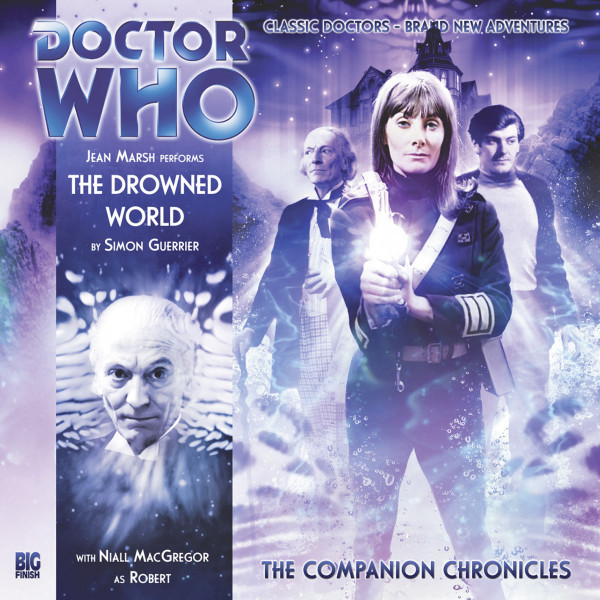

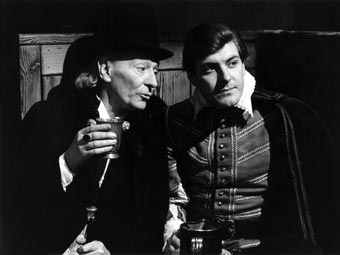
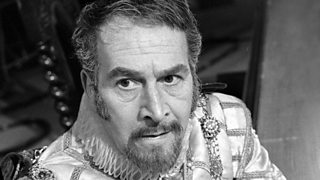
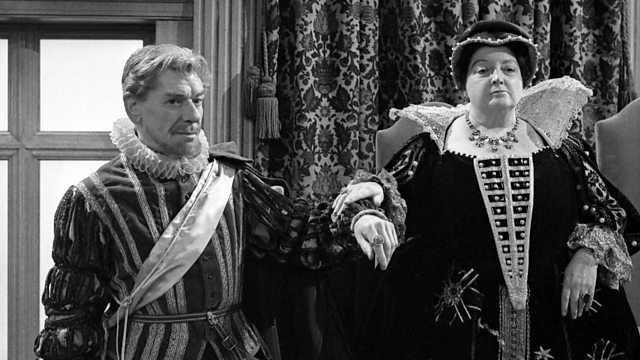
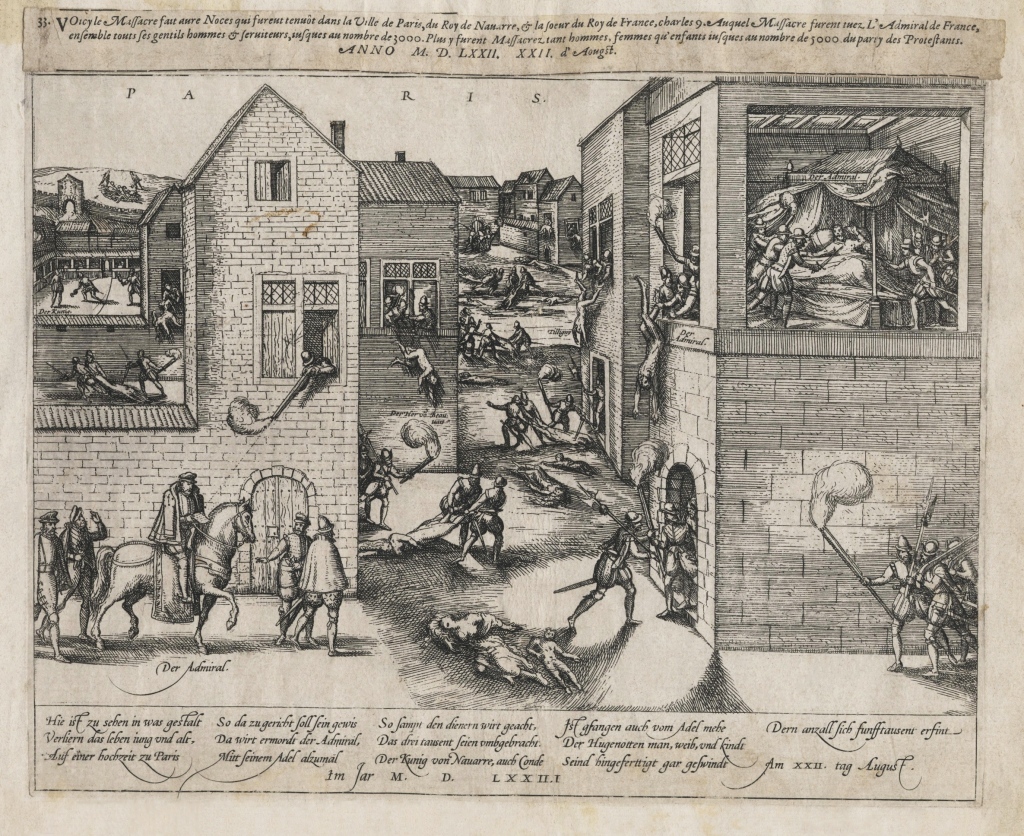
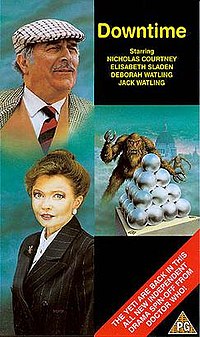
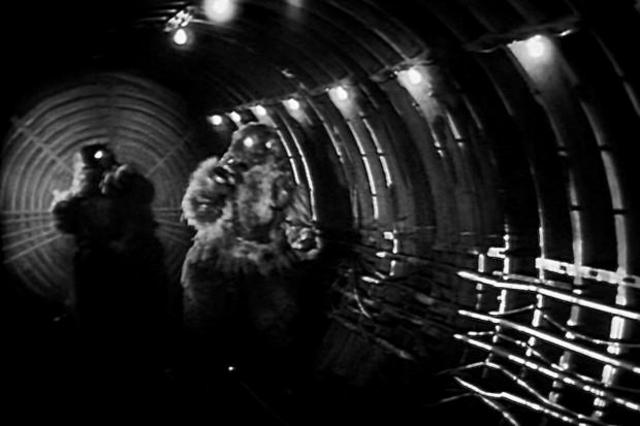


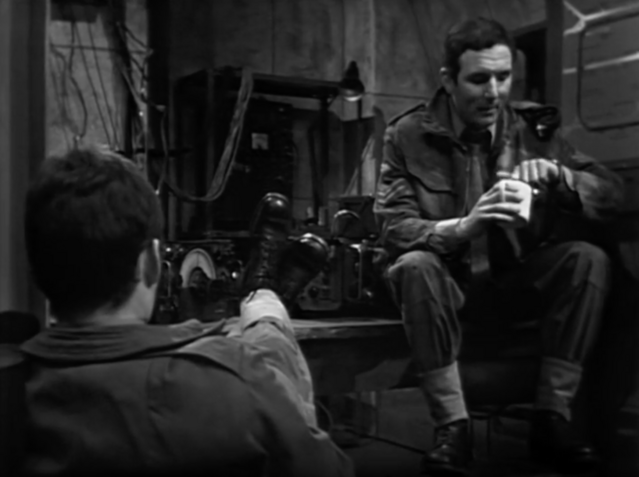

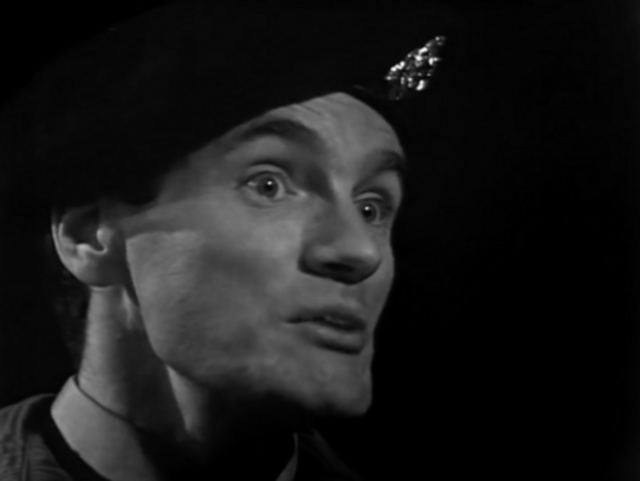



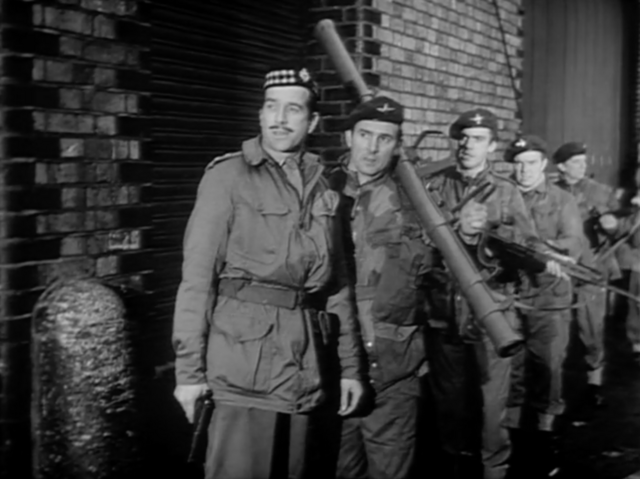
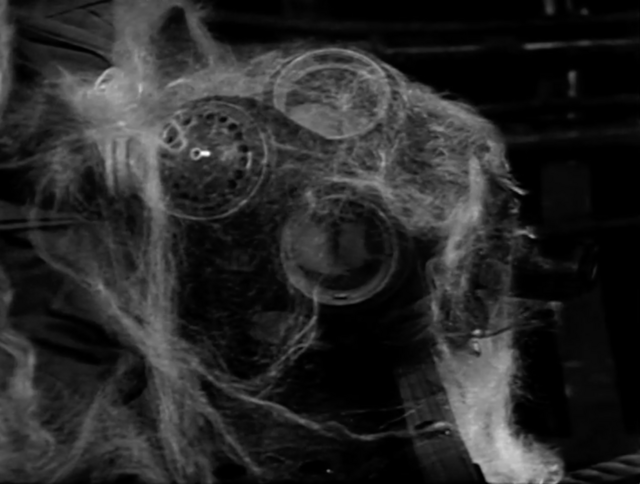
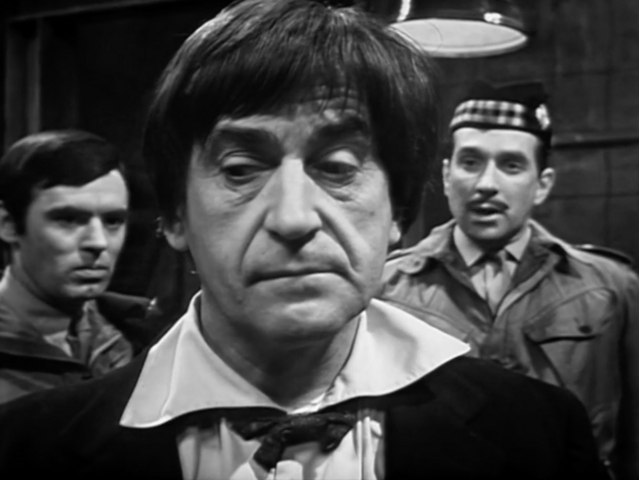



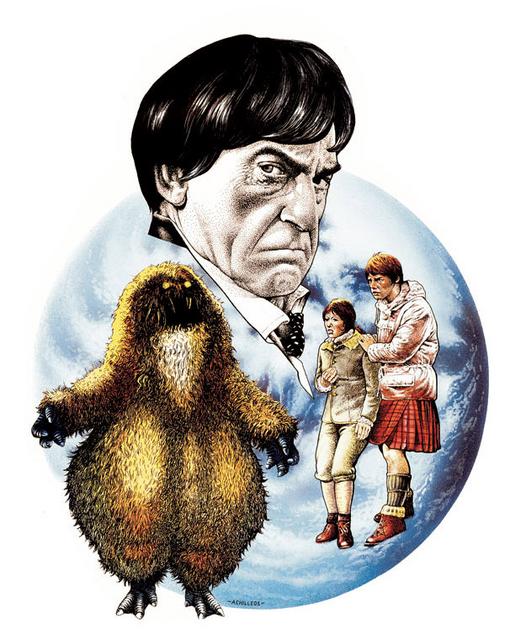


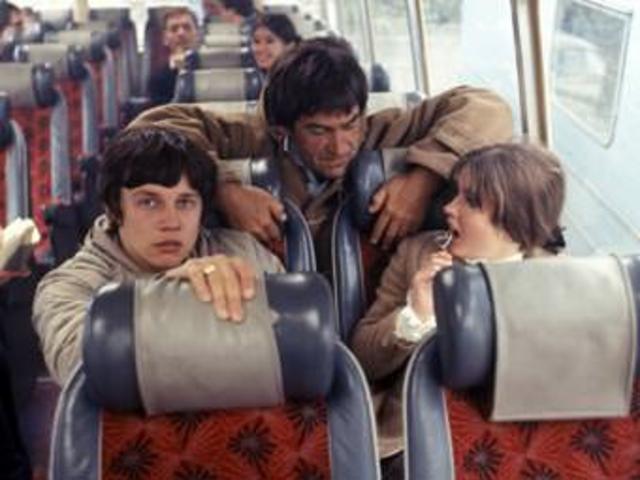
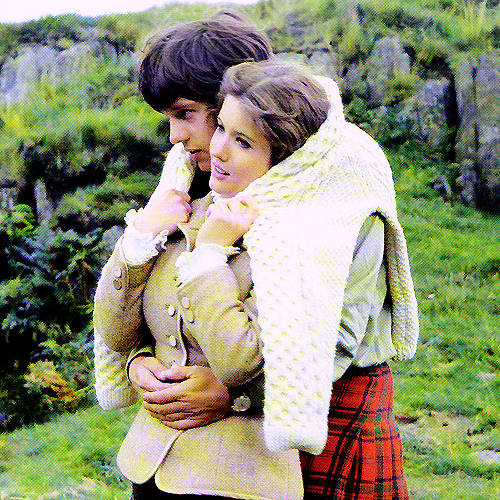

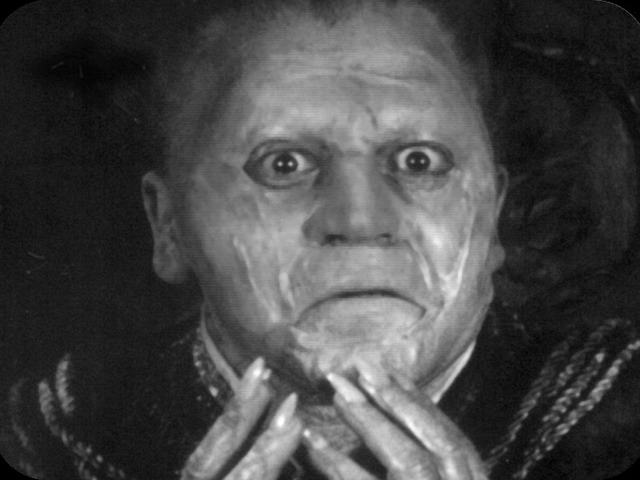
 A Journal of Impossible Things