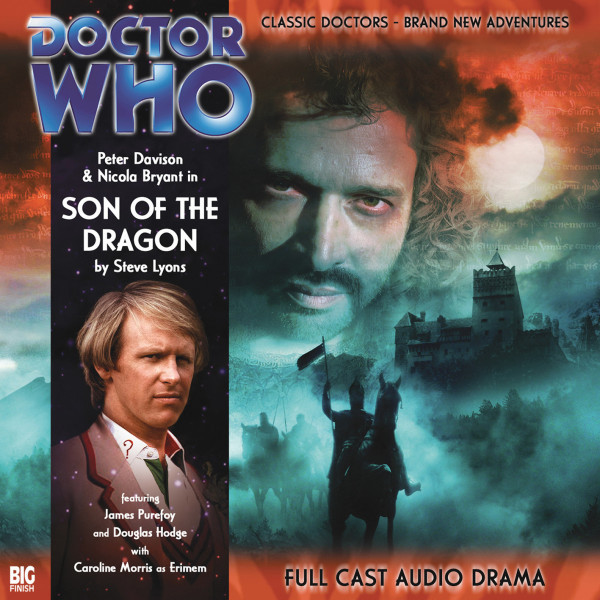
In which the Doctor, Peri and Erimem travel to 15th century Wallachia and meet Vlad the Impaler – Dracula (the ‘Son of the Dragon’ of the title), see his handiwork and meet his brother ‘Radu the Handsome’ (less inclined to impale people on the whole and presumably mote handsome!).
‘Farewell, Great Macedon’ aside, this is my favourite of the Big Finish historical stories. It is superb. Along the way, there are discussions about seeing history and the actions of the main protagonists in context and there is a maturity to the piece which allows us even to view Prince Vlad and his horrific actions from his perspective. In fact, throughout the piece we get a range of perspectives – the Turks, Radu (Vlad’s brother) and his followers, Vlad and his subjects (including ordinary working people) and through a series of conversations with different regulars – the Doctor, Peri and Erimem in particular are our conduit for this, we are enlightened over the course of the story. That is sophisticated, grown-up writing and I really enjoyed listening to this one again.
The joy of a historical story in ‘Doctor Who’ for me at least, lies in the fact that it is a time travel show. Plenty of other books or TV shows depict historical events and do it very well, but ‘Doctor Who’ via the medium of time travel provides a perfect framing device for a contemporary audience. More than that, we don’t just view history through their eyes, they also react and get involved in a way that we might do. Like ‘An American Yankee in King Arthur’s Court’, we get a modern perspective on the past – in this case Peri’s absolute horror at Prince Vlad and the violence of the age. More than that, we also get the Doctor’s unique perspective on history and the nature of time – of its ebb and flow and despite often being deeply embroiled in events, he also at times has a detachment that a wider view sometimes provides. What we also get here, but not often elsewhere, is what Erimem brings. She is much further removed from this time period (mid 15th Century) than Peri is, from deep in the past, but she understands this time period better and that is an almost unique perspective for the series.
Part of me wishes that the modern TV show could address history in this sophisticated way, but too often it has had neither the time required (the four parts here really help and the story enfolds over weeks or months), nor the appetite to do this. More often than not we get ‘print the legend’ short-cut storytelling, lacking subtlety or alternatively giving us comedy Vikings or Nazis. All of which are fine in their own right (I’ve just positively reviewed a comedy after all) but not if that is all we get. If that is the case then we are being a bit short changed. It all seems a bit too easy and rather than being interested in the complexity and those ‘difficult’ aspects of history that are hard to explain to children, we get something bright and shiny and simplistic. This is something that until recently has made me quite sad, that the children of the early 60’s and indeed myself growing up reading the novelisations of stories like ‘The Crusades’, were much better served in this regard – better than most wanted probably! However, this is something that Chris Chibnall has started to address, credit where it is due. ‘Rosa’ was probably the best example of this in years and alien presence aside, ‘Demons of the Punjab’ at least goes some of the way in this regard. It will be interesting to see where the TV show takes this in the future.
Anyway, back to ‘Son of the Dragon’. One thing I thought on the initial listen of this, was that it is a story best told on audio. My reasoning behind that was that it opens with the Doctor and his companions meeting a dying man who has been impaled on a spike, later the scene of 20,000 Turks that Vlad has ordered to be impaled is described. Now that is horrific enough on audio (horrific enough in real life for the Sultan to retreat back home, despite his superior forces), it certainly couldn’t be shown in any form on TV for the show’s time-slot and necessarily a novel would be required to be described these scenes in more graphic detail. Audio gives us just enough to be horrified and for the impact, but not too much for it to be completely obscene.
I will admit that this is a period of history and indeed a region that I know very little about. As such, the story is almost entirely new to me. One of the rather brilliant consequences of this for me personally, is that the beautifully controlled release of information across the story works perfectly when everything is new. It twists and turns with each revelation, only the Doctor has a wider perspective on things and the chain of events. As ever, Peri and in particular Erimem are embroiled deep in the heart of events. Whilst Erimem gets most of the time with Vlad, Peri gets to meet the ‘ordinary folk’ – primarily John Dobrin who is loyal to Vlad. While the Doctor gets what might be second billing, spending most time with Vlad’s brother Radu. However, Radu is far more important to events than he first appears and whilst not a hero (he is ruthless in his own way) the Doctor does get to influence his actions and shape future events. This Doctor’s journey in this story, as in many is from the clown or jester to the wise man and trusted confidante. We also get a very ‘Caves of Androzani’ heroic interpretation of a Doctor determined to rescue Peri and Erimem from the peril they find themselves in – particularly in the light of the Doctor’s fragmentary knowledge of the story of the fate of Vlad’s wife.
What of Vlad himself? Well he is horrific obviously, a merciless, ruthless bully, having his pregnant servant lover killed, the wholesale massacre of his enemies (and those supposed to be his allies) and for the regulars, he throws Peri out of a window and forces Erimem to accept him in order to save the Doctor and Peri’s lives. However, through his betrothal to Erimem and through his conversations with her, we do begin to understand him a little better, through the prism of the murder of his father and brother, betrayal by the Boyars and himself and Radu being held hostage by the Turkish Sultan and growing up in his court. Through his subjects (and Peri) we find that the crime rate has perhaps unsurprisingly plummeted in Wallachia, as the punishments are so severe – rather like Mussolini making the trains run on time! It never spares the horror or the cruelty of his actions – but it does place them in the context of his life and the times. Pairing him with Erimem (she has given him her word and bond and she remains loyal to him) is a very astute piece of storytelling. As an, albeit uncrowned, Pharaoh, she comes from a much earlier time period and the harshness of this period, really is nothing new for her or the actions required to remain a leader (she lost her own throne). It is fascinating. And again, very grown-up storytelling.
I can’t emphasise enough how continually amazed I am by the casts that Big Finish put together. I am not saying this to knock the TV show in any way, as Andy Pryor in particular has done a superb job over the years, even if we’ve sometimes had great people in pretty small roles where you wish they had more screen-time – but these plays are often at least the equal of the TV show and sometimes surpass it. Here we have James Purefoy as Vlad – and he is just superb in this, a really towering performance and great use of his vocal talents and almost as good is Douglas Hodge as Radu. The latter could have been the lesser role, he’s the brother who isn’t the impaling one, but it is beautifully written and a really great performance by a top actor. Add in the regulars – each on superb form in their own right and the cast is pretty stellar.
One of the joys of ‘Doctor Who’ is the range of stories that can be told and different ways in which they can be framed. Sometimes you feel like listening to a fun run around type story or a comedy like ‘The Kingmaker’, but as a grown-up (well at least a part time one!), sometimes I want to be rewarded by something more and a story like this plays that role for me. On another day with another writer, the story of Richard III and the princes in the tower could be told in this way – a serious, dark look at someone that history has cast as a monster – on another day it is a broad comedy! I have another couple of stories coming up that feature figures from history that are relatively unloved or in some cases detested and it is an interesting contrast how each are treated.Overall, I suspect that this story might, a bit like ‘The Massacre’ for example, divide opinion, but like that story, it is one that I really love and really rewards a re-listen.
I am going to leave Erimem here for the moment I might return to her some other time. First a few words about her. To my mind, like Evelyn or Charley or Lucie or Liv she is a really great companion and a terrific original creation from Big Finish. As I have already mentioned, there are some parallels with Leela, but she is also quite different – she is forthright, stubborn and passionate, but her perspective as someone born and raised to lead is something that just works in a historical context. She also works beautifully with the Fifth Doctor and particularly with Peri, who gets a younger sister, friend and confidante, someone who is also an older head at times. Their relationship works really well, they fight and argue at times – but always for a reason and they always make up. I understand the reasons why she was eventually written out, but it is a shame she hasn’t been revisited in the way that Charley, Evelyn and (soon) Lucie have been.

