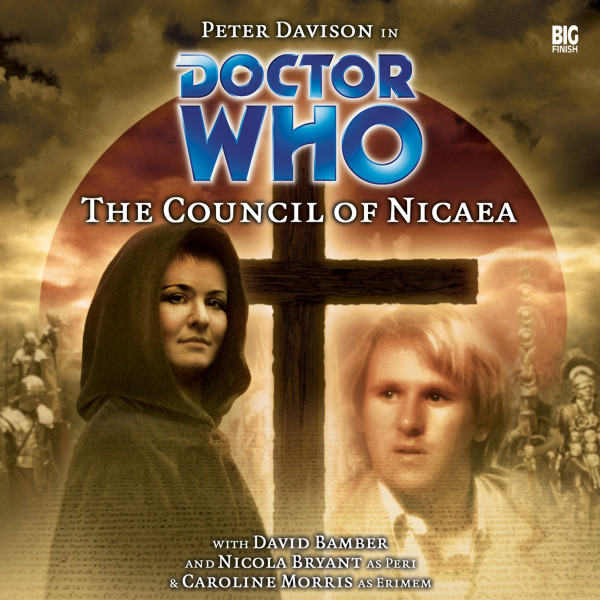
In which the Fifth Doctor, Peri and Erimem discover a schism in the Christian church in Nicaea in (modern-day Turkey) 325AD and Erimem upsets the Emperor Constantine.
Well, it isn’t often that you get to review a ‘Doctor Who’ story written by your local vicar! The author of this play – Caroline Symcox (married to Paul Cornell) is the vicar of Fairford which is not far from where I live. It is a beautiful church and my favourite place for a coffee overlooks it. I’ve spent many a morning there reading DWM or a Target Book while the church bells ring out.
Anyway, on with the story. On the face of it, the premise doesn’t sound too exciting – a council to decide whether Jesus was created out of nothing or out of the being of God. To most of us without a background in theology, that would provoke a shrug, but the story shows very well how much this meant not just to the church authorities, but to the ordinary people of the time as well. The masses take sides and there are riots in the streets. The supporters of Arius (whose views on the divinity of Jesus are viewed as heretical by many in the church)|, including the shrewd political operator Athanasius. Into this powder keg arrive the Fifth Doctor and his rather outspoken young charges – Peri and Erimem. Despite the Doctor’s warnings Erimem in particular wades into a situation that she knows little about, something which threatens all of their lives and also to fracture their friendship. Erimem is nothing if not forthright and outspoken and this time period is closer to her own time. She instinctively sides with Arius, not because she believes in his cause or understands the theological arguments, but rather because she senses injustice as he won’t be allowed to speak at the council. She also gets to show off her leadership skills – marshalling Arius’s supporters and organising a protest march. All of which allows us to meet the working people who support Arius and gives us a glimpse of the world at this time.
Of the other protagonists, the Emperor Constantine (the excellent David Bamber from ‘Mummy on the Orient Express’) wants unity and harmony in his empire, he doesn’t much care how it is achieved, but the First Council of Nicaea is his attempt to avoid a split in the church peacefully. He is quite a fascinating character as portrayed here – ruthless, but not without morality. After the Doctor is seen trying to stop the violence in the streets, Constantine co-opts him as a special envoy to the council. Just one problem he brings Peri and particularly Erimem with him. Her outburst at the Council lands the Doctor and Peri in trouble and threatens to unleash reprisals from the Roman troops on the street.
The Doctor is a peacemaker in all of this, he knows what the future holds – that Arius will be forced into exile, but after a few years Constantine will reverse this decision. Erimem thinks that her friends have betrayed her and as such, this is a great character piece for her. Likewise Peri who is put in a very difficult situation between two friends – Erimem who is trying to change history and the Doctor, who for once sides with authority. On those terms it works very well. Ultimately, it is the Doctor’s intervention with Constantine, which defuses a stand-off at the demonstration that Erimem has organized and avoids a massacre by the Legionnaires.
This is an interesting play overall, maybe not big on excitement and adventure, but it is very accomplished and a fascinating, thoughtful, grown-up listen. What I personally love about it is that rather like ‘The Massacre’, it isn’t a period of history that I would otherwise know anything about and spending time immersed in this world was ultimately a rather rewarding experience.

