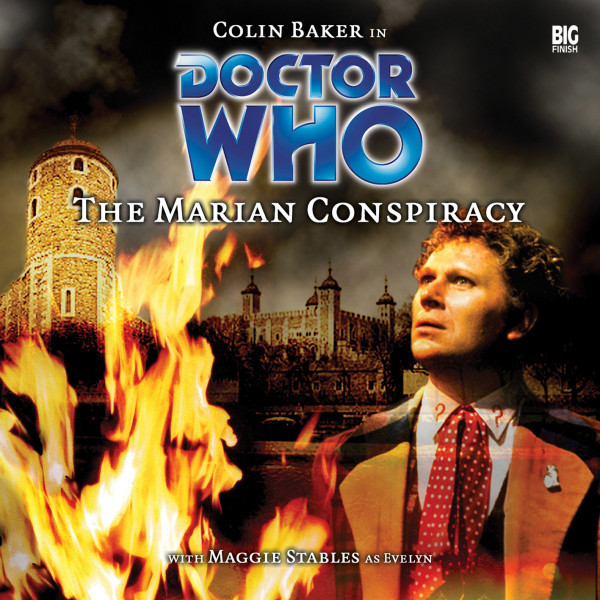
In which the Sixth Doctor meets a new best friend and Evelyn learns that history isn’t always quite as it seems.
This is a very early Big Finish release (no. 6 released in March 2000, when the universe was less than half its present size – or at least a much nicer place) and I tend to think of it as the start of the rehabilitation of Colin Baker’s Doctor. Some would argue that he didn’t need rehabilitating and others would argue that he’s not really any better on audio. I’d disagree with both those views – he did and he is. I return far more frequently to his audio stories than those on TV and whereas I’m unlikely to buy season 23 on Blu-ray, there a couple of his BF releases coming up that I quite fancy. This is his third story for the range (after ‘Sirens of Time’ and ‘Whispers of Terror’) and introduces a companion that would define these early years of his run on audio. She also has quite a profound impact on the way his character is portrayed and to my mind, it is one of the most astute pieces of character work for the show (kudos to Gary Russell for this), finding a pairing that really brings out the best in this Doctor.
We start the story with the Doctor interrupting a university lecture by Doctor Evelyn Smythe (the wonderful Maggie Stables), a specialist in Tudor history with his gadget to detect time distortion going off rather loudly! She takes some persuading, but she is at the centre of a temporal nexus point centred on her family and in particular a John Whiteside-Smith, an advisor to Elizabeth I. Her family starts to disappear from history, the ink vanishing from the pages of her history books and Evelyn herself even starts to fade away before the Doctor intervenes. So, with her physical form stabilised by an obligatory gadget, he takes her with him back to the Tudor court (in the not quite the right time period obviously) and in a way that is reminiscent of Barbara in season one – the history professor gets to visit the very period she specializes in.
Paired with a rather formidable, but rather endearing older woman, the Sixth Doctor is actually fun to spend time with. His extravagant personality is still there, but the bombast is dialled down and she well and truly puts him in his place, in way that Peri never really did on TV. It is a combination that works perfectly, it also helps that the Doctor gets some lovely, quieter character moments in this story and that Colin decides that acting, rather than overacting is actually a good thing. What is quite nice for Evelyn within this story is that her knowledge of the history of this time and her opinion of Mary proves not quite as complete or as clear cut as she thought. She shows her naivety at times as well, some of the events of this story happen directly as a result of her talking out of turn or not understanding the consequences of time travel. While the Doctor hob nobs at court, Evelyn mixes in the tavern with the working classes, which embroils her in a plot – she toasts good Queen Bess, however the Doctor has his sums wrong and Mary is still on the throne! She also gets to show her compassion (she is far from being a dragon) and her almost motherly instincts – which come from the way she looks after her students rather than a family of her own. These two aspects recur across her run of stories and are an endearing, likeable feature. At the end of the story you feel that both Evelyn and the Doctor have learned from their experiences and most importantly evidently enjoy spending time in each other’s company, in turn I enjoyed spending time with them – easy isn’t it sometimes?
Like ‘Son of the Dragon’, ‘The Kingmaker’ and at least one of the stories to come, at the centre of this story is a real figure from history who is rather maligned – maybe not to the degree of Vlad the Impaler, but someone who nonetheless is responsible for the deaths of thousands. This is Queen Mary. Evelyn instinctively sides with her hero Elizabeth (who is not in this story – she is mentioned, but the focus is very much on Mary), but over the course of the story, Evelyn at least learns to have some sympathy for her. Likewise, the Doctor, who displays a rare empathy for Mary – her loveless marriage, her inability to produce a male heir, her illnesses and phantom pregnancies. In the process he becomes a trusted advisor and the subject of the amorous attentions of one of Mary’s ladies in waiting! As with Vlad in the previous story, we do at least learn that despite her religious zeal, there is another side to her. All of which is balanced in those moments when it is clear that she is perfectly happy to deal with those she views as heretics in horrific ways. The impacts of her changes to the law become clear through Sarah, her Lady-in-Waiting, who it transpires married a priest when this was legal under her brother Edward. This is now illegal thanks to the new queen and Mary has no sympathy for those caught in this predicament. Mary is by turns frightened and vulnerable and horrific, it is a great performance by Annah Ruddin and brings out the best in Colin Baker as well.
The exchanges between the Doctor and Mary and also Sarah are compassionate, caring and thoughtful and then in the case of Mary they veer off into the terrifying as the religious zealot surfaces. One of my favourites is a beautiful quiet moment between the Doctor and Sarah, musing on his own actions in a way which mirrors his own views on Mary (who also believes she is doing the right thing), it is a scene that Colin plays in a beautifully restrained way:
‘What would you say if I were to tell you that I once destroyed an entire race, that I have led friends to their deaths and caused numerous wars. That my intervention has led to peaceful people taking up arms and good people having their faith or reason destroyed. Because I failed to act millions upon millions of people have been enslaved or killed. What if I had done all of those things but had always, always believed I was doing to the right thing’
The Doctor and Evelyn end up embroiled in plots to oust Mary and put Elizabeth on the throne, assassination attempts and also plots by the French ambassador to discredit them both. The story ebbs and flows, without ever really feeling like there is a huge amount of jeopardy – it lacks the pervading sense of danger of something like ‘Son of the Dragon’, despite the obligatory threat of execution or the tower. One of the cliffhangers is even Mary rewarding the Doctor by telling him that she will arrange a wife for him – with Sarah his intended! However, despite that the story is a very pleasant way to spend time and an interesting, well-crafted story that gets the best out of its protagonists. The ending – saving Evelyn’s new (protestant) friends – Crow, Leaf and their families from the religious persecution to come, has later echoes in both the BF and TV tellings of the story of Pompeii (coming soon).
A quick word on the writer. Jac Rayner was one of those very rare things back in the day – a female, British ‘Doctor Who’ fan and more than that a very capable writer of both books and audio. She was also an exec on the early Big Finish productions and worked on the Benny adaptations which resulted in BF getting the Who licence, I will cover some of her other stories later in this blog but it would be great to hear some new stuff for Big Finish from her.
Overall, this a lovely story, an old favourite and a brand new start for an old Doctor – as he once said: ‘Change my dear and it seems not a moment too soon’.

