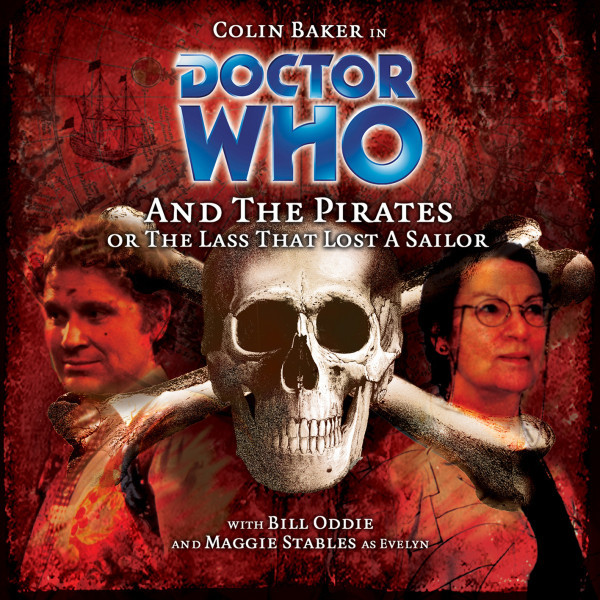
Doctor Who and the Pirates (or the lass that lost a sailor) by Jacqueline Rayner (2003)

In which a Gallifreyan Buccaneer and the pirate ‘Evil Evelyn’ battle the insane pirate leader Red Jasper and help a young girl make it through the night.

Warning. Contains singing!

Welcome everyone to ‘Doctor Who’s’ only unreliable narrator, pirate musical, ermm thing…

To start off this review off, I thought a flavour of this story – or at least episode 3, would best be achieved for those who are otherwise unacquainted with it through a song – there are two versions on youtube, one with moving pictures and one without – feel free to choose your favourite! just search for ‘The Very Model Of A Gallifreyan Buccanneer’.

One of my very favourite things about Big Finish are the sheer number of things that they produce that sound like really, really bad ideas, but actually work brilliantly. ‘Doctor Who’ does a musical in the style of Gilbert & Sullivan, with pirates doesn’t sound great does it? Especially, if like me, you happen to hate musicals. So, here’s the strange thing – I love this thing and now I’ve got to try and explain why – and I’m not sure I actually can or if I can even get out of this review with my dignity intact!

Some stories like ‘Warriors Gate’ or ‘Kinda’ or ‘Ghost Light’ (or ‘Scherzo’ or ‘Natural History of Fear’ for that matter) are experimental in that they are weird or surreal or plain difficult to fathom. Others experiment with content or form – the prime example be ‘Love and Monsters’ for me, which also features music used in an unusual context for the show and an unreliable narrator. It is the latter that that this story has most in common with. It is a story within a story, which changes from a children’s tale of pirates and the high sea adventures, to a musical, to a tragedy and just when you think you know what it is, it changes again – the story isn’t a fiction, but uses the trapping of different forms of fiction to a specific and rather sad end. Evelyn is very much the unreliable narrator – making up names on the fly (John Johnson, Tom Thomson etc.) and when the Doctor shows up, he is not much better either, so we end up confused as to whether the story is real or a fiction in of itself. One of the episode cliffhangers is even the Doctor about to sing, cutting off Colin just in his big moment ‘oh no, you are going to sing!’!

In this play, like Scherzerade, Evelyn tells a story to her student Sally to help her get through the night – we learn this over the course of the story. And at the same time the story is helping Sally, it also helps Evelyn to get over her own loss – which also that becomes apparent over the course of the four episodes. You see, Sally has accidentally killed someone in a car crash and broken hearted has left a suicide note for her tutor Evelyn. The story that Evelyn tells is a story of pirates, of treasure buried on a desert island, of a young cabin boy Jem and of the insane pirate leader Red Jasper, played by the incomparable Bill Oddie! Part ‘Captain Pugwash’, part ‘Treasure Island’ and part ‘HMS Pinafore’ – with a little bit of ‘It’s a Wonderful life’ thrown in – oh and a Gilbert & Sullivan version of the Who theme at the end! It is very silly, funny at times and very moving – but like something like ‘The Myth Makers’ it also descends suddenly into bloodshed and is no longer so silly. Oddie’s Red Jasper is in the end, an insane sadist and killer and is happy to slaughter Jem for that old cliche – the treasure map. Evelyn is heartbroken and powerless to stop him.

It is another set of tour-de-force performances from Maggie Stables and Colin Baker, ably assisted by Bill Oddie (who clearly relishes this, but won’t be to everyone’s taste), Nicholas Pegg as the foppish RN Captain Swan and in particular Helen Goldwyn as Sally. The story gives Maggie Stables a lot to do, leading the survivors of the Sea Eagle, but most of all in her motherly relationship with Jem, the cabin boy in the inner story and with her student Sally in the outer story. She loses Jem tragically, but is determined to save Sally. Again, her relationship with Doctor, who gently supports her through this difficult night, whilst also going off into Gilbert & Sullivan territory, works remarkably well. I thought, before we leave her here (I’ll be back at some point) it was worth looking at the character summary that Gary Russell originally put together for Evelyn, amongst the detail we have:

Characteristics: Think Emelia Rumford, meets Angela Lansbury, meets Margaret Rutherford, meets Cameca, meets Maggie Stables (he already wanted her to play the role) .

Things to avoid: Not as dotty as Amelia Ducat. And most of all, be careful not to let her and the Doctor’s conflicts to get near Peri levels. I simply do not want anything as boring as that. Let their mutual respect and liking for each other show.

Wise words. People sometimes mock Gary Russell for his novels, but I would say he makes a terrific Exec producer for Big Finish and that section is typical of the sort of clever character work that we get across his time in charge. It works very well here and Evelyn is one of the jewels in the BF crown to my mind.

It would be remiss of me not to say that plaudits should also go to Tim Sutton for the music and David Darlington for sound. The musical part of the story is only really episode three (something which surprised me and didn’t match my memories of the play), but it is a testament to all involved that I really enjoyed it, despite my dislike for the genre!

So, all in all a quite an amazing creation. I have absolutely no idea how fandom views this one, so it will be interesting to see whether anyone on this thread has heard it and to hear your own opinions on it all. I don’t know what else to say about this one. You really have to hear for this for yourselves to judge properly. Rather like the generation which grew up being told that ‘The Gunfighters’ was rubbish, some now love it, some still hate it, some like me are largely ambivalent – but you have to see it for yourself to decide, give this a listen – it is at least never dull!
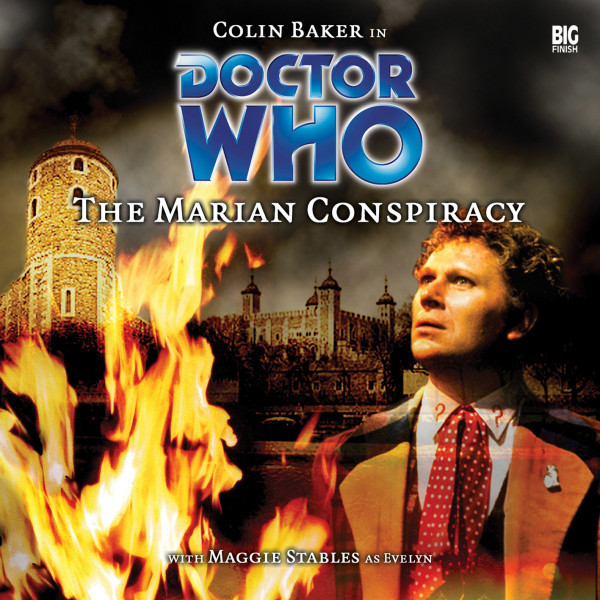
The Marian Conspiracy by Jacqueline Rayner (2000)

In which the Sixth Doctor meets a new best friend and Evelyn learns that history isn’t always quite as it seems.

This is a very early Big Finish release (no. 6 released in March 2000, when the universe was less than half its present size – or at least a much nicer place) and I tend to think of it as the start of the rehabilitation of Colin Baker’s Doctor. Some would argue that he didn’t need rehabilitating and others would argue that he’s not really any better on audio. I’d disagree with both those views – he did and he is. I return far more frequently to his audio stories than those on TV and whereas I’m unlikely to buy season 23 on Blu-ray, there a couple of his BF releases coming up that I quite fancy. This is his third story for the range (after ‘Sirens of Time’ and ‘Whispers of Terror’) and introduces a companion that would define these early years of his run on audio. She also has quite a profound impact on the way his character is portrayed and to my mind, it is one of the most astute pieces of character work for the show (kudos to Gary Russell for this), finding a pairing that really brings out the best in this Doctor.

We start the story with the Doctor interrupting a university lecture by Doctor Evelyn Smythe (the wonderful Maggie Stables), a specialist in Tudor history with his gadget to detect time distortion going off rather loudly! She takes some persuading, but she is at the centre of a temporal nexus point centred on her family and in particular a John Whiteside-Smith, an advisor to Elizabeth I. Her family starts to disappear from history, the ink vanishing from the pages of her history books and Evelyn herself even starts to fade away before the Doctor intervenes. So, with her physical form stabilised by an obligatory gadget, he takes her with him back to the Tudor court (in the not quite the right time period obviously) and in a way that is reminiscent of Barbara in season one – the history professor gets to visit the very period she specializes in.

Paired with a rather formidable, but rather endearing older woman, the Sixth Doctor is actually fun to spend time with. His extravagant personality is still there, but the bombast is dialled down and she well and truly puts him in his place, in way that Peri never really did on TV. It is a combination that works perfectly, it also helps that the Doctor gets some lovely, quieter character moments in this story and that Colin decides that acting, rather than overacting is actually a good thing. What is quite nice for Evelyn within this story is that her knowledge of the history of this time and her opinion of Mary proves not quite as complete or as clear cut as she thought. She shows her naivety at times as well, some of the events of this story happen directly as a result of her talking out of turn or not understanding the consequences of time travel. While the Doctor hob nobs at court, Evelyn mixes in the tavern with the working classes, which embroils her in a plot – she toasts good Queen Bess, however the Doctor has his sums wrong and Mary is still on the throne! She also gets to show her compassion (she is far from being a dragon) and her almost motherly instincts – which come from the way she looks after her students rather than a family of her own. These two aspects recur across her run of stories and are an endearing, likeable feature. At the end of the story you feel that both Evelyn and the Doctor have learned from their experiences and most importantly evidently enjoy spending time in each other’s company, in turn I enjoyed spending time with them – easy isn’t it sometimes?

Like ‘Son of the Dragon’, ‘The Kingmaker’ and at least one of the stories to come, at the centre of this story is a real figure from history who is rather maligned – maybe not to the degree of Vlad the Impaler, but someone who nonetheless is responsible for the deaths of thousands. This is Queen Mary. Evelyn instinctively sides with her hero Elizabeth (who is not in this story – she is mentioned, but the focus is very much on Mary), but over the course of the story, Evelyn at least learns to have some sympathy for her. Likewise, the Doctor, who displays a rare empathy for Mary – her loveless marriage, her inability to produce a male heir, her illnesses and phantom pregnancies. In the process he becomes a trusted advisor and the subject of the amorous attentions of one of Mary’s ladies in waiting! As with Vlad in the previous story, we do at least learn that despite her religious zeal, there is another side to her. All of which is balanced in those moments when it is clear that she is perfectly happy to deal with those she views as heretics in horrific ways. The impacts of her changes to the law become clear through Sarah, her Lady-in-Waiting, who it transpires married a priest when this was legal under her brother Edward. This is now illegal thanks to the new queen and Mary has no sympathy for those caught in this predicament. Mary is by turns frightened and vulnerable and horrific, it is a great performance by Annah Ruddin and brings out the best in Colin Baker as well.

The exchanges between the Doctor and Mary and also Sarah are compassionate, caring and thoughtful and then in the case of Mary they veer off into the terrifying as the religious zealot surfaces. One of my favourites is a beautiful quiet moment between the Doctor and Sarah, musing on his own actions in a way which mirrors his own views on Mary (who also believes she is doing the right thing), it is a scene that Colin plays in a beautifully restrained way:

What would you say if I were to tell you that I once destroyed an entire race, that I have led friends to their deaths and caused numerous wars. That my intervention has led to peaceful people taking up arms and good people having their faith or reason destroyed. Because I failed to act millions upon millions of people have been enslaved or killed. What if I had done all of those things but had always, always believed I was doing to the right thing’

The Doctor and Evelyn end up embroiled in plots to oust Mary and put Elizabeth on the throne, assassination attempts and also plots by the French ambassador to discredit them both. The story ebbs and flows, without ever really feeling like there is a huge amount of jeopardy – it lacks the pervading sense of danger of something like ‘Son of the Dragon’, despite the obligatory threat of execution or the tower. One of the cliffhangers is even Mary rewarding the Doctor by telling him that she will arrange a wife for him – with Sarah his intended! However, despite that the story is a very pleasant way to spend time and an interesting, well-crafted story that gets the best out of its protagonists. The ending – saving Evelyn’s new (protestant) friends – Crow, Leaf and their families from the religious persecution to come, has later echoes in both the BF and TV tellings of the story of Pompeii (coming soon).

A quick word on the writer. Jac Rayner was one of those very rare things back in the day – a female, British ‘Doctor Who’ fan and more than that a very capable writer of both books and audio. She was also an exec on the early Big Finish productions and worked on the Benny adaptations which resulted in BF getting the Who licence, I will cover some of her other stories later in this blog but it would be great to hear some new stuff for Big Finish from her.

Overall, this a lovely story, an old favourite and a brand new start for an old Doctor – as he once said: ‘Change my dear and it seems not a moment too soon’.

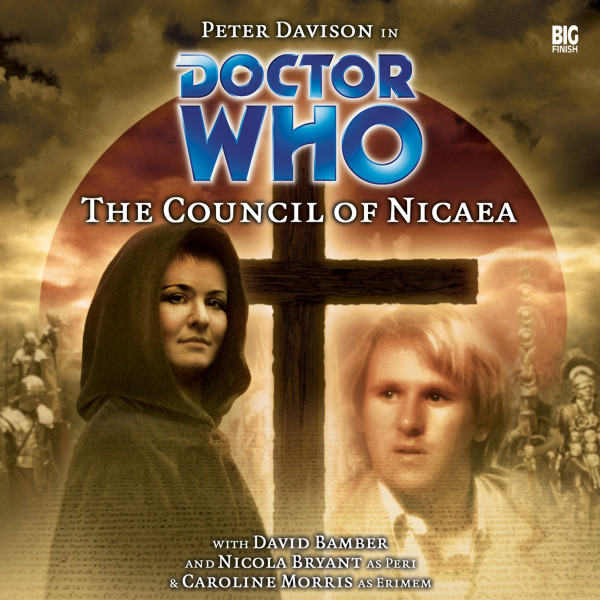
The Council of Nicaea by Caroline Symcox (2005)

In which the Fifth Doctor, Peri and Erimem discover a schism in the Christian church in Nicaea in (modern-day Turkey) 325AD and Erimem upsets the Emperor Constantine.

Well, it isn’t often that you get to review a ‘Doctor Who’ story written by your local vicar! The author of this play – Caroline Symcox (married to Paul Cornell) is the vicar of Fairford which is not far from where I live. It is a beautiful church and my favourite place for a coffee overlooks it. I’ve spent many a morning there reading DWM or a Target Book while the church bells ring out.

Anyway, on with the story. On the face of it, the premise doesn’t sound too exciting – a council to decide whether Jesus was created out of nothing or out of the being of God. To most of us without a background in theology, that would provoke a shrug, but the story shows very well how much this meant not just to the church authorities, but to the ordinary people of the time as well. The masses take sides and there are riots in the streets. The supporters of Arius (whose views on the divinity of Jesus are viewed as heretical by many in the church)|, including the shrewd political operator Athanasius. Into this powder keg arrive the Fifth Doctor and his rather outspoken young charges – Peri and Erimem. Despite the Doctor’s warnings Erimem in particular wades into a situation that she knows little about, something which threatens all of their lives and also to fracture their friendship. Erimem is nothing if not forthright and outspoken and this time period is closer to her own time. She instinctively sides with Arius, not because she believes in his cause or understands the theological arguments, but rather because she senses injustice as he won’t be allowed to speak at the council. She also gets to show off her leadership skills – marshalling Arius’s supporters and organising a protest march. All of which allows us to meet the working people who support Arius and gives us a glimpse of the world at this time.

Of the other protagonists, the Emperor Constantine (the excellent David Bamber from ‘Mummy on the Orient Express’) wants unity and harmony in his empire, he doesn’t much care how it is achieved, but the First Council of Nicaea is his attempt to avoid a split in the church peacefully. He is quite a fascinating character as portrayed here – ruthless, but not without morality. After the Doctor is seen trying to stop the violence in the streets, Constantine co-opts him as a special envoy to the council. Just one problem he brings Peri and particularly Erimem with him. Her outburst at the Council lands the Doctor and Peri in trouble and threatens to unleash reprisals from the Roman troops on the street.

The Doctor is a peacemaker in all of this, he knows what the future holds – that Arius will be forced into exile, but after a few years Constantine will reverse this decision. Erimem thinks that her friends have betrayed her and as such, this is a great character piece for her. Likewise Peri who is put in a very difficult situation between two friends – Erimem who is trying to change history and the Doctor, who for once sides with authority. On those terms it works very well. Ultimately, it is the Doctor’s intervention with Constantine, which defuses a stand-off at the demonstration that Erimem has organized and avoids a massacre by the Legionnaires.

This is an interesting play overall, maybe not big on excitement and adventure, but it is very accomplished and a fascinating, thoughtful, grown-up listen. What I personally love about it is that rather like ‘The Massacre’, it isn’t a period of history that I would otherwise know anything about and spending time immersed in this world was ultimately a rather rewarding experience.

The Church and the Crown by Mark Wright and Cavan Scott (2002)

In which the Fifth Doctor, Peri and Erimem end up in an Alexandre Dumas novel – a tale of Musketeers, Richelieu’s guards, court politics, Queen Anne, a vain King Louis and the Duke of Buckingham’s attempts to invade France!

There are quite a few different ways to do a ‘Doctor Who’ historical – one is a philosophical piece on the dangers of changing history, another meeting famous historical figures or important events in history (either through the eyes of the big players or a more social history approach) and another is the action, derring-do world of the historical romance (think more of ‘The Smugglers’ or to some extent ‘The Highlanders’). The latter is the world of ‘The Church and the Crown’. It opens with a literal battle between the church (Cardinal Richelieu) and the crown (King Louis) – this time over the chessboard, but soon and for most of the play, they will be at loggerheads for real, culminating in Richelieu ending up in in the cells. Add in that old standby of a companion of the Doctor as a double of a historical figure – here we have Peri as double of Queen Anne (don’t complain it might be a cliché, but Nicola Bryant’s natural accent – a world away from Peri, in all of its breathy glory is enough to reduce a grown man to a puddle!).

You might not unreasonably think, why, what is the point? Well, the point is that it is tremendous fun and hugely entertaining and sometimes that is enough for me, others might disagree – but for me the primary purpose of a ‘Doctor Who’ story is entertain and divert. If it is interesting and has something profound to say as well, well great that is a bonus. This play might not have the depth of ‘Farewell Great Macedon’, ‘The Aztecs’ or some of the other stories in this run, but it delivers an exciting, fast paced adventure with plenty of good stuff for Peri, Erimem and the Doctor. So, whilst not 10/10 fare, it still manages to be superior stuff.

If you don’t know Erimem, she joined this TARDIS team in a story set in ancient Egypt called the ‘The Eye the Scorpion’. She is the Pharaoh Erimemushinteperem or rather was, the Doctor and Peri offered her a way out of being deposed by opponents. This is her first story as part of the TRADIS crew. As unlikely as this sounds, she fits in brilliantly with Peri and this Doctor. Peri and her become like sisters and their relationship is really rather touching. It doesn’t always run smoothly, just like sisters, but it works beautifully and brings out the best in Peri.

Like the Peri of these Big Finish stories, Erimem stands for absolutely no messing and is highly opinionated – giving both the King and Queen a very frank assessment of the standard of their leadership. She also works quite brilliantly in these historical stories, as she comes from a completely different time, the stories I am covering here are all in her future and as an ex-ruler of a country has a very different perspective when meeting royalty and leaders (more to come in later reviews on this). At times you do slightly wonder what the Fifth Doctor has done to deserve to travel with these two after Tegan, Adric and Turlough, but they function amazingly well as a team, with only a few exceptions (I can think of one story in their run in particular that should never have been made). The Doctor almost becomes like a harassed school teacher or an uncle showing his headstrong nieces around the world.

So, how does Davison’s Doctor work in a historical story? Well, I have little run of these to come, but incredibly well I think. He is the Doctor that everyone starts off thinking is a fool (literally a fool or jester in some cases), but earns the respect of those around him. Anyone who has heard Peter Davison read any of the Target books should know what a great narrator he is, injecting great energy and urgency into the material (he even manages this with ‘Castrovalva’!). Likewise, he works very well in full-cast audio drama (as here), maturing over the years and becoming somewhat spikier. Here (it can’t really be 17 years ago can it?), he still feels more like the Doctor he was on TV, he gets to play the innocent abroad, but also when called for steps up and is as good with the sword as any Musketeer. My favourite moments are his disappointment when trying to get a rousing chant of ‘All for one and one for all’ going only to be met with bemused silence by the musketeers Ruffet and Delmarre. It must also be one of the few stories where the Doctor (this very English Doctor especially) helps another nation to stop an English invasion – although it won’t be the last story in this run where the English are the villains of the piece.

With regard to the subject matter, I have rather fond memories of Michael York/Richard Lester Musketeer films of the 70’s – a staple of many a Bank Holiday and although possessing more depth than those, this play is possessed of much the same sense of fun, energy, adventure, romance and sometimes bawdy humour – all with added ‘Doctor Who’. I’m not going to try to tell you that this is up there with ‘The Aztecs’, it isn’t, but it was very enjoyable listen all the same.

The Angel of Scutari by Paul Sutton (2009)

In which Hex meets one of his heroes and Ace gets chatted up by Tolstoy!

Now this is a story I should really love. Set during the Crimean War, this is partly a homage to Tolstoy’s ‘Sebastapol Sketches’, which I’ve read a couple of times – I became obsessed with Tolstoy for some reason in my early 20’s. This is a period that is also covered in another favourite book of mine – Beryl Bainbridge’s ‘Master Georgie’. The big headline plot component is Hex getting to meet and work with his hero – Florence Nightingale (played very well by Jeanny Spark). With appearances from various other real historical figures and set in an interesting conflict on the cusp of the modern world, it should be great. And yet, it isn’t quite as successful as some of the other stories I have reviewed. Why is that?

Well if there is a fault with the story, it is that it somewhat squanders the strongest cards in its hand and loses coherency at the same time. There was a lot of mileage in both Hex struggling to transform the standard of healthcare at the military hospital (sometimes with anachronistic technology) and the eventual arrival and meeting Florence and yet a relationship never quite develops, he is tongue tied and embarrassed throughout and that starts out as fine, but gets wearying very quickly. She is an interesting, forthright character – a real force of nature, but doesn’t really get the time she deserves in this story. Likewise, the setup in Sebastapol with Ace and her rescuer/captor – a young Leo Tolstoy. Instead of being trapped in a besieged town, we have a rather pointless chase across Russia and multiple time periods. I suppose in part the split storytelling is already in place through necessity, with the hospital being in Turkey (having to link in with Florence’s story) and the main war in Crimea (to allow Tolstoy and the siege to be shown), that is done quite successfully, splitting the travellers as the Doctor and Ace go to Sebastapol and back in time a month to investigate a mystery setup when they first arrive at Scutari.

The main issues arrive as the Doctor ends up involved in a plot at the British embassy in Petersburg and some quite confusing timey-wimey stuff, involving different time periods and a character they meet in Scutari and in Russia. It just seems to meander and wander too much, when it should have been tight and focussed. Sebastapol and the hospital in Scutari (now part of Istanbul) are where the war is at and nice as it to have the Doctor hob knob with the Tsar (great performance from Hugh Bonneville), it just seems to dilute what should be the main story.

It also falls foul of the problem that ‘The Settling’ neatly sidestepped, what to do with the seventh Doctor in a historical story. He gets involved in all sorts of court and state intrigue and separated geographically and temporally, with the TARDIS lost in an attack in Sebastapol. And inevitably viewed as a spy by both sides in the conflict. It all just gets a bit messy though. Eventually I had to admit I just got a little bit lost where everything was happening and when. All this despite listening to it while I was on my own driving across Western Iceland and so I really could concentrate on the plot without much distraction. It isn’t the non-linear structure per se that is the issue, I will be reviewing some stories soon that make very good use of that technique, it more feels like an issue with execution here.Having said all of that, it is still a very enjoyable play, just that it doesn’t make the most of the setup.

As in ‘The Settling’ Hex is the focus, but here he gets to use his medical skills to try to improve the lives and life expectancy of the wounded. Fighting a slightly losing battle and ‘holding the fort’ until Florence arrives – he becomes ‘The Angel of Scutari’ at the hospital in Turkey where the British wounded are sent. It is a decent performance by Philip Olivier, who is good addition to this TARDIS crew – he’s not quite in the same league as the likes of Charley, Erimem and Evelyn, but a nice character all the same and adds something to the traditional Seventh Doctor/Ace line-up. Some of the other characters though get rather wearying – William Russell – the Times correspondent is a bit one-note, turning belligerent every time the script needs him to be, likewise the psychologically damaged British spymaster – Brigadier-General Kitchen, who plays an important part in the plot.

Overall, an interesting period of history and a decent, but not great story. It is still entertaining and well worth a listen though and as I read back the review, I feel that I might have been a little harsh on it –8 out of 10 stuff.

The Settling by Simon Guerrier (2006)

In which Hex meets an infamous figure from his family’s past and the Doctor delivers a baby.

And we finally get a story set in Ireland. I can’t think of many of those in any of the thousands of ‘Doctor Who’ books, audios and TV stories. From Big Finish – ‘The Book of Kells’, ‘Iterations of I’, some of Molly’s story in ‘Dark Eyes’? Any others that I’ve missed?

So why is this? Well part of it I think, is obviously the history between Ireland and England/Scotland, but more the fact that this history is still very relevant and very raw. As such, it is easier for many creatives particularly those with no Irish connection, just not to take the risk and go there. I sort of understand why this is, if you don’t address the history, you could be accused of ducking these issues and if you do, you get accused of taking sides (normally by both sides at the same time) in a conflict that is much closer to home (actually at home) than the religious conflicts in the history of France, Rome or Turkey depicted in the TV series and other BF stories. Even so, it is about time there was a TV story set in Ireland.

This story directly looks at what happens when an English Army besieges Irish cities. The events of the siege of Drogheda and sacking of Wexford, which form the backdrop to this story are infamous in Ireland, but less well known in the rest of the British Isles. They aren’t necessarily as well known as the potato famine or the Easter rising, Bloody Sunday or any of the atrocities perpetrated in the dark days of 70’s or 80’s, but it is a set of events that still live in the minds of people on both sides of the divide, despite being a period of history that I suspect many English people (at least those without Irish ancestry) know little about. It might seem to some people that something that happened 370 years ago wouldn’t be quite so sensitive now, however that would be to ignore the nature of such conflicts and divisions all around the world, Ireland is no exception. History matters. So, despite being set in 1649 it still feels unusual and a bit ‘risky’ for a ‘Doctor Who’ story, albeit one that it likely to have a distribution of less than 10,000 listeners.

You can easily be reductive about Drogheda and Wexford and still tell a good story about an oppressive alien army invading and you would still be correct. As ever in Ireland though, things aren’t really as simple as that, well they are – it happened and the death toll, particularly the civilian one, is horrific. However, it isn’t a simple English protestant vs Irish catholic conflict. Stationed at Drogheda were regiments of protestant English Royalist troops, along with Irish protestants, English and Irish Catholics. So, in some ways it is really a Roundhead/parliament/New Model Army vs Royalist conflict – an extension of the English Civil War. The massacre at Drogheda seems like a deliberate policy decision by Cromwell to make a crushing statement to avoid a lengthy campaign elsewhere in Ireland. It is a calculated act of terror, designed to deter future resistance. Something that partially worked in places like Dundalk that surrendered. Something perpetrated by someone who felt like he had God and right on his side and in partial reprisal for the massacres of Scottish and English settlers a few years earlier during the ‘Irish Rebellion’ following ‘The Plantation of Ulster’. Which was in itself largely a policy started by a Scottish Stewart king. As far as I can work out, Wexford seems slightly different, something that happened partly by accident, a lack of discipline in Cromwell’s army and a miscalculation on the part of the Irish commander. The result was the same, whatever the reason or nuances. What we are left with is one of the bloodiest moments in the history of the British Isles – the number of civilian deaths is unclear but in the thousands across the two cities. It is the sheer violence and terror of the attacks that lingers.

So that’s some of the rather complex background – it is actually more complicated than that, but hopefully you get the drift. I’m sure someone will correct me if I have got any of that wrong. Back to ‘Doctor Who’.

An interesting feature of the run of three stories that I am covering from this era, is that they place the Seventh Doctor into historical events. He obviously visited the past in stories like ‘Curse of Fenric’ and ‘Ghost Light’, but these are stories of alien activity in history – with an enemy to defeat, not of great historical events or figures from history. To my mind, there is a slight problem with using the later, darker Seventh Doctor in a historical story, a lot of the joy of these stories is derived from not being able to change history, in being swept along by events and trying to survive and do your best to help where you can. So, how does that work for this version of the Doctor – a planner, a schemer and a revolutionary? How do you place him in a historical story based on a series of infamous massacre’s in the British Isles, which are a real source of contention and conflict even today? Well, rather brilliantly you occupy him throughout most of the story in trying to deliver a baby! More of that later – and in the final review of this run. Here though the action is largely driven by his companions- Ace and Hex.

A quick introduction to Hex for uninitiated. He is Thomas Hector Schofield (played by Philip Olivier) a young nurse originally from Liverpool, who meets the Doctor and Ace in the story ‘The Harvest’ – which is set in the London hospital where he works. He acts as almost a younger brother to Ace and I think it’s fair to say that he wishes that their relationship was a bit less familial in nature! In this story there are long scenes (basically the framing device to this whole story) between them as they discuss the events and their repercussions as the episodes progress. Ace is helping him come to terms with his actions and their losses, while Hex has a long dark night of the soul.

The writer of this story, Simon Guerrier is one of the best at Big Finish to my mind – his Sara Kingdom trilogy of Companion Chronicles is excellent and he has also written terrific stories for Zoe and Steven Taylor. Here, Guerrier places Hex (of Liverpool Irish Catholic background) right into the camp of Cromwell – a hated figure within Hex’s family. And one of the key aspects of the story is the relationship between Hex and Cromwell, becoming almost his ‘favourite’. Much of what we find out about Cromwell here is from their discussion. Hex is honest with him and that honesty about Drogheda, which first attracts Cromwell to him is only going to be tolerated so far. Cromwell asks him to advise him on how to settle Ireland peaceably. It is a fascinating relationship that develops between the two and we get insights into Cromwell’s capricious character when Hex stands up to him one too many times and he turns viciously on him. Later Hex goes on to help organise the defence of Wexford – warning them of his experiences at Drogheda at the start of the story. At the end of the story he realises that he would have been better sticking to his role as a nurse.

Like, Vlad or Mary or Richard in previous stories I’ve reviewed, Cromwell is a very contentious figure in history, especially in Ireland. What is terrifying about all of them isn’t so much their ability to casually order the murder of thousands of people, but more the fact that at times they actually sound reasonable, before veering back into the genocidal. I suspect that these sorts of people are always like that, occasionally charming and thoughtful, charismatic and then just monstrous. Like Vlad he seems happy to use terror in a calculated way to inflict the maximum psychological damage on their opponents. Here, Cromwell is played excellently by Clive Mantel and similar to Mary he veers from the charming to the horrific and has an unerring sense of purpose and that he is right. And that defines these historical figures – a belief that they are in the right, such that they can justify any sort of massacre of innocents, the displacement and destruction of communities and families. It is all just ‘collateral damage’ – even ‘for their own good’.

Whilst the ‘high policy’ plays out in Hex’s story. Ace helps defend Drogheda and the Doctor stays with Mary, who is pregnant and stays with her to help protect her from the invading army. He keeps her safe, tells her stories to pass the time and ends up delivering her baby! This is the more loveable side of the seventh Doctor and it works very well. This though is just a microcosm of the overall tragedy, two brothers who die in each of the towns and in the end, even Mary, the woman they both love; distraught at their deaths, is horrifically killed just after childbirth, by Cromwell himself. A personal tragedy that mirrors the larger tragedy that has befallen Drogheda and Wexford.

As I said at the start of the review, the other Big Finish stories set in Ireland are very different to this – and quite right too. This is bloody and tragic, but it is only one aspect of the country and its’ history. Whilst it can’t be ignored, it isn’t the only story that can be told about the island. The TV series has ignored this part of the British Isles too long and hopefully it will redress this sometime soon.

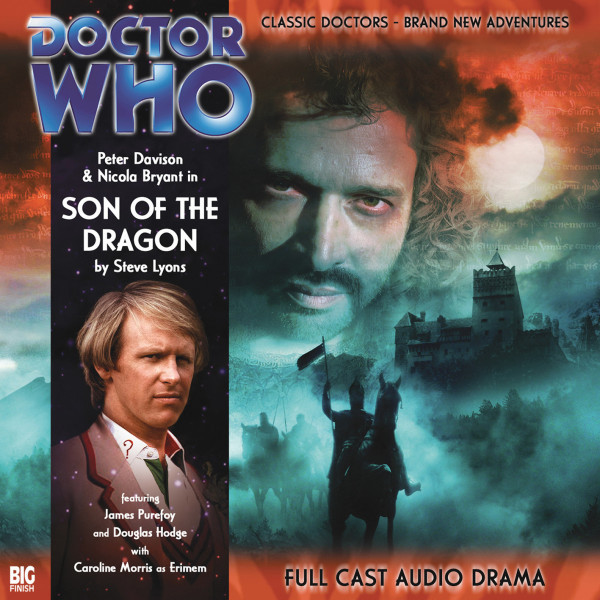
The Son of the Dragon by Steve Lyons (2007)

In which the Doctor, Peri and Erimem travel to 15th century Wallachia and meet Vlad the Impaler – Dracula (the ‘Son of the Dragon’ of the title), see his handiwork and meet his brother ‘Radu the Handsome’ (less inclined to impale people on the whole and presumably mote handsome!).

‘Farewell, Great Macedon’ aside, this is my favourite of the Big Finish historical stories. It is superb. Along the way, there are discussions about seeing history and the actions of the main protagonists in context and there is a maturity to the piece which allows us even to view Prince Vlad and his horrific actions from his perspective. In fact, throughout the piece we get a range of perspectives – the Turks, Radu (Vlad’s brother) and his followers, Vlad and his subjects (including ordinary working people) and through a series of conversations with different regulars – the Doctor, Peri and Erimem in particular are our conduit for this, we are enlightened over the course of the story. That is sophisticated, grown-up writing and I really enjoyed listening to this one again.

The joy of a historical story in ‘Doctor Who’ for me at least, lies in the fact that it is a time travel show. Plenty of other books or TV shows depict historical events and do it very well, but ‘Doctor Who’ via the medium of time travel provides a perfect framing device for a contemporary audience. More than that, we don’t just view history through their eyes, they also react and get involved in a way that we might do. Like ‘An American Yankee in King Arthur’s Court’, we get a modern perspective on the past – in this case Peri’s absolute horror at Prince Vlad and the violence of the age. More than that, we also get the Doctor’s unique perspective on history and the nature of time – of its ebb and flow and despite often being deeply embroiled in events, he also at times has a detachment that a wider view sometimes provides. What we also get here, but not often elsewhere, is what Erimem brings. She is much further removed from this time period (mid 15th Century) than Peri is, from deep in the past, but she understands this time period better and that is an almost unique perspective for the series.

Part of me wishes that the modern TV show could address history in this sophisticated way, but too often it has had neither the time required (the four parts here really help and the story enfolds over weeks or months), nor the appetite to do this. More often than not we get ‘print the legend’ short-cut storytelling, lacking subtlety or alternatively giving us comedy Vikings or Nazis. All of which are fine in their own right (I’ve just positively reviewed a comedy after all) but not if that is all we get. If that is the case then we are being a bit short changed. It all seems a bit too easy and rather than being interested in the complexity and those ‘difficult’ aspects of history that are hard to explain to children, we get something bright and shiny and simplistic. This is something that until recently has made me quite sad, that the children of the early 60’s and indeed myself growing up reading the novelisations of stories like ‘The Crusades’, were much better served in this regard – better than most wanted probably! However, this is something that Chris Chibnall has started to address, credit where it is due. ‘Rosa’ was probably the best example of this in years and alien presence aside, ‘Demons of the Punjab’ at least goes some of the way in this regard. It will be interesting to see where the TV show takes this in the future.

Anyway, back to ‘Son of the Dragon’. One thing I thought on the initial listen of this, was that it is a story best told on audio. My reasoning behind that was that it opens with the Doctor and his companions meeting a dying man who has been impaled on a spike, later the scene of 20,000 Turks that Vlad has ordered to be impaled is described. Now that is horrific enough on audio (horrific enough in real life for the Sultan to retreat back home, despite his superior forces), it certainly couldn’t be shown in any form on TV for the show’s time-slot and necessarily a novel would be required to be described these scenes in more graphic detail. Audio gives us just enough to be horrified and for the impact, but not too much for it to be completely obscene.

I will admit that this is a period of history and indeed a region that I know very little about. As such, the story is almost entirely new to me. One of the rather brilliant consequences of this for me personally, is that the beautifully controlled release of information across the story works perfectly when everything is new. It twists and turns with each revelation, only the Doctor has a wider perspective on things and the chain of events. As ever, Peri and in particular Erimem are embroiled deep in the heart of events. Whilst Erimem gets most of the time with Vlad, Peri gets to meet the ‘ordinary folk’ – primarily John Dobrin who is loyal to Vlad. While the Doctor gets what might be second billing, spending most time with Vlad’s brother Radu. However, Radu is far more important to events than he first appears and whilst not a hero (he is ruthless in his own way) the Doctor does get to influence his actions and shape future events. This Doctor’s journey in this story, as in many is from the clown or jester to the wise man and trusted confidante. We also get a very ‘Caves of Androzani’ heroic interpretation of a Doctor determined to rescue Peri and Erimem from the peril they find themselves in – particularly in the light of the Doctor’s fragmentary knowledge of the story of the fate of Vlad’s wife.

What of Vlad himself? Well he is horrific obviously, a merciless, ruthless bully, having his pregnant servant lover killed, the wholesale massacre of his enemies (and those supposed to be his allies) and for the regulars, he throws Peri out of a window and forces Erimem to accept him in order to save the Doctor and Peri’s lives. However, through his betrothal to Erimem and through his conversations with her, we do begin to understand him a little better, through the prism of the murder of his father and brother, betrayal by the Boyars and himself and Radu being held hostage by the Turkish Sultan and growing up in his court. Through his subjects (and Peri) we find that the crime rate has perhaps unsurprisingly plummeted in Wallachia, as the punishments are so severe – rather like Mussolini making the trains run on time! It never spares the horror or the cruelty of his actions – but it does place them in the context of his life and the times. Pairing him with Erimem (she has given him her word and bond and she remains loyal to him) is a very astute piece of storytelling. As an, albeit uncrowned, Pharaoh, she comes from a much earlier time period and the harshness of this period, really is nothing new for her or the actions required to remain a leader (she lost her own throne). It is fascinating. And again, very grown-up storytelling.

I can’t emphasise enough how continually amazed I am by the casts that Big Finish put together. I am not saying this to knock the TV show in any way, as Andy Pryor in particular has done a superb job over the years, even if we’ve sometimes had great people in pretty small roles where you wish they had more screen-time – but these plays are often at least the equal of the TV show and sometimes surpass it. Here we have James Purefoy as Vlad – and he is just superb in this, a really towering performance and great use of his vocal talents and almost as good is Douglas Hodge as Radu. The latter could have been the lesser role, he’s the brother who isn’t the impaling one, but it is beautifully written and a really great performance by a top actor. Add in the regulars – each on superb form in their own right and the cast is pretty stellar.

One of the joys of ‘Doctor Who’ is the range of stories that can be told and different ways in which they can be framed. Sometimes you feel like listening to a fun run around type story or a comedy like ‘The Kingmaker’, but as a grown-up (well at least a part time one!), sometimes I want to be rewarded by something more and a story like this plays that role for me. On another day with another writer, the story of Richard III and the princes in the tower could be told in this way – a serious, dark look at someone that history has cast as a monster – on another day it is a broad comedy! I have another couple of stories coming up that feature figures from history that are relatively unloved or in some cases detested and it is an interesting contrast how each are treated.Overall, I suspect that this story might, a bit like ‘The Massacre’ for example, divide opinion, but like that story, it is one that I really love and really rewards a re-listen.

I am going to leave Erimem here for the moment I might return to her some other time. First a few words about her. To my mind, like Evelyn or Charley or Lucie or Liv she is a really great companion and a terrific original creation from Big Finish. As I have already mentioned, there are some parallels with Leela, but she is also quite different – she is forthright, stubborn and passionate, but her perspective as someone born and raised to lead is something that just works in a historical context. She also works beautifully with the Fifth Doctor and particularly with Peri, who gets a younger sister, friend and confidante, someone who is also an older head at times. Their relationship works really well, they fight and argue at times – but always for a reason and they always make up. I understand the reasons why she was eventually written out, but it is a shame she hasn’t been revisited in the way that Charley, Evelyn and (soon) Lucie have been.

The Kingmaker by Nev Fountain (2006)

In which: ‘Doctor Who Discovers: The Secret of the Princes in the Tower’, Peri pulls something off and Erimem breaks a few arms.

I’m not really sure where to start with this one! After a number of serious plays, this is very different take on a historical ‘Doctor Who’ story – basically placing the TARDIS team in the middle of the first series of Blackadder, which in an alternative world was co-scripted with Douglas Adams. Where Christopher Eccleston plays Richard III (actually that’s a great idea – but it is actually Stephen Beckett here, he just sounds uncannily like him), Arthur Smith plays a pub landlord who isn’t what he seems and Jon Culshaw plays both Earl Rivers and the Fourth Doctor.

The premise is incredibly clever and a wonderfully evocative reference for those of us of a certain age. When the Doctor was with UNIT, sometime after thwarting the Zygon invasion, word of his role in the affair leaked out. Badgered by publishers, the Doctor was coerced into writing a series of books for children the ‘Doctor Who Discovers’ range (a real-life series including ‘Prehistoric Animals’, ‘Early Man’, ‘Space Travel’, ‘Strange and Mysterious Creature’ and “The Conquerors’). Many years later in the far future when there is only one surviving publisher (not unrealistic) a robot is sent back in time to chase up his final commission – which is long overdue Douglas Adams style! This was ‘Doctor Who Discovers – Historical Mysteries’. Cue the Doctor reviewing his original notes (rather wonderfully in voiceover by Jon Culshaw as Tom Baker) and a trip back in time to research the mystery of the Princes in the tower. We even have a cheeky ninth Doctor reference – the show was just back on TV at the time this was made.

The author, Nev Fountain is primarily a comedy writer, best known for ‘Dead Ringers’ and it has to be said this is great fun. It also has some great material for the Fifth Doctor, Peri and Erimem. He writes very well for Peri in particular (they are now married I believe? Cue jealousy of a section of fandom of a certain age…). I might cover some of his other writing for her later in the thread, possibly his Companion Chronicle. Even in this more overtly comic script, Erimem is allowed her own unique view on history – I’ll talk more about her in another review in some ways she is like Leela but a very distinctive take on that – if Leela had been the Queen of the Sevateem, a leader as well as a young, headstrong warrior. Listening to these again, I’m reminded of what a great character she was and how great Caroline Morris was in the role. The Fifth Doctor didn’t get that many comic moments/stories on TV, which is a bit odd considering Peter Davison was also in two sitcoms at that point and can obviously handle comedy really well. My favourite moment for him in this story is his return from going on the lash with Shakespeare!

I should also say that I found that a little of this story goes a long way, so I ended up listening in episode chunks with a break in between, with that proviso, it is very enjoyable. It is also hugely imaginative and very, very clever. I’m going to place this section in spoilers, as there are several jaw-dropping moments in this story and if you plan on listening to it in the future, I would urge you to avoid these:

Spoilers!:
Richard the Third did not die at Bosworth Field (more to come)
The Princes in the tower were not Princes – rather Princesses, as Peri finds out when one of their codpieces comes off in her hand (don’t ask!)
They both survive quite happily and Richard is not quite the villain that Shakespeare painted him as
Peri spoils the ending of Richard III at the first night performance, much to the anger of the locals
Erimem’s standard response to having her bottom fondled is to break the offender’s arm!
Clarrie the pub landlord (Arthur Smith) s actually the Duke of Clarence – Richard’s brother and was saved by Richard, not murdered
Mr Satan, he of black pointy beard, black clothes and a villainous disposition is not in fact the Master, rather he is Shakespeare, who proceeds to go on a rampage with Sontaran and Cyberman weaponry – don’t ask!
It is Shakespeare who dies at Bosworth Field, not Richard
Richard Survives, takes Shakespeare’s place and writes the remaining plays with Francis Bacon!
Phew – I think that’s it!

There is no world in which the ingredients of this play should add up to one of my favourite ‘Doctor Who’ stories, but oh my, this story is very funny, great fun, hugely inventive, with some brilliant and often surprising ideas. It is another different take on what constitutes, time travel aside, a purely historical story – Ok it also has a brief appearance from a robot and it does play with structure and split time zones in a way that was about to become de rigour in the contemporary TV series, but essentially it is a historical story, just a very different one. It proves that they don’t always have to be serious meditations of the dangers of changing history.

The Rocket Men by John Dorney (2011)

When do you know?

In which Ian struggles with his feelings for Barbara, Vicki is very brave, the Doctor communes with space mantas and there are some very nasty men with rocket packs.

Back in my youth, during school holidays or on a Saturday morning, the BBC often ran classic sci-fi serials from the 1930’s, 40’s and 50’s – the sort that my Dad and his pals would have watched as youngsters at the Saturday morning pictures, shown along with the cartoons and westerns. Serials with cliff-hangers (very ‘Doctor Who’) such as ‘Flash Gordon’, ‘Buck Rogers’ and not forgetting ‘King of the Rocket Men’. The latter was an inspiration for this story – a man in a leather flying suit and helmet with am atomic-powered jet pack, this was also the inspiration for ‘The Rocketeer’ an early 90’s film and comic strip. This story however, does a very ‘Doctor Who’ thing with this little sub-genre and treats it totally seriously, in the process transforming the Rocket Men into a thoroughly nasty adversary. Future space pirates, sounding like East-end villains on a blag from ‘The Sweeney’, who use calculated acts of violence and threat to get their way. The result is a piece that is really gripping, scary at times and yet also rather lovely. In other words, it is prime John Dorney – a writer who if you don’t know his work is one of the gems of the BF range and a real favourite of mine.

The setting is a leisure platform (platform 5) suspended in the atmosphere of the planet Jobis – a stunning world, protected by the intergalactic trust, inhabited by a crystalline insect species and iridescent manta-like creatures. The narration beautifully describes this paradise world, with its wealth of wildlife. The First Doctor, Vicki, Ian and Barbara are enjoying a peaceful break, very much like the opening of ‘The Romans’. Ian is rather put out when the Doctor is invited (without him) to visit a scientific research platform on the other side of the planet. As ever though, the peace of this world is shattered with the arrival of the Rocket men, who emerge from their mother ship, flying with jet packs on their back to terrorise platform 5. They, especially their leader Ashman, are real thugs and thoroughly nasty, something which really ratchets up the tension and jeopardy and gives the whole thing a very real edge. The rocket men are quite happy to randomly shoot hostages and slaughter anyone who gets in their way and even randomly use the native fauna for target practice. Dorney cleverly employs an ‘out of story order’ structure and the narration by William Russell, who is on terrific form here, both add towards making this a gripping, pacey story out of something that could have been quite leisurely.

With the Doctor at another platform, which helps to raise the stakes as the Rocket men try to force him to surrender by threatening to kill his friends, the focus of this story is on Ian and Barbara. There is also a beautifully Vicki moment when she bravely stands up and admits she is with the Doctor when the hostages are being executed, Barbara bravely backing her up, while Ian is powerless to help. This is followed later in the story by a lovely change of perspective and sleight of hand, using the audio medium to the full and taking advantage of the abstract order of the story perfectly. It really is terrific writing.

At the heart of the story though is Ian Chesterton, his heroism and his developing love for Barbara. There is a moment in this story when he heartbreakingly thinks he has lost her for ever, and while bravely trying to rescue her, something that seems impossible, he realises how much she means to him. This really is a lesson in how to write about the love that develops between two slightly repressed British schoolteachers from the 1960’s as they travel the universe. Despite the views of William Russell, I think that I’ve always assumed the Ian and Barbara were in love. Why wouldn’t Ian love Barbara – she’s amazing and likewise Barbara love Ian – he saves her life and is heroic and clever. I always assumed that they would marry on their return to London. It seems obvious – the amount of times Ian risked his life to find her and that infamous scene in the villa during ‘The Romans’ and the montage at the end of ‘The Chase’. I just always thought that it was a very British romance, underplayed and unstated and private. Their marriage has been covered in a number of books, but Russell confirms this in the ‘Sarah Jane Adventures’ and it makes sense to me. The Big Finish ‘Companion Chronicles’ series, where we are privy to the thoughts of these characters, via the narration, is exactly the place that this can be explored and as ever with John Dorney, the emotional heart of this story is beautifully written and sensitively done.

I won’t spoil the ending, suffice to say it involves an action-packed act of heroism on the part of Ian and an elegant solution from the Doctor that left me chuckling. It is a great Hartnell moment. At its heart though, this story is about Ian struggling to decide whether he should tell Barbara how he feels about her. What is funny, is that everyone else seems to notice this anyway, even the Doctor offers his sage advice at the end of the story! He says ‘Don’t wait too long, my boy. These things can fade, we all have opportunities we let slide. You don’t want to live your life regretting chances missed’. The voice of experience, I can just imagine Hartnell playing that line – Ok it might have come out a bit mangled! He isn’t the emotionally naive ‘asexual’ figure that we sometimes see later in other incarnations and after all he noticed ‘something cooking’ between Susan and David and has a granddaughter. An astute piece of writing really.

I don’t think I want to say any more about this story – although a relatively straightforward story, with the abstract structure it fits together beautifully like a puzzle box and is a richly observed and realised character piece, whilst being gripping and tense and very, very satisfying. My advice – try it for yourself – effortlessly ten out of ten for me. Everyone should have a bit of John Dorney in their life!

Farewell Great Macedon by Moris Fahri (adapted by Nigel Robinson) (2010)

‘Farewell Alexander! Farewell Great Macedon!’

This ‘Lost Story’ is an absolute gem, to my mind the match of the best of the TV historical stories. It was originally written for season one and such is the quality of the script it is a bit perplexing that it wasn’t made. Moris Fahri (an Anglo-Turkish writer, who unfortunately died earlier this year), worked on the scripts for David Whittaker and wrote most of it while watching the TV transmission of ‘Marco Polo’. Unlike many of the other ‘Lost Stories’ there were 6 almost complete scripts to work off (apparently, he was only asked for a treatment by Whitaker, but enjoyed it so much he wrote all of it) and the finished result is pretty close to what was originally written. The format of this production is a hybrid of full cast and spoken word narration – with the piece being carried by William Russell (on terrific form – what a joy it is to have more of Ian), Carole Ann Ford and John Dorney (an actor, whose often brilliant work as I writer I will be covering as we go) – excellent as Alexander. At 6 episodes, the story flies by. It is a mix of a thoughtful exploration of history and one of its key figures, combined with intrigue and action.

So where does it sit amongst the other Hartnell historical stories – well It is less of a journey than ‘Marco Polo’ (which given the subject matter it could easily have been), bound as it is to the outskirts of Babylon in the year 323BC. However, it does have elements in common with both ‘Marco Polo’ and ‘The Aztecs’ – dealing with both a central figure, surrounded by those trying to kill him and also the dangers of changing history, Barbara having already learned her lesson in that regard. It is also rather more like the ‘celebrity historical stories’ of the future, albeit a more detailed, mature and leisurely version. It is essentially a character study of Alexander the Great and his four appointed successors and friends – the blustering General (old Father Clytus – a father figure to Alexander), the wise man (the Indian Callanus – a trusted advisor), the bodyguard/warrior (Ptolemy) and the best friend, confidante – and possibly more (Hephaestion). They are all beautifully sketched and the collegiate atmosphere of brotherhood in Alexander’s camp is rather wonderfully captured. Soon, you feel like you know them all. Alexander is an idealist, he isn’t perfect and his idea of bringing together nations through conquest is questioned and challenged in the piece, but despite his impulsiveness at times (clashing with Clytus for example), he is shown to be a wise man and great leader.

The story works in patterns of four – the four friends matched against the four travellers. However, as ever there are vipers in this nest, manouvering to succeed Alexander – Iollas (the soothsayer who the Doctor gives tips to on how to cook lamb!), Antipater (the politician), Seleucus (a general with designs on Alexanders throne) and Glaucius (the physician). One by one they kill Alexander’s friends and conspire (rather unsuccessfully) to try to poison Alexander’s relationship with the travellers. The leader is far too clever for that and the conspirators are a very obvious bunch. However, that doesn’t stop the four friends dying one by one in a series of very moving scenes, culminating in the death of Alexander himself. Each time the travellers try to help the victims, fate intervenes and history snaps back into place.

This is also an excellent story for the regulars. Everyone gets something to do – Barbara commanding the respect of Alexander through her wisdom and compassion, Ian gets to be brave and courageous – besting Alexander’s men at wrestling, but also gets to use his scientific skills. The Doctor is in early season 1 grumpy mode, but he gets to show his ingenuity devising blood transfusions and an iron lung many centuries too early – only to be thwarted by the tide of history. In fact, there are some priceless moments for the Doctor – accepting Alexander’s challenge to walk barefoot through fire – which he does so gleefully, shamelessly showing off for the crowd – you can just imagine the great man chuckling delightedly to himself. My favourite though is at the start of the story when the TARDIS has crash landed after a fuel leak. They arrive in some gardens (actually the Hanging Gardens) and hear heavenly music – Susan fears that they have died and this is heaven – to which the Doctor tells her that this cannot be heaven – as he doesn’t know the way! Only Susan (as ever) is slightly left out, without a Ping Cho type figure to bond with. It never really feels entirely like this though as she is one of the main narrating characters and so is never far from the action.

If you like ‘Marco Polo’ and ‘The Aztecs’ and wish you had more of Ian, Barbara, Susan and the First Doctor in your life (and you really should), you could do very much worse than trying this. The Hartnell era is evoked so perfectly, that to my mind, by the end of the story, you almost feel that Phil Morris has found it buried in a desert somewhere and you have watched it in all its VidFired glory, with the hanging Gardens of Babylon depicted by Barry Newberry using a few painted backcloths. I don’t normally give out scores, but this one is effortlessly 10/10